

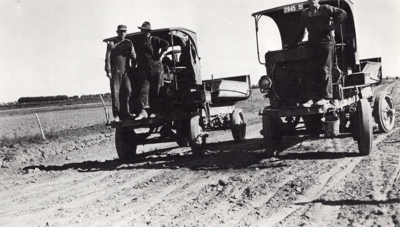

1917 road gang on graveled road.
On Sept. 3, 1918, the Idaho Republican newspaper printed the first of a series of articles on road conditions in Bingham County. Later information said that this series continued for 11 months, through 96 editions of the newspaper. The writer of the articles carefully looked at the issue from all angles. The Bingham County Civic League had spent over a year studying the road conditions, considering the pros and cons of various road materials, and polling other counties on what had worked or had not worked for them. The League was now ready to publish its findings.
The consensus was that graveled roads, while fine for local or occasional use, did not adequately support the constant heavy traffic found on the main thoroughfares of the county. The League (and the road gang) did not care to expend money or effort for the continual work needed to keep gravel roads smooth. Their proposal was to make all high-traffic roads from concrete. By concrete, they meant one of several types of hard-surface material available — water bound, tarvia bound, asphaltum bound or bitulithtic bound — but not specifically cement-bound. They stated that the choice between those materials would not be made by the League, but by “persons who are competent to make intelligent settlement after considering” all factors involved, including location conditions, availability of materials, and cost.
The League then listed eight sections of road most in need of attention: 1) Bridge Street between the edge of town and the Oborn Store; 2) North Main Street from the edge of town to just past the sugar factory; 3) South Broadway to the Blackfoot River; 4) a 2-mile section of Shelley’s Main Street; 5) a 2-mile section of Aberdeen’s Main Street; 6) from the sugar factory to the Porterville Bridge; 7) a mile of road at Sterling; and 8) a section between Kimball and Firth where it was sandy and/or swampy.
This was followed by suggestions for further efforts, including a road from Blackfoot to Aberdeen that paralleled the railroad tracks. At the time, the only way to drive to Aberdeen was to take the local roads, laid out in square-mile grids, making the route into one 90-degree turn after another. A parallel road would cut several miles from the trip and allow drivers to move at a consistent speed. An added benefit would be to make it easier for strangers to find Aberdeen, as well as the other small communities along the way.
The road to Fort Hall had a macadam surface, done years before to solve the problem of the deep sand north of the Fort Hall townsite. This road was now ready for resurfacing.
A bond election was held, approved by 89% of those voting, and work began on 110 miles of new graveled roads, several smaller bridges, culverts and siphons, and some concrete roads. By the time the prep work was finished on the roads involved, federal and state matching funds had become available, and Blackfoot was in an enviable position to receive money as its roads were already prepared to be paved.
As roads improved, businesses took advantage by expanding beyond their established buildings. Bakeries made deliveries, newspapers and laundries made deliveries, milk was picked up at farms and fuel was delivered. Mail carrier routes were greatly improved. Schools benefited from the organization of bus routes. Many new kinds of services became available where they would have been impractical only a few years earlier.
Tourism also became a factor in road building. “Trunk lines” became a hot topic as the desire to see Yellowstone infected the country, and the traffic was being routed to the park through Wyoming, rather than Idaho, because our roads were considered inferior. The counties had to coordinate with each other, and with the state, to construct “trunk lines” for seamless travel north to Yellowstone and west to Twin Falls and Boise.
At this point, I went back to the newspapers to see what the original writer could possibly have covered in his 96 articles. In the second, the writer said that if he woke up some morning and found he had been put in charge of the road situation, he would — and then wrote at least 500 words of detailed, step-by-step plans, with a materials list and a labor estimate. Of course, none of his ideas were used for the actual construction.


(0) comments
Welcome to the discussion.
Log In