

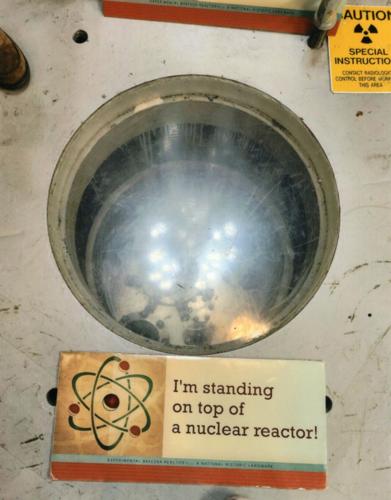
On December 20, 1951, atoms of uranium-235 were used to generate the electricity to light four lightbulbs in the middle of the Arco desert. It was the first time atoms had been used in this way, and it happened in Eastern Idaho. An incredible amount of time, money and human brainpower had gone into the lighting of these famous lightbulbs, but it sparked the creation of something that has become fundamental and far-reaching in the development of our area — the Idaho National Laboratory.
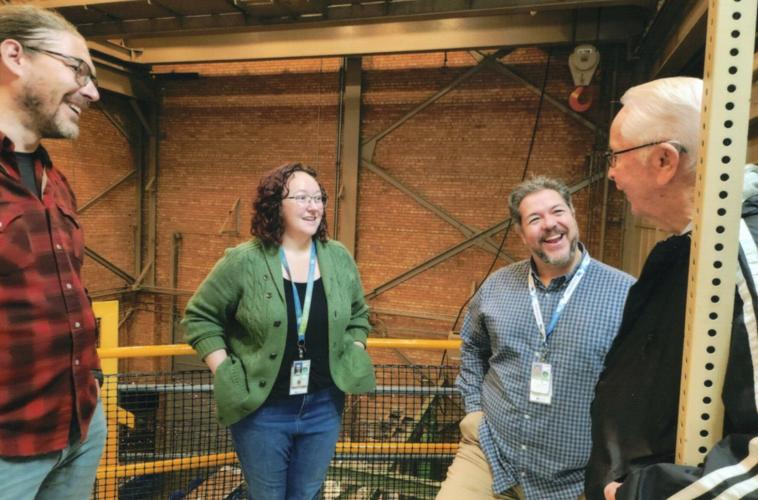
December 20th fell on a Saturday in 2025, and the EBR-I building was open to the public for a 75th anniversary celebration. The Bingham County Historical Society received an invitation, but being the Saturday before Christmas, everyone had other things going on. I knew that I couldn’t miss this opportunity and I invited my friend, Richard Lindsay, of Blackfoot to go with me. He worked at “The Site” for many years, both in EBR-I and EBR-II in those exciting early days, and later served as the President of the Historical Society. I think he was excited to make this trip, since he was waiting by his front door with his coat on, when I pulled in the driveway.
Richard had me drive the route that he took for so many years — Mark Lane, Rose Road, Porterville Road to the Arco Highway, and then northwest across the farmland and desert. There were no buses until many years later. He filled the time with stories of people and places including Augustine’s Pasture and field of apple trees, the home he was born in on Williams Road and neighbor, Elmer Williams.
Finally, the blocky, red brick building appeared on the south side of the highway, quite a distance from the buildings currently in use. EBR-I is short for Experimental Breeder Reactor #1. It was the first building constructed on what has become a huge plot, nearly 900 acres, of Federal land in a sagebrush plain with only antelope and coyotes for neighbors. It was in operation from 1951 to 1964. Our first stop before going inside was to see the old Oliver plow, left behind by a failed dry farmer, but now honored with a sign and patch of red lava, proving to visitors that settlers had once tried to make a home in this inhospitable wilderness. Richard was responsible for the finding and moving of this plow (and another now housed at EBR-II) to its current location.
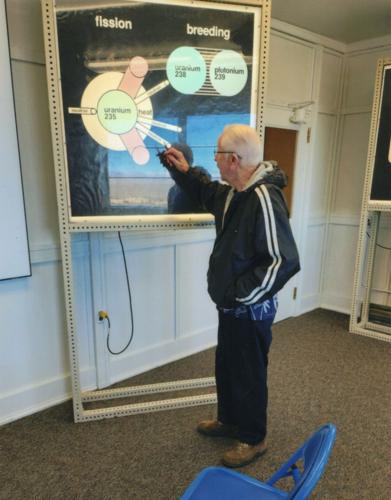
Inside and out of the wind, we found our guides, Libby and Jeremias, then headed upstairs to a classroom. Libby began to explain Fission, using a framed diagram, but Richard quietly stood up and reached for the pointer with a gentle “May I?”. He spoke about the very earliest moments, when nuclear power was an idea in a lab at the University of Chicago, when calculations, pencil diagrams, and finally, a simple prototype were shown to the Department of Energy people, who responded with ‘It works on paper. Here is a bucket of money. Find a place in the middle of nowhere and make it work’. Several spots were considered and Idaho was chosen.
The building was started without a plan and grew as they discovered (realized) what they needed. They built big, not knowing how much room all the piping would take, but not big enough, as additions sprouted on the east and the south. A nuclear power plant had never been built before. There was no manual to follow. It was a figure-it-out-as-you-go process.
We learned that Richard started his career as an employee of the Argonne, a research division of University of Chicago; that the University built that prototype reactor in an empty space under the bleachers of the squash stadium; that he had been hired to work at EBR-II but the building wasn’t ready, so EBR-I became his training ground; that he was there for the closing of EBR-I and the initial firing up of EBR-II; that he was promoted to Training Manager and later to Public Relations with Argonne National Laboratory in control of those two facilities.
Next stop, the control room. Again, Richard took the lead and described what it was like to sit at the desk, monitoring the readings on the analog dials for the reactor and the heat transfer system. To the right is the SCRAM button which shuts down the reactor if a problem develops. An orange sign tells visitors that SCRAM means Safety Control Rod Axe Man, because in the University of Chicago’s prototype, the ultimate safety control was a man with an axe standing by a rope which suspended a control rod over a hole in the center of the reactor. If something went wrong, the man would swing the axe to cut the rope and the reactor would shut down. We’ve come a long way, baby.
A few feet from the control station, a chain hangs from the ceiling with a handle on the bottom. Richard told us that this was the backup to the SCRAM button. If the button didn’t work, pull the chain. Later, in the basement, we saw where the other end of the chain attaches to a switch on the side of the housing. This evolved into several stories about practical jokes played on supervisors over the years. Richard has a perfect memory and is a talented speaker, full of wit and knowledge.
We spent two hours passing slowly through all the sections of the plant, stopping at each portion for stories and explanations. In a long hallway in the annex section of the building, there is a large display board of each decade that has passed since that day in 1951. On the opposite wall, Richard pointed to a framed hand-drawn diagram of the EBR-II reactor and the cooling system, laid out as it sits in the building, but without any of the separating walls. Richard said “I drew that. I needed a simplified way to teach new operators how things worked together.” How wonderful it is that this drawing was preserved, framed and hung in that hallway of history.
We ended the tour in front of a photo of President Lyndon Johnson holding one of the lightbulbs on his visit to the INL in 1966 to designate EBR-I as a national historic landmark. Someone asked Richard if he was there that day. He seemed a little embarrassed to tell us that they had asked him to hold a microphone and stay out of any pictures. The microphone made it into a few photos, but Richard stayed back as instructed.
We were treated to two other good stories that day — commuting by airplane and the day they skied the Big Butte. Richard and his friend, Reno Tam who lived on the Firth River Road, were both private pilots and had access to a small plane. Several times, they plane-pooled to the Atomic City airport and walked out to the highway to catch the bus for the last few miles to work. Then, on a week that the reactor was down for maintenance, a huge snowstorm passed through, dumping considerable snow on the Big Butte. One of the executives made arrangements for a helicopter and told everyone to bring their skis to work. The helicopter pilot flew the skiers to the top of the Butte and they skied down. Later, T-shirts appeared with the slogan I SKIED THE BIG BUTTE.
Richard told me later that he was lucky enough to work for a company that appreciated education. They helped him to learn as much as he could at work, and to complete his degree at Idaho State University. He had many opportunities to meet and work with the top scientists in the nuclear field, and to work on various projects such as designing better control rooms. Richard has obvious pride in what has been accomplished at the INL site. He completely charmed our guides and gave them plenty of details to add to subsequent tours.
EBR-I is open to the public from Memorial Day to Labor Day. It is well worth the drive to see this historic and special place.

(0) comments
Welcome to the discussion.
Log In