

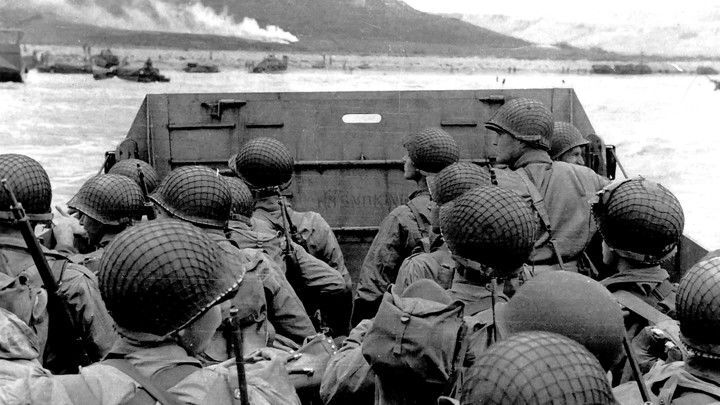

On June 6, 1944, thousands of American, British and other allied forces crossed the English Channel to confront Adolph Hitler’s war machine in Normandy, northern France. It would cost the Allies some 10,000 men, but it would become the turning point of World War II.
It is standard practice for the president of the United States to take part in ceremonies commemorating the struggles and casualties of past battles. On the 40th anniversary of D-Day, President Ronald Reagan gave an elegiac speech at Pointe du Hoc where U.S. Army Rangers under heavy fire scaled a 130-foot cliff with grappling hooks and ladders. One of those men was Lt. Walter Taylor who led his team against German machine guns firing on Omaha Beach. Utah Beach was a safer place to land, but Omaha Beach became a death trap. Mortars hit the landing craft coming toward the beach which was mined and sprayed by withering machine gun rounds. In the confusion, many soldiers drowned before they even reached the beach because of their heavy equipment and choppy water.
Another officer named Taylor — Col. George Taylor — landed on Omaha Beach, and before clearing an opening through barriers, delivered a famous quote: “There are two kinds of people who are staying on this beach: Those who are dead and those who are going to die. Now let’s get the hell out of here.”
George Taylor is sometimes confused with Gen. Norman Cota, who was also on the beach that day. In the film “The Longest Day,” Gen. Cota played by Robert Mitchum, delivers Taylor’s line. Shot off the coast of Ireland, Steven Spielberg’s “Saving Private Ryan” is more realistic depicting the terrible slaughter the troops experienced on that June 6 day.
For the 75th anniversary of D-Day, President Donald Trump joined British Prime Minister Theresa May, Queen Elizabeth II and leaders from the other nations which took part in the Allied D-Day invasion. The commemorative events began in Portsmouth on the southern English coast, one of the primary points of departure for the Allied forces as they sailed across the English Channel to invade Normandy. The day of the attack was delayed because of bad weather, but the weather wasn’t that much better when the troops landed, some of them sea sick. The invasion did surprise the German forces, but that did not mitigate the terrible loss of life before the mission succeeded.
It was the beginning of the end for Nazi Germany.
The day before the anniversary, Anthony Mason of CBS News interviewed three veterans of Normandy, all in their 90s. The two words they used when asked how it felt to enter the killing fields were “exciting” and “dreadful.” The cemetery behind Omaha Beach holds the graves of over 9,000 American soldiers. The graves face toward the United States. One veteran, Stanley Friday, warned about forgetting the terrible lessons of World War II, and that younger people “should read the history books so it doesn’t happen again.”
It might seem ironic to view these various leaders united to celebrate the allied forces from 75 years ago knowing that in America and Europe, today, there are so many fractured alliances.
Michael Corrigan of Pocatello is a San Francisco native and a retired Idaho State University English and speech communication instructor. He studied screenwriting at the American Film Institute and has authored seven books, many about the Irish American experience.

(0) comments
Welcome to the discussion.
Log In