

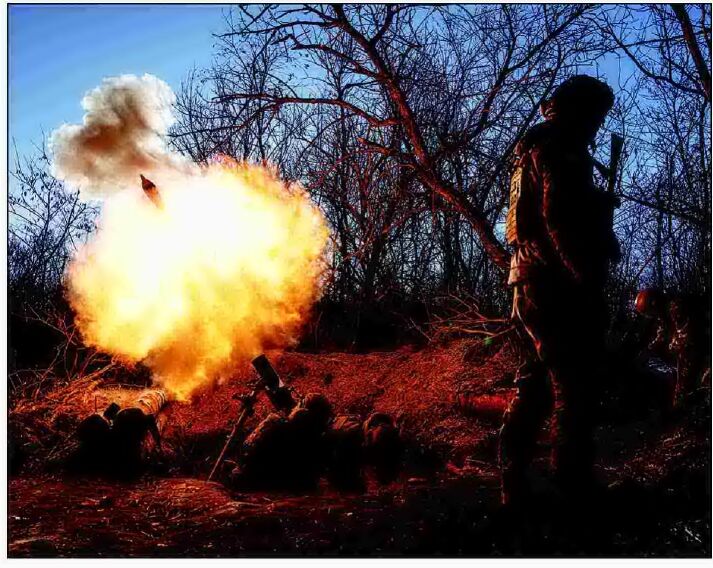
KYIV, Ukraine — The fate of a devastated salt-mining town in eastern Ukraine hung in the balance Wednesday in one of the bloodiest battles of Russia's invasion, while Ukraine's unflagging resistance and other challenges prompted Moscow to shake up its military leadership again.
Russian forces used jets, mortars and rockets to bombard Soledar in an unrelenting assault.
Soledar's fall, while unlikely to serve as a turning point in the nearly 11-month war, would be a prize for a Kremlin starved of good news from the battlefield in recent months. It would also offer Russian troops a springboard to conquer other areas of Donetsk province that remain under Ukrainian control, such as the nearby strategic city of Bakhmut.
Donetsk and neighboring Luhansk province, which together make up the Donbas region bordering Russia, were Moscow's main stated territorial targets in invading Ukraine, but the fighting has stood mostly at a stalemate.
In an apparent recognition of battlefield setbacks, Russia's Defense Ministry announced the demotion of the head of Russian forces in Ukraine after only three months on the job. The chief of the military's General Staff, Gen. Valery Gerasimov, was named as the replacement for Gen. Sergei Surovikin, who was demoted to deputy.
During his short time overseeing the troops in Ukraine, Surovikin was credited with strengthening coordination and reinforcing control. But he also announced a humiliating withdrawal in November from Kherson, the only regional center Russian forces had captured just weeks after the Kremlin illegally annexed the area. His demotion signaled that Russian President Vladimir Putin wasn't fully satisfied with his performance.
Gerasimov, meanwhile, was seen as the top architect of the Russian invasion of Ukraine, and critics have blamed him for Moscow's military setbacks.
The Defense Ministry said expanded military tasks an the need for "closer interaction between branches of the military as well as increasing the quality of supplies and the efficiency of directing groups of forces" prompted the leadership changes.
On the battlefield, a Ukrainian officer, near Soledar, told The Associated Press the pattern is that first the Russians send one or two waves of soldiers, many from the private Russian military contractor Wagner Group, who take heavy casualties as they probe the Ukrainian defenses. When Ukrainian troops have taken casualties and are exhausted, the Russians send a fresh wave of highly-trained soldiers, paratroopers or special forces, said the Ukrainian officer, who insisted on anonymity for security reasons.
Ukrainian Deputy Defense Minister Hanna Malyar and the spokesman for Ukraine's Eastern Group of Forces, Serhiy Cherevaty, denied Russian claims that Soledar had fallen.
Yevgeny Prigozhin, the Wagner Group's owner, on Wednesday repeated a claim he had made the day before that Ukrainian forces had been defeated in Soledar.
"Once again I want to confirm the complete liberation and cleansing of the territory of Soledar from units of the Ukrainian army," Prigozhin wrote on his Russian social media platform. "Civilians were withdrawn. Ukrainian units that did not want to surrender were destroyed." He claimed about 500 people were killed and that "the whole city is littered with the corpses of Ukrainian soldiers."
The AP was unable independently to verify his claims.
Kremlin spokesman Dmitry Peskov stopped short of declaring the settlement's capture, telling reporters Russian forces had achieved "positive dynamics in advancing" in Soledar. "Let's not rush, and wait for official statements," he added.
Ukrainian President Volodymyr Zelenskyy weighed in Wednesday in his nightly video address: "Now the terrorist state and its propagandists are trying to pretend that some part of our city of Soledar a city that was almost completely destroyed by the occupiers is allegedly some kind of Russia's achievement." He said Ukrainian forces in the area are holding out against the Russians.
Soledar, known for salt mining and processing, has little intrinsic value but it lies at a strategic point 10 kilometers (six miles) north of the city of Bakhmut, which Russian forces want to surround.
Taking Bakhmut would disrupt Ukraine's supply lines and open a route for the Russians to press toward Kramatorsk and Sloviansk, key Ukrainian strongholds in Donetsk province.

(0) comments
Welcome to the discussion.
Log In