



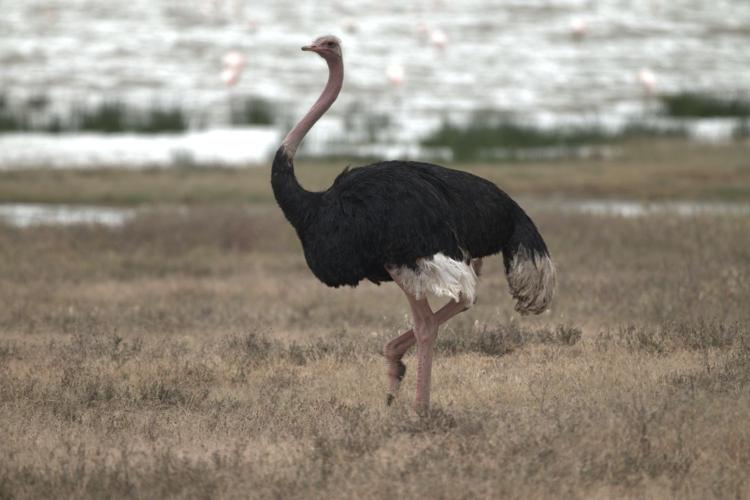
I marveled at the big bird wandering within Ngorongoro Crater in Tanzania, Africa. I knew I was looking at the largest bird in the world, a male ostrich standing nearly 9 feet tall. He was flightless, but more than made up for that with huge and immensely powerful legs that could propel his 280-pound frame at a top speed of 45 mph and deliver a formidable kick that could kill a lion.
I thought of the ostrich as the biggest and baddest of the birds until I was in a museum in New Zealand and learned of the giant moas, a recently extinct (500-600 years ago) bird species that stood up to 12 feet tall and weighed as much as 550 pounds. I looked up at my ceiling, 10 feet overhead, and imagined this bird having to duck its head to stand next to me.
That put me on a quest to discover what scientists considered the biggest bird to ever live on Earth (and leave a fossil record). Madagascar can lay claim to that bird, named, Vorombe titan (“big bird” in Malagasy and Greek), which at nearly 10 feet tall was significantly shorter than the giant moa. However, the largest of these birds, appropriately named elephant birds, may have weighed nearly a ton. These birds became extinct about 1,000 years ago, dying out about 400 years before Columbus made his fateful voyage across the Atlantic, although a governor of Madagascar made reference to them around 1640 as if they still existed in remote areas.
Elephant birds appear to have been found throughout Madagascar and may have been nocturnal like the kiwi of New Zealand. Scientists also speculate that despite their enormous size, they were likely mostly vegetarian. These giants laid eggs with a 2-gallon capacity, enough to hold 12 dozen or more large hen eggs. Since an egg yolk is a single cell, the elephant bird eggs were arguably the largest cells to ever exist on the planet.
Ostriches, moas and elephant birds are or were part of a group of birds known as ratites. Other ratites include emus, rheas, cassowaries and kiwis. These birds all share common characteristics, such as a long neck, sharp spear-like bill and stubby wings. Most telling, though, is the fact that they do not have a keeled sternum for flight muscle attachment, making flight impossible.
Current scientific research has determined that these ratites originated from a small bird that could fly and thus disperse to the various habitats where these species evolved independently — Africa, Australia, New Zealand, South America and Madagascar. Moas and elephant birds were unique, though, as they landed on islands and evolved into giants because there were no land predators.
Moas did have a flying predator, the now extinct Haast’s eagle, that was the largest and strongest bird of prey ever known, weighing up to about 40 pounds, with a wingspan of 10 feet. When Polynesians arrived in New Zealand about 1,300 years ago, populations of all nine species of moas were considered stable, despite Haast eagle predation. Within 100 years, all moas were extinct and the Haast eagle soon followed.
It is a similar tale for the four species of elephant birds. They thrived for thousands of years, but human presence on Madagascar, which likely began about 10,000 years ago, eventually did them in, although it took longer than the moa extinction.
It is sad to think that these huge birds were eliminated from the planet because of unrestricted human pressure, including habitat alteration through forest clearing. However, these people didn’t know any better. The same can’t be said for us.

(0) comments
Welcome to the discussion.
Log In