

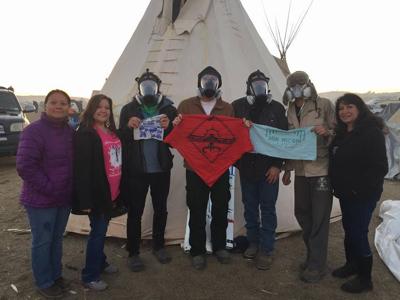


Submitted photo
LaNada War Jack and Jessica James pose recently with protestors of the Dakota Access Pipeline in North Dakota.
By Debbie Bryce For the Journal
In what the Standing Rock Sioux tribe called a historic decision, the U.S. Army Corps of Engineers announced Sunday that it will not approve an easement for the Dakota Access Pipeline. The Corps will pursue an environmental impact statement and look at other possible routes for construction of the pipeline.
In a statement released following the announcement, Standing Rock Chairman Dave Archambault II thanked the Corps and the Obama administration for doing the right thing.
“We wholeheartedly support the decision of the administration and commend with the utmost gratitude the courage it took on the part of President Obama, the Army Corps, the Department of Justice and the Department of the Interior to take steps to correct the course of history and to do the right thing,” Archambault said. “The Standing Rock Sioux Tribe and all of Indian Country will be forever grateful to the Obama Administration for this historic decision.”
“We hope that Kelcy Warren, Gov. Jack Dalrymple, and the incoming Trump administration respect this decision and understand the complex process that led us to this point. When it comes to infrastructure development in Indian Country and with respect to treaty lands, we must strive to work together to reach decisions that reflect the multifaceted considerations of tribes,” Archambault said. “Treaties are paramount law and must be respected, and we welcome dialogue on how to continue to honor that moving forward. We are not opposed to energy independence, economic development, or national security concerns but we must ensure that these decisions are made with the considerations of our Indigenous peoples.”
However, celebrations in Indian Country were short-lived following the announcement.
Energy Transfer Partners and Sunoco Logistics own the DAPL and they told the Associated Press Monday that the corporations remain “fully committed to ensuring that this vital project is brought to completion and fully expect to complete construction of the pipeline without any additional rerouting in and around Lake Oahe. Nothing this administration has done today changes that in any way.”
The segment of pipeline under Lake Oahe is the only large chunk of construction left on the DAPL, which also crosses through South Dakota and Iowa.
The American Petroleum Institute, which represents the U.S. oil and natural gas industry, urged Trump to make approval of the disputed pipeline a “top priority” once he takes office next month, according to an Associated Press story Monday.
Trump spokesman Jason Miller told the Associated Press Monday that Trump supports construction of the pipeline, but he declined to say whether Trump would reverse the Corps’ decision.
Pocatello therapist Crete Brown just returned from the DAPL protest last week and she said the announcement Sunday will have little impact on construction of the pipeline or the movement to stop it.
“The oil companies have already said that this doesn’t change anything and they fully intend to move forward with construction of the pipeline and they’re willing to pay the $50,000 per day fine to do that,” Brown said. “While it sounds like good news, it probably is not.”
Brown said she will continue to do what she can locally to raise awareness and support for the water protectors, but she doesn’t plan to return to the camp this winter.
“I don’t think I would survive. They’re in the middle of blizzards and the cold is brutal,” Brown said.
In spite of harsh winter conditions, between 8,000 and 10,000 people are at Oceti Sakowin — Seven Council Fires camp. Housed in teepees, tents and RVs near Cannonball, North Dakota, the protestors include more than 400 Native American tribes and thousands of non-Indian supporters from around the world.
On Monday, Archambault asked all non-Sioux protestors, or water protectors as they’ve come to be called, to leave the camp.
“I’m asking them to go. Their presence will only cause the environment to be unsafe,” he told Reuters on Monday.
Even if the Trump administration looks to change the decision, nothing is going to happen before he takes office on Jan. 20, 2017, Archambault said. Archambault, the leader of about 9,000 enrolled Sioux members, said he hopes to meet with the incoming president to educate him about the decision that was made and the future of the pipeline.
LaNada War Jack, a member of the Shoshone-Bannock Tribes, said that the federal government announced its decision to not grant the easement on the same day that thousands of U.S. veterans showed up in North Dakota to support the water protectors.
“It’s great news. However it’s only a short break until (President-elect Donald Trump) comes in,” War Jack said. “I think that the (Corps) couldn’t risk looking bad since our force now included the veterans. Thousands of vets just arrived in the camp on Sunday.”
War Jack said she’s concerned about enforcement of the Corps’ decision and believes that it was aimed at getting the water protectors to leave. She said family members still on the DAPL front lines report that drilling for the pipeline has not stopped, and she said protestors are hunkered down and prepared to stay the course.
War Jack, the first Native American to enroll at UC Berkley in 1967, also took part in the Occupation of Alcatraz by Native Americans in 1969. She said the situation at Standing Rock indicates that relations between the U.S. government and Native Americans have improved little in the past half-century.
“As Native people, it’s about our connection to the earth, our relationship to the water, water is sacred, it is medicine and it’s what we’re made of. Anything that threatens the water threatens us and our way of life,” War Jack said. “Native people have a history of hardship and we are very resilient people. I don’t think the protestors will leave the camp.”
Jessica James is also a member of the Shoshone-Bannock Tribes. She returned from the camp in North Dakota last week. She is skeptical, but optimistic following the Corps’ announcement Sunday.
“It is good news. It’s like a battle has been won, but the war still continues. I fear that with the new administration coming into power next month, things will change,” James said. “For now, I am happy and will continue to pray for the future.”
She and War Jack delivered supplies to the North Dakota camp last month, and James said it was her first visit to the site. She said the water protectors are united in a spirit of solidarity and are committed to non-violent protest.
“It is amazing, you go into the camp and see all the tribal flags, and then you see the camp,” James said.
Everyone who enters the camp receives an orientation, while weapons and alcohol are prohibited. Medical tents are set up along with stations to keep protestors fed and hydrated.
Militarized security forces at the camp have deployed an arsenal of non-lethal weapons against the protestors, including attack dogs, rubber bullets, pepper spray, fire hoses and sound cannons.
James said a number of people have been treated for hypothermia from being sprayed with water hoses and exposed to freezing temperatures.
During her stay at the camp, James also rubbed elbows with some famous objectors — actress and activist Jane Fonda provided Thanksgiving Day dinner to the protesters and offered James and War Jack the use of her hotel room and shower.
“She is so energetic and so passionate, she really is a woman-warrior,” James said.
Fonda and War Jack first met when both were students at UC Berkley.
In August, the Shoshone-Bannock Tribes in Fort Hall approved a resolution of support for the Standing Rock tribe.
The current route of the DAPL would pass over the Ogallala Aquifer, which provides 30 percent of the country’s groundwater. If spread across the U.S., the aquifer would cover all 50 states with 1.5-feet of water. If drained, it would take more than 6,000 years to refill naturally.
More than 90 percent of the water is used for irrigation, and $20 billion a year in agricultural production depends on the Ogallala Aquifer.
The pipeline will also cross under the Missouri River twice.
When completed, the 1,200-mile pipeline will carry more than 450,000 gallons of crude oil per day from the oil fields of western North Dakota to Patoka, Illinois.
DAPL advocates claim that the project will create 8,000 to 12,000 local jobs during construction and increase demand for manufactured products, which will provide a much-needed boost to local economies along the pipeline route.

(0) comments
Welcome to the discussion.
Log In