

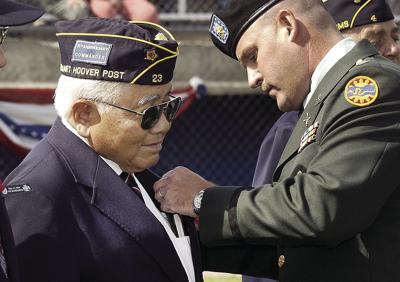
The world has lost a Hero — a World War II veteran known for his patriotism and service, a man who truly lived up to his name.
Hero Shiosaki, 97, of Blackfoot, died Monday from complications caused by a fall, according to his son, Randy Shiosaki.
“He was just a wonderful person,” said Randy, who describes his father as patriotic, strong, giving and humble. “He loved this country and he loved God.”
Hero was one of a handful of Japanese-Americans from Southeast Idaho who served with the 442nd Regimental Combat Team during World War II. The motto of the 442nd, which was the most decorated unit in the war, was “Go For Broke.”
Hero once told the Journal that his father, who immigrated to the U.S. in 1896 and struggled to make a living and raise his family in a country where he didn’t speak the language and faced discrimination, gave him a simple message when he was drafted:
“You go fight for America,” Hero told the Journal. “And if you have to die for America, so be it.”
Although Hero did not have to make the ultimate sacrifice, he could tell you about the comrades who did.
They included people like Eddie Ogada, who had hoped to be the mayor of Lava Hot Springs one day, Ken Tsumaki and Raito Nakashima, both of Pocatello. And also Fred Nagano of Thomas, Kiyoshi Murakami of Shelley, and Roy Shiogawa of the Tyhee area.
Hero was a living encyclopedia of the events surrounding the Japanese-American community in Southeast Idaho, and often shared their stories.
He particularly enjoyed teaching youths. Randy says his father spoke to around 200 government and history classes over the years.
Holly Kartchner, who teaches We The People, a program that promotes civic competence and responsibility among youth, according to its website, has asked Hero to address her classes in the past.
She said he had a special place in his heart for teaching students, and he often talked to them about U.S. history and Japanese internment camps and the importance of the Constitution.
Hero was proud to be a Japanese-American, she said.
“He was really proud of his family’s history and the benefits they received by living in the U.S.,” Kartchner said.
She noted that Hero was not only generous with his time, but also his money. He financially supported programs that he felt would benefit youths.
Randy agrees that his father was a generous man, and he taught his kids to be the same way.
He said his dad would occasionally bring some penny candy home for him, and if he had friends over, he had to share.
“He would make us pass out the candy to our friends (first). If there was nothing left over for me and my brother, that’s the way it was,” Randy said, adding that such lessons taught him the importance of being kind and giving of himself.
Hero lived what he taught.
When the war ended, he gave most of his issued clothing to a family that didn’t have much. The family, who lived in Carrara, Italy — a place famous for its marble quarries — gave him a marble sculpture of Jesus Christ in return.
When he came home, Hero had a frame made for the sculpture and donated it to the local Methodist church.
Hero also spent a lot of time tracking down the names of three Japanese immigrants who drowned in Henry’s Lake in the early 1900s. Two of the men were buried in a plot in the southwestern corner of the Ashton Pineview Cemetery; the body of the third was never found.
The cemetery had no record of their names. But thanks to Hero’s efforts, the individuals were properly identified and a headstone was eventually placed on their grave.
Hero was a longtime member of the Japanese American Citizens League, and he served 15 years on the Governor’s Human Rights Commission. He was also active in the American Legion and Veterans of Foreign Wars for much of his life.
In his later years, he received an Idaho Hometown Hero award from the JRM Foundation in Pocatello. And, along with other members of the 442nd, was honored with a Congressional Gold Medal during special ceremonies in Washington, D.C.
Kartchner said Hero enjoyed showing that medal to students.
“There’s only one Hero. There’s no one like him,” she said. “He was an exceptional human being.”

(0) comments
Welcome to the discussion.
Log In