

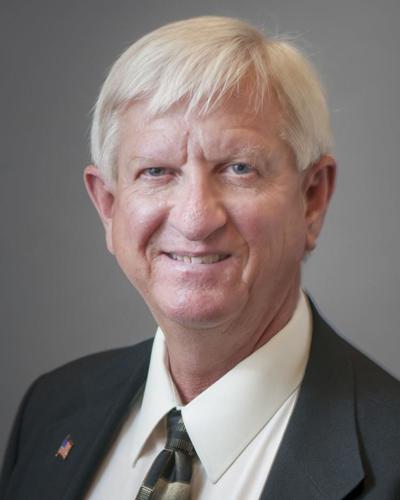
Brent Bunn first started having lofty thoughts about his career path in the late 1970s after meeting Blaine Skinner, a Bonneville County sheriff who received a presidential appointment to become a U.S. marshal.
“I thought, ‘That’s pretty cool.’ I always had the dream (of becoming a U.S. marshal) in the back of my mind, never thinking it would amount to reality,” Bunn said. “I come from a small county in Southeast Idaho, a long way from Boise, and never dreamed I’d be able to attain that position.”
A year and a half into his tenure as U.S. marshal for the District of Idaho, Bunn, 68, reflected on the time he’s spent working his dream job and the uncertainty that lies ahead. He was appointed by President Donald Trump, and he can’t be certain if he’ll be retained under President-elect Joe Biden.
Bunn was a deputy in Bear Lake County when he first started imagining himself as a top federal law enforcement official for Idaho. He went on to have a 32-year career as Bear Lake County’s sheriff, serving in the position from 1985 until his retirement in 2017.
Bunn learned that his decades-old dream had come to fruition in July of 2018, when he was notified he’d been selected to be Idaho’s next marshal.
“Hopefully I’ll be able to continue that position,” Bunn said, explaining his job boils down to making Idaho communities safer by working with other law enforcement agencies to capture the most violent offenders. “I’ve really enjoyed it.”
It took nearly a year, however, for the necessary background checks to be completed and for Bunn’s nomination to pass through the U.S. Senate Judiciary Committee and be voted upon by the full Senate. That finally happened on May 23, 2019, and he officially took office in June of 2019.
There are 94 judicial districts in the U.S., including districts in Guam, Puerto Rico and the Virgin Islands.
Bunn’s office is based in the U.S. Federal Courthouse in Boise. The U.S. Marshals Service has sub-offices in Pocatello and Coeur d’Alene, which are staffed by four deputies each. In all, Bunn oversees 17 deputy marshals.
In his supervisory role, he helps to coordinate personnel from sheriffs offices, police departments and probation and parole departments from throughout the state. He spearheads the Greater Idaho Felony Task Force, which serves warrants on the most serious felony offenses from throughout the state.
Bunn explained his deputies have specialized training to handle such difficult cases. The Marshals Service is also tasked with searching for violent fugitives, providing security for federal judges, housing federal prisoners and producing them for court appearances, investigating sex offenders and tracking interstate travel of sex offenders, who are required to register in their new counties.
Bunn also traveled the state to facilitate communication with departments in every region — at least prior to the coronavirus pandemic.
Bunn said one of his proudest moments occurred recently, when the U.S. Marshals Greater Idaho Fugitive Task Force apprehended a California woman who reportedly fled with her four children eight years ago, after a judge granted full custody of the children to her ex-husband. The woman, Segalit McRoberts, was arrested in Coeur d’Alene. Two of her children are now adults.
Bunn said anyone with tips about the whereabouts of wanted violent felons may call his office at 208-334-9355.
“People need to understand the Marshals Service is really working hard every day trying to make their communities safer by getting these felons off of the streets,” Bunn said.

(0) comments
Welcome to the discussion.
Log In