



POCATELLO — A piece of NASA history parted ways with the sky this week and will instead remain forever parked in Pocatello.
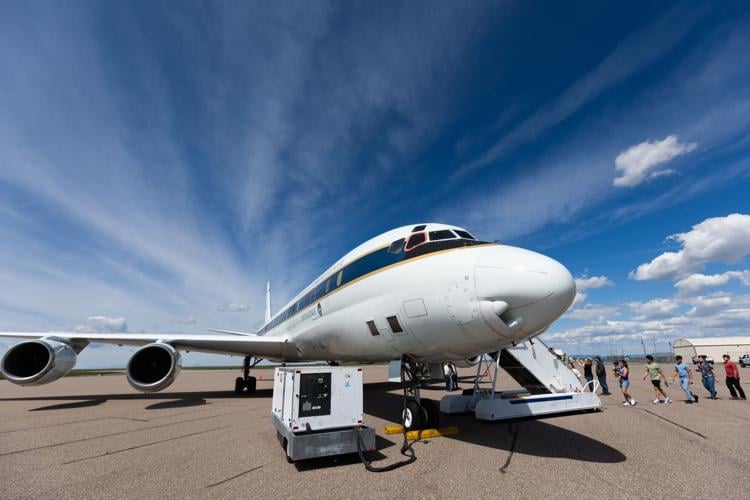
The world’s first and largest flying science laboratory, the historic NASA DC-8 aircraft, now has a permanent home with Idaho State University’s Aircraft Maintenance Program after the federal government donated the plane to the school.
“The DC-8 is coming here to retire, so it’s not going to fly anymore after its last flight today,” said ISU Director of Marketing and Recruitment for the ISU College of Technology Jake Dixon. “Moving forward, our aircraft maintenance students will work on it. They’ve never before had a chance to work on a 150-foot-long behemoth with four jet turbine engines, so this really is a game changer for our students. They can now enter the industry and it’s not just, ‘Oh, we’ve read about it,’ it’s ‘No, I’ve actually done it. I’ve worked on a plane this big. I’ve worked on jet turbines.’”

The NASA DC-8 getting a water cannon salute upon it's arrival to the Pocatello Regional Airport on Wednesday, May 15.
The DC-8 made its final landing around 2:20 p.m. Wednesday, completing a flyover at the Pocatello Regional Airport before receiving what’s known as a water cannon salute, which involved firefighting apparatus spraying large water cannons above the aircraft as it approached the ISU aircraft maintenance hangar. The crew of the aircraft then disembarked for the final time before being greeted by ISU officials, community leaders and students from the Aircraft Maintenance Program.
“I have been lucky enough to work with this amazing team over the last four years, finding ways to help scientists do all kinds of science research,” said NASA DC-8 Deputy Project Manager Kirsten Boogaard. “I’ve been fortunate enough to be a part of various science missions, from studying weather and hurricanes in the Virgin Islands to doing air quality research over large cities like New York. The relationship between NASA and Idaho State University has innovated both research here on Earth, as well as the mission to the moon and beyond. Now, after approximately 150 science missions over 37 years, the DC-8 aircraft is joining the ISU family to train future aircraft technicians.”
The NASA DC-8 makes its final landing at the Pocatello Regional Airport on Wednesday, May 15, before being officially donated to Idaho State University.
As the largest flying science laboratory in the world, the modified Douglas DC-8 jetliner, has been used to support NASA’s Airborne Science mission since 1987. This unique aircraft was first acquired by NASA in 1985 and collected data for experiments in support of scientific projects serving the world’s scientific community — including scientists, researchers and students from NASA and other federal, state, academic and foreign institutions.
The DC-8 was based at NASA’s Armstrong Flight Research Center in Palmdale, California. Data gathered by the aircraft at flight altitude, and by remote sensing, have been used for studies in archaeology, ecology, geography, hydrology, and among others, oceanography. On average, the aircraft would boast about 40 crew members as it conducted studies across the globe.
“We’ve done campaigns where we were studying hurricanes out over the ocean, we’ve been to the Virgin Islands to study the strengthening of storms and we’ve been to Cape Verde, the island of Sal, off the coast of Africa where we were studying the formation of hurricanes,” Boogaard said. “We’ve flown low over big cities for air pollution studies and we’ve even flown over Antarctica conducting detailed surveying.”

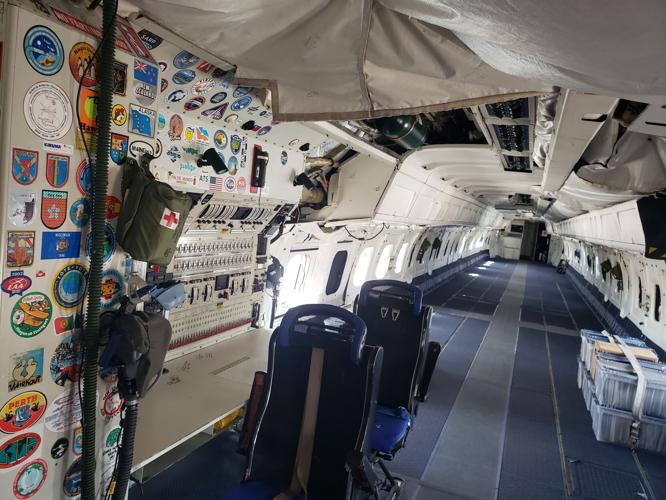
The interior of the NASA DC-8 aircraft.
Tracy Phelps, a member of the DC-8 crew, added, “One of my favorites things that we did was fly over Antarctica because it was just such a unique perspective of that landscape. That was a place that most people will never get a chance to see. We would map it for about five hours a day and then come out and do it all the next day. It was a definite sense of remoteness. It was the closest I’ll ever get to be on another planet. I remember flying by the South Pole station and we would call the guys on the radio just to be able to talk to another human being for a little bit.”
The DC-9 flew over 8,000 miles for each of its 158 successful airborne campaigns before it retired in the Gate City. Much of the interior of the aircraft was vastly different that what you would expect to see in a standard commercial plane, with some of the windows sections serving as the home for probes and sensors that would collect real-time data and spaces where the seats would normally be serving as research stations, Boogaard said.
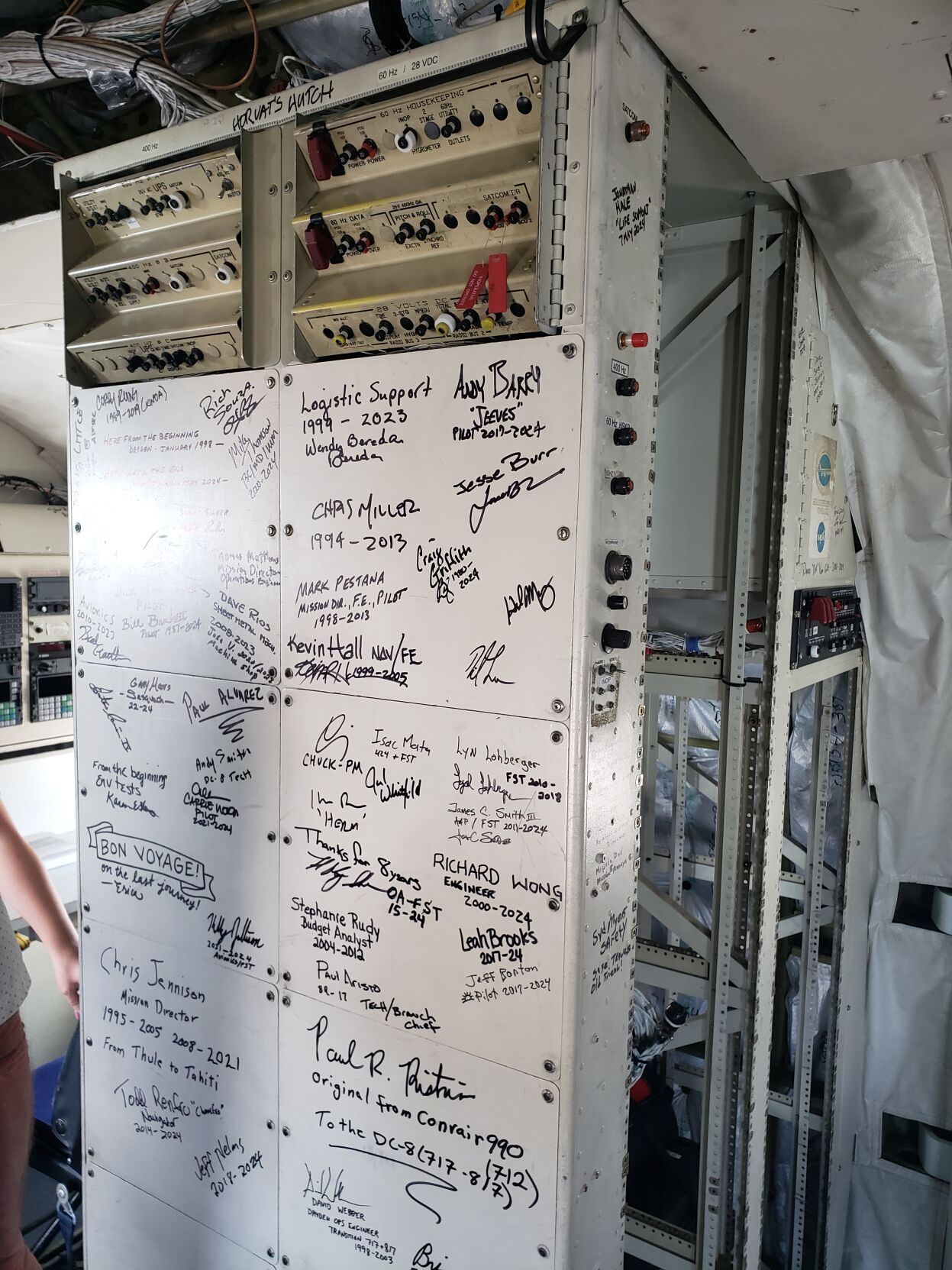
Signatures from previous crew members of some of the 158 different science campaigns NASA's DC-8 completed during its 37 years in service.
The Idaho State Journal toured the inside of the plane and observed numerous signatures throughout the aircraft that were left by those who served on the campaigns. One particular signature read “Suicide for Science,” which Boogaard said paid homage to the notion that those serving on some of the missions must have had a death wish to willingly fly into or around a hurricane just to simply obtain and collect important data.
Traditionally, an aircraft such as the DC-8 would be placed in a museum, said Headquarters NASA Product Support Manager Taylor McQuain, but NASA always hopes to repurpose equipment when possible. The aircraft was donated to Idaho State’s Aircraft Maintenance Program by the federal government, and will continue its mission of creating an environment for learning.
“This particular donation benefits future generations in a different way- this way future generations will get hands-on learning,” McQuain said. “It is also unique in that, according to my contacts at (General Services Administration), this is believed to be the largest donation that the federal government has given to the state of Idaho.”

The cockpit of the NASA DC-8 aircraft.
College of Technology Dean Jerry Anhorn said the donation will help the University to continue to train highly-skilled technicians ready to meet industry needs.
“The benefits of this donation extend beyond our university,” he said. “By training highly skilled technicians ready to meet industry needs, we are contributing to a workforce that is versatile, innovative, and, above all, well-prepared. These professionals will go on to ensure the safety and reliability of air travel, to innovate in the fields of aircraft maintenance and aerospace technology.”
ISU President Robert Wagner thanked all who attended Wednesday’s event and made the donation possible, especially Ed Foster, Aircraft Maintenance Technology Program coordinator and an instructor in the program and Airport Manager Alan Evans. The donation, he said, provides ISU students with a unique opportunity they can’t receive elsewhere.
“What a remarkable piece of history — for nearly three decades, this aircraft has served as a premier flying science lab, contributing to groundbreaking research,” Wagner said. “And now, it embarks on a new journey, here at ISU, that will significantly impact our students and their futures.”
Wagner concluded, “The sky is the limit for our program.”

(0) comments
Welcome to the discussion.
Log In