

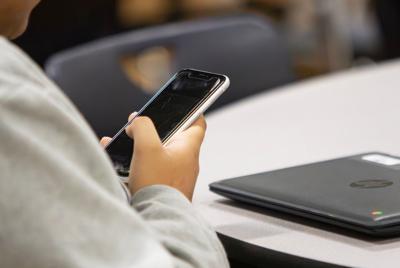
Pocatello/Chubbuck School District 25 is looking for community feedback as it moves to revise its cellphone policy in an effort to reduce distractions and create a positive environment where learners can thrive.
School District 25 is currently reviewing a draft revision of its Student Use of Personal Electronic Communication Devices Policy, which was first adopted in 1996.
“This has just been a topic of conversation across the country, not just nationally, but right here in Idaho and we’ve seen other school districts take up this issue,” said Courtney Fisher, director of communications for the district. “There’s more literature supporting that policies that limit distractions in a learning environment are better for student outcomes and so our district has started to have that conversation informally, probably about a year ago.”
The district has launched a dedicated webpage, sd25.us/district/current-initiatives, where people can submit feedback on the cellphone policy revisions. The website also features the district’s guiding cellphone principles, meeting agendas, materials and minutes.
This year Pocatello/Chubbuck school board members participated in a book study of “The Anxious Generation” and held two public meetings to share their findings. The first meeting was in January of this year when they sent invitations to area families to serve on a cellphone policy committee. The committee, consisting of teachers, parents and other individuals, then met in February, March and April to evaluate the existing cellphone policy and recommend revisions.
“The former policy says that the use of personal electronic devices during instructional time is strictly prohibited,” said Fisher. “We already have a policy that students shouldn’t be using their personal electronic devices in the classroom and that was maybe not implemented the same across every school. We wanted to, first and foremost, review what schools were doing and then come back and try to see how do we make this policy easier to implement in a standard, consistent way across every school in the district.”
A revised version of the policy was placed on the school board agenda for first reading during its April 15 meeting along with draft communications plans and information on frequently asked questions.
Additionally in April, the draft policy revisions were shared publicly and a formal invitation sent out for community input. The board is now reviewing the input provided and preparing for a continued discussion.
The current draft of the revised cellphone policy would require all learner cellphones to be powered off and out of sight, stored in a student’s locker, backpack, bag or vehicle, with some exceptions granted. The new policy would not grant exceptions based on an individual teacher’s discretion regarding his or her classroom.
“Violations of this policy may lead to (student) disciplinary measures including, but not limited to, forfeiting device privileges on school grounds, detention, suspension and/or expulsion, and confiscation of the device as outlined in the corresponding procedure,” the revised cellphone policy states.
School District 25 has also reviewed recently adopted electronic device policies in other East Idaho school districts, which have enacted nuanced changes on when students can and can’t use their cellphones.
“We know that personal electronic devices in the classroom are a distraction and some teachers deal with it more frequently than others based on how they approach that issue,” Fisher said. “Our entire goal is not necessarily about removing that distraction, but it’s about supporting learners. It’s about helping learners feel connected. We’ve seen the research point to that.”
Some of the particular nuances of other districts’ electronic device policies include either allowing students to keep hold of their cellphones all school day as long as they’re turned off or requiring the devices be kept in backpacks or lockers, and whether to allow cellphones to be used by students between classes and during lunch.
“We’ve talked to some of these other districts nearby that have done this and they’ve expressed some pain points,” said Fisher. “They’ve said the first two to four weeks are really kind of hard, but once everybody settles into that, they have been exceedingly happy with how their students in the hallways are more connected. They’re more engaged in class and really feel supported and present through the whole school day. That’s the goal.”
The school board will hold a work session at 3:30 p.m. at the district office on May 13 where it will consider potential changes to the draft policy revisions based on public feedback and research. Any changes that are approved will then move forward through the board’s policy revision process, with additional opportunities for public engagement before the policy revisions are adopted.
Once the revised policy has been officially adopted by the school board, the district plans to launch a communications effort to educate the public concerning the policy changes and will set clear expectations for the 2025-2026 school year when the updated policy is expected to go into effect.
“We started this campaign across the district that’s going to be sort of a years long message that we’re trying to send to our learners, our staff, our family, that You Belong Here,” said Fisher. “I’m personally excited to fold all of this into that line of thinking that you belong in a classroom free from distraction, or where your voice is heard, not drowned out by distractions. It’s our commitment to convey to everyone you belong here and then also align with our mission that we try to frame everything with — to Think More, Learn More, Be More Together and we feel like eliminating those distractions is going to improve the learning environment for everybody.”

(0) comments
Welcome to the discussion.
Log In