

NAMPA — The city of Nampa and Nampa Police Department held an open house last week at the Hugh Nichols Public Safety Building to dispel the misconceptions of the city’s Real Time Crime Center to Nampa’s residents.
The Integrated Command Center, which houses the Real Time Crime Center, “monitors and optimizes traffic flow in Nampa,” with its Traffic Monitoring Center, according to a city of Nampa brochure on the ICC.
Chris Krajsa, NPD’s Integrated Command Center (ICC) supervisor, spoke to 50 or so members of the public about what Krajsa and her team do and don’t do with the information they get. Krajsa has worked in law enforcement for 47 years, mostly at Minnesota State Police. But she’s been in Nampa for the past couple years.
In an interview with the Idaho Press, Krajsa made a promise to Nampa’s residents and the people who visit Idaho’s third-largest city.
“That if you have a crime that’s committed against you, that we will do what we can to solve it with officers on the street and those of us in the Real Time Crime Center, should we have the access to a camera that was in that area,” Krajsa said.
Krajsa said NPD is “not mass surveilling and watching.”
As for the issue of red light cameras, that’s not on the table, according to a city of Nampa brochure on the ICC.
“While there is growing concern about drivers running red lights in Nampa, using red light cameras for remote traffic enforcement is neither allowed under Idaho state code nor desired by the Nampa Police Department,” the brochure states.
MOMENTS FROM THE PRESENTATION
For background on what NPD’s staff of officers deal with and how they deal, Krajsa shared a few statistics about Nampa and NPD:
- The population is just under 127,000 people.
- NPD’s coverage area is 33.5 square miles.
- NPD has 160 sworn officers, but 63 of them are assigned to patrol.
- NPD has 71 support staff, with a little over 79,000 calls for service.
“That’s a pretty large area to cover,” Krajsa said about 63 patrol officers covering 33.5 square miles.
The ICC’s total cost was $6.1 million, but only $800,000 was paid for by the city. Amazon paid for $2.7 million for traffic mitigation via the city of Nampa and Idaho Transportation Department. An additional $2.6 million came from American Rescue Plan Act (ARPA) funds.
While the ICC also is home to the Traffic Management Center, Crime Analysis Unit and Emergency Operations Center, the people were there to learn about its Real Time Crime Center.
The crime center is staffed Sunday through Saturday, 60 hours per week, with a day shift and an evening shift.
Then Krasja got into the traffic cameras: There are 34 intersections where they’re used, and automated license plate readers are used at 27 intersections.
“Obviously, privacy, civil rights and civil liberties are a big important part of what we do upstairs,” Krajsa said. “And so we want you to know that we have, we respect your privacy, we respect civil rights and civil liberties,” Krajsa said. “We are bound by Idaho Code 49-1432. We also have policies that discuss both of these areas of our police department.”
Krajsa also pointed out a major concern residents have shared about potential illegal uses of the ALPRs.
“And know that we understand one of the major concerns that it can be used in nefarious ways, that has not happened here,” Krajsa said. “We are an agency. We don’t tolerate that type of behavior. We can discipline all the way up to firing somebody. Our chief would support someone getting criminally charged if they (were) using our systems the wrong way.”
The Idaho code defines ALPRs as “a device that passively records license plates of vehicles on a roadway or any similar device,” according to the state’s legislature.
“An agency may use an automated license plate reader and its data for law enforcement purposes, traffic flow analysis purposes or both,” the code states. “An agency that uses an automated license plate reader for law enforcement purposes shall do so pursuant to the following requirements:
- The device and its data shall not be used for any purpose other than the investigation of felony or misdemeanor crimes or traffic accidents or to search for missing or endangered persons.
- The device and its data shall not be used to enforce traffic infractions other than those associated with a traffic accident.
Krajsa pointed out that ALPRs “do not provide registered owner information; they do not tell us who a driver is.”
She also addressed the concerns about ALPRs being used in residential areas.
“ALPRs are located at select intersections; they’re not in residential areas,” Krajsa said. “I can’t say that enough, because that’s one of the things that goes around is that we know when you leave your home and when you come home and where you stopped in between. That’s just not the case. They’re not at every intersection.”
Then she showed several examples of how they’ve used the ALPR system.
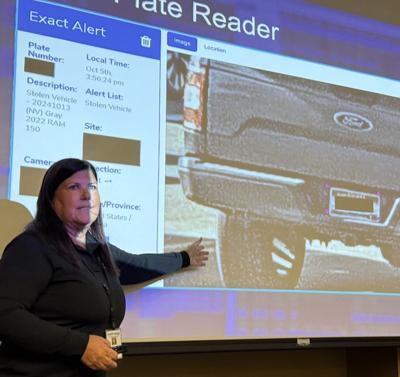
“You can see that the ALPR is reading the plates there and logging them over here. … Traffic goes through. We don’t even see that upstairs; it’s running in the background. We can’t see in your vehicles. But what we do get is we get an alert on a vehicle.”
In that case, the vehicle — a Ford pickup — had an Idaho license plate. But there’s a “human element.”
“We hear about people going to jail because they got taken out because ALPR read something wrong,” Krajsa said. “The human element in this is that it is our job as a human to look at this and say this alert is for a gray Dodge Ram with a plate out (from another state). ... So what we have to do and what dispatch does is they confirm that this vehicle is stolen or not. But honestly, I already know, this is an Idaho plate. So, this alert comes up, we don’t have to do anything with it; it goes away. We don’t need to (do anything); it’s not the right vehicle. We know that.”
She also showed how the crime center helps solves crimes in Nampa.
“We got a report of two hit-and-runs in our city,” Krajsa said. “When we get this, a call is created, officers are responding. After the fact, we start looking for footage of this vehicle to help support evidence.”
The footage showed the driver running a red light “because she was too impatient,” and then it shows her motoring through an intersection and then continuing up the road.
The driver was in a total of three crashes with more near-collisions. Part of the footage, from the county, came through a Freedom of Information (FOIA) request, according to Krajsa.
“This was not just given to me, I did a FOIA request like you would have to do if you wanted something from us,” Krajsa said.
The last collision showed a lot of damage to both her vehicle and the last one she struck, which shocked the crowd.
“She was arrested and she blew a 0.24 (blood alcohol content). She was breastfeeding her baby and she had an unrestrained 2-year-old in the backseat,” Krajsa said. “She got 25 years in prison. During the sentencing, the judge told us that part of why they sentenced her so strongly is because the video footage.”
In more than the two years the center has been open, they’ve done more than 90 tours with more than 3,000 people touring the center.
“We have been transparent since day one,” Krajsa said. “That’s why we’re doing this open house.”

(0) comments
Welcome to the discussion.
Log In