

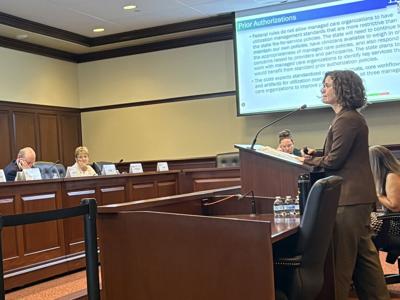

Deputy Director of the Idaho Department of Health and Welfare Sasha O’Connell provides an update to legislators on Thursday regarding the ongoing overhaul of Medicaid in Idaho.
BOISE — The Idaho Legislature’s Medicaid Review Panel met Thursday to discuss the state’s overhaul of Medicaid. Preliminary stages for a competitive bidding process are slated to begin in the coming months before a full, multi-year transition sees private organizations playing a primary role in administering the federal health program in Idaho.
The change moves the state away from the traditional fee-for-service system where the state directly contracts with and pays healthcare providers a fee for each service provided to a Medicaid recipient. Through what is known as Managed Care Organizations (MCOs), Idaho will will use third-party contractors to administer Medicaid benefits, coordinate care and provide oversight for the system.
The wide-reaching shift was initiated after the Idaho Legislature passed House Bill 345 in 2025 to reform Medicaid in the state and transition to a comprehensive managed care program. This overhaul has been delayed to Jan. 1, 2030, however, as a result of litigation with the state’s prior Medicaid Administrator, as reported by the Idaho Capital Sun.
Even with this date several years away, officials with the Idaho Department of Health and Welfare (IDHW) are gearing up in the coming months as the agency works to prepare a request for proposal (RFP), which invites private vendors or MCOs to bid on contracts to manage the state’s Medicaid program, that will be posted in 2027.
Starting on Dec. 1, the Idaho Department of Health and Welfare will begin a “blackout” to cease public discussion for any and all staff working on the RFP, who will each be required to sign non-disclosure agreements.
“We want to ensure that everyone has a fair opportunity when the RFP is posted so that everyone has the same chance at winning this procurement,” Sasha O’Connell, IDHW’s deputy director, said. “… We will not have any meetings about the contract with folks, including with our current or potential future managed care organizations.”
As this work approaches in the near-term, committee members laid out some of their key concerns they are looking to have addressed by the RFP and MCO contracts.
Sen. Melissa Wintrow, D-Boise, said she had received a significant volume of complaints of individuals not reviewing in-person assessments when requested. “We, as a state, have to monitor this and make sure that people are being assessed promptly with compassion as a human being, with dignity and has somebody that really can hands-on help them navigate the system,” she said.
This was an area of concern at one of the several regional stakeholder listening sessions held across the state from September 2025 through May of this year. During a hearing in Rexburg, members of the public voiced concern about care coordinators being ill-defined and, in practice, resulting in what is intended to be a singular point of contact for patients instead spread across multiple individuals fulfilling separate roles. In one instance, a Twin Falls resident said they had a nutritionist, care navigator, pharmacist consultant and a temporary provider to manage her needs, as was reported by the Idaho Press.
Wintrow also questioned how many Medicaid enrollees could be dropped from coverage in the coming months if they aren’t contacted or appropriately enrolled to confirm they meet new eligibility requirements associated with House Bill 913, which directed the state to implement work requirements for Medicaid to align with the federal One Big Beautiful Bill.
O’Connell said a past point-in-time number indicated there were 89,000 Medicaid expansion members in Idaho who are already enrolled in the Supplemental Nutrition Assistance Program (SNAP) or Temporary Assistance for Needy Families (TANF) program or have one of several exemptions including for children being in the household. She added an estimated 14,700 expansion enrollees are remaining that the department is unsure of whether they are meeting new work requirements, which go into effect on Jan. 1, 2027.
In another issue pertaining to clarity within the program, Sen. Kevin Cook, R-Idaho Falls, said he wanted to ensure there were consistent forms in place for the three MCOs the state intends to work to manage Medicaid. Cook posited that doing so would potentially mitigate healthcare providers being told they failed to submit necessary information or being asked to resubmit forms relating to healthcare services or prior-authorization entirely.
Jennifer Strohecker, the CEO of Strohecker Health Solutions and a consultant for the committee, noted the state already is committed to developing a standardized reporting template for prior authorization requests. Still up for discussion is how prior authorization criteria — used to determine whether insurance plans will recover a requested medical procedure — will be standardized.
If the department wished to engage in conversation around pharmaceutical treatment pre-authorization, for example, Strohecker said IDHW would then engage in conversation with the MCOs to identify which program areas would benefit from alignment.
Legislators are slated to reconvene for a continued discussion of the Medicaid managed care transition in November, in advance of the anticipated blackout date.

(0) comments
Welcome to the discussion.
Log In