





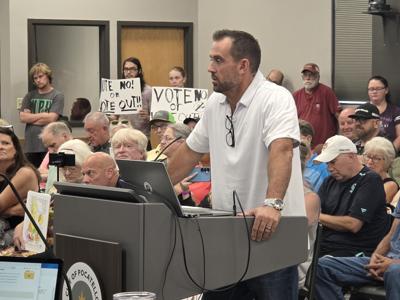
POCATELLO — Gus Schultz isn’t done yet.
One day shy of the two-week deadline set after the Pocatello City Council voted 4-1 on July 16 to uphold Hearing Examiner Kathleen Lewis’ denial of his conditional use permit for a large-scale AI data center on the former Hoku site, Schultz, of Lex Developments LLC, filed a formal request for reconsideration.
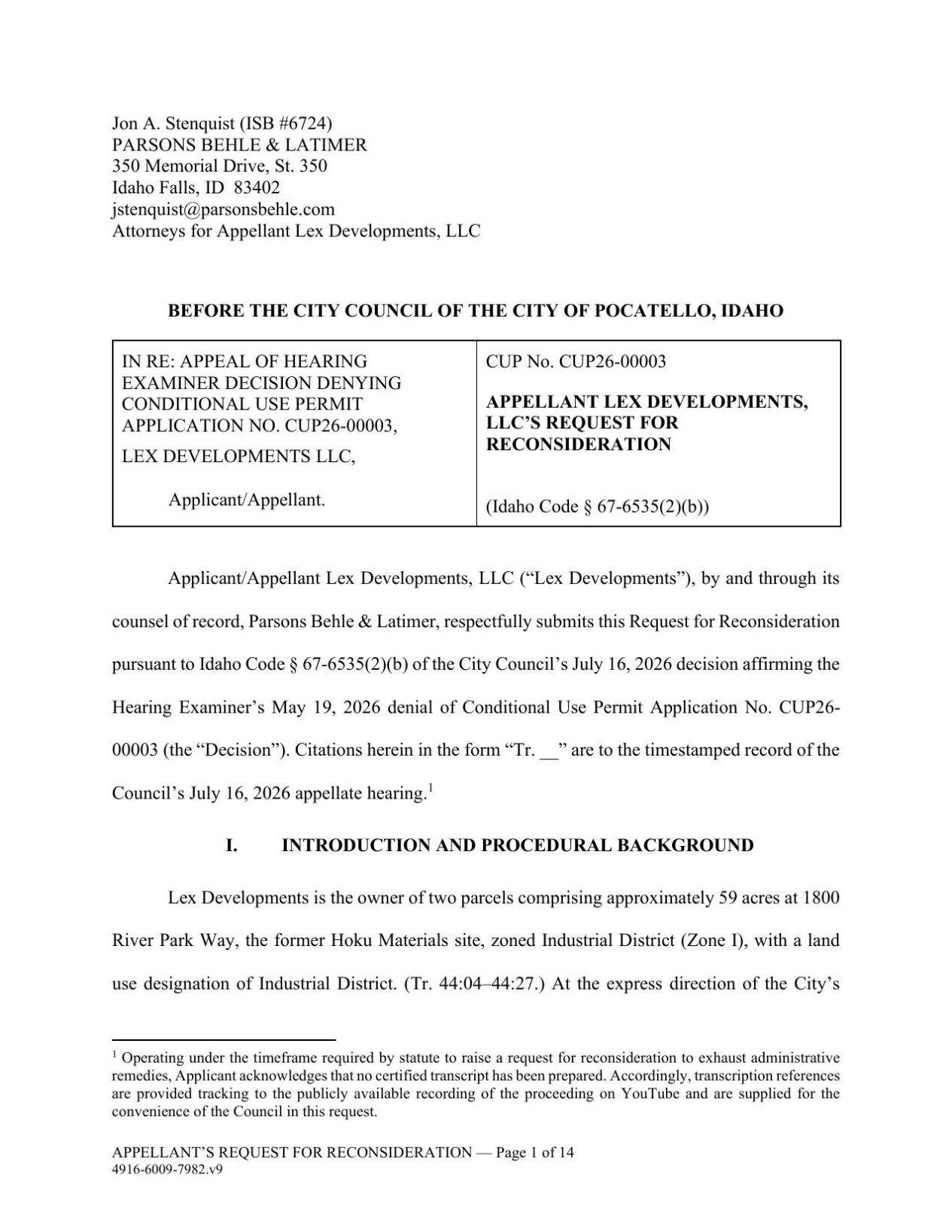
The Wednesday filing — a 14-page request made through his Idaho Falls attorney, Jon Stenquist of Parsons Behle & Latimer — puts the matter back before the City Council, which now has 60 days to issue a final written decision on whether an AI data center is an acceptable use of the industrial-zoned land that formerly housed the failed Hoku polysilicon plant at 1800 River Park Way.

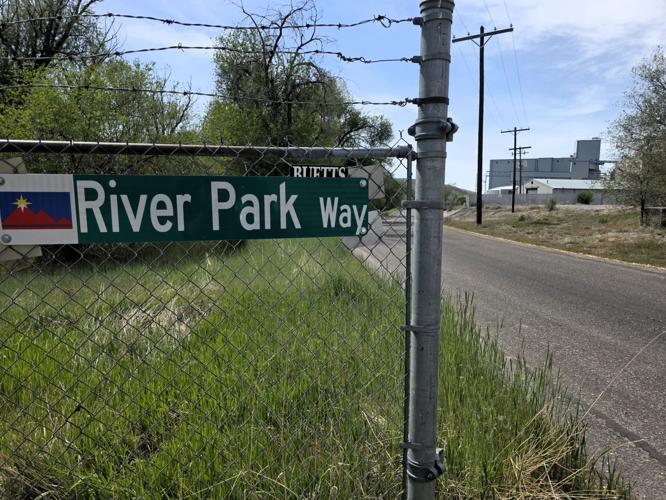
The River Park Way street sign marks the entrance to the former Hoku polysilicon plant site on Pocatello's northwest side in this May photo. Portneuf Capital rebranded the road — formerly known as Hoku Way — as part of an effort to shed the property's troubled past.
The city has not yet issued an official written statement affirming its oral decision from the July 16 hearing and vote. Stenquist filed the reconsideration request anyway, he wrote,” out of an abundance of caution.” City officials told the Idaho State Journal Thursday the request for reconsideration was submitted to the city July 29 and that a date for reconsideration has not been set.
The filing doesn’t just rehash arguments from the original appeal of Lewis’ denial, it goes further, arguing the July 16 hearing itself was procedurally defective on five independent grounds that together, Stenquist writes, “render the decision arbitrary, capricious, procedurally defective and unsupported by the record.”
If the Council refuses the request, Stenquist asks for justification specific to each ground, noting the filing was made to exhaust administrative remedies and that Lex Developments “reserves all rights to seek judicial review” — a lawsuit Schultz has already promised is coming “absolutely, 100 percent.”
Background and procedure


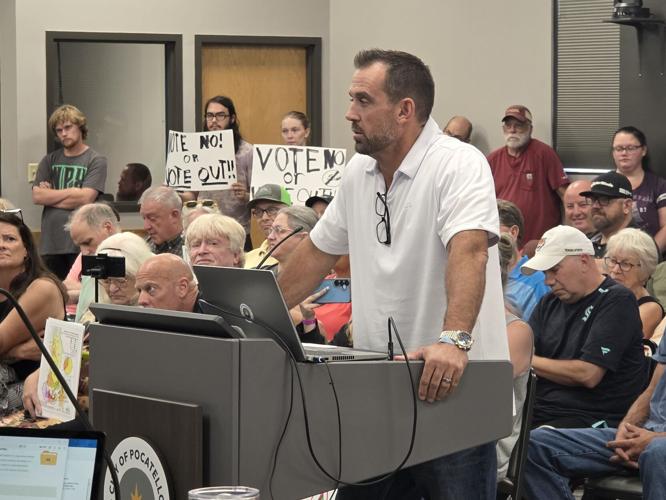
Every seat in Pocatello’s Council Chambers was claimed well before the May 14 hearing began, with hundreds more standing along the walls and spilling into the foyer of City Hall. More than 100 people ultimately testified during the more than four-hour hearing.
The data center proposal for the roughly 59-acre former Hoku site has been before the public since May, when Lex Developments’ permit application triggered a standing-room-only hearing at City Hall that drew hundreds of residents and more than 100 speakers over nearly four and a half hours.
Lewis denied the permit May 19, finding the application inadequate on three of seven required criteria: public facilities, environmental impact, and public health and welfare. Lex Developments appealed June 1, and the Council took up the matter July 16, voting 4-1 to affirm Lewis’ denial.
Councilmembers Corey Mangum, Stacy Satterfield, Brent Nichols and Hayden Paulsen supported the affirmation while Councilmember Dakota Bates cast the lone dissenting vote; Councilmember Ann Swanson was absent.
After the vote, Schultz told the Journal the Council’s decision was “the best thing that could have happened for me.” Wednesday’s filing is the required next step before he can take the matter to court.
The Council has not yet adopted the written reasoned statement City Attorney Jared Johnson said would come before the Council at a future meeting. Stenquist reserves the right to supplement the reconsideration request once that statement is issued, and reserves all objections to it, according to the request.
Ground one: Evidence outside the record
Stenquist argues the Council violated its own rules by relying on evidence outside the prior record.
At the outset of the July 16 hearing, Mayor Mark Dahlquist told the room the Council was sitting in a quasi-judicial capacity — “similar to that of a judge reviewing a case” — and could not receive new testimony beyond what was presented at the original May 14 hearing.
City planning staff likewise cautioned that the “Council should remain vigilant in its procedural duties with regards to its motion and its discussion of this agenda item.”
What followed, Stenquist argues, was the opposite.
During deliberations, Dahlquist called Schultz to the podium and pressed him on whether he had companies committed to using the data center, whether any were present, and whether he had signed letters of intent — none of which are criteria under the permit ordinance, and none of which appeared in the prior record.
The exchange drew applause and cheering that Stenquist argues “influenced the tenor of the proceeding.”
At least one affirmative vote, he adds, was cast in part on “aligning with what the populace desire is” — a decision Stenquist characterizes as driven by public clamor rather than the record, which Idaho law doesn’t permit.

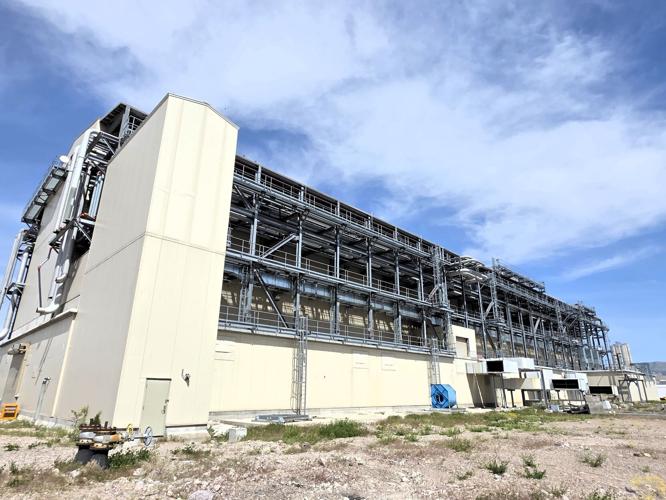
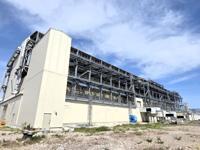
The hulking reactor building of the former Hoku polysilicon plant looms over the River Park Complex. The $700 million plant broke ground in 2007 but never opened for commercial production, filing for bankruptcy in 2013.
Stenquist also points to new utility evidence offered mid-deliberation by Pocatello Public Works Director Tom Kirkman, who testified that some commercial users consume 150,000 to 300,000 gallons of water per day — testimony absent from the hearing examiner’s findings.
Whether that extra-record testimony helped or hurt Schultz’s application is beside the point, Stenquist writes, because when a quasi-judicial body deviates from the record, it “essentially conducts a second fact-gathering session without proper notice, a clear violation of due process.”
Ground two: A due process violation
Stenquist argues the Council ignored a due process violation predating the July 16 hearing entirely.
Under city code, when a proposed use isn’t listed in the zoning ordinance, the city’s planning director must conduct a formal written analysis of whether the use — in this case, an approximately 700,000-square-foot AI data center — is compatible with and similar to uses already permitted in the zone.
Stenquist argues that analysis was never properly performed, and that Planning and Zoning Director Brent McClane’s written interpretation wasn’t delivered to Lex Developments until five hours before the May 14 hearing.
Under city code, an applicant has 14 days to appeal such an interpretation to the Council. Delivering it hours before the hearing effectively stripped Lex Developments of that right, Stenquist argues.
When Bates asked at the July 16 hearing whether that process was properly followed, Johnson responded it was “really up to the Council to decide.”

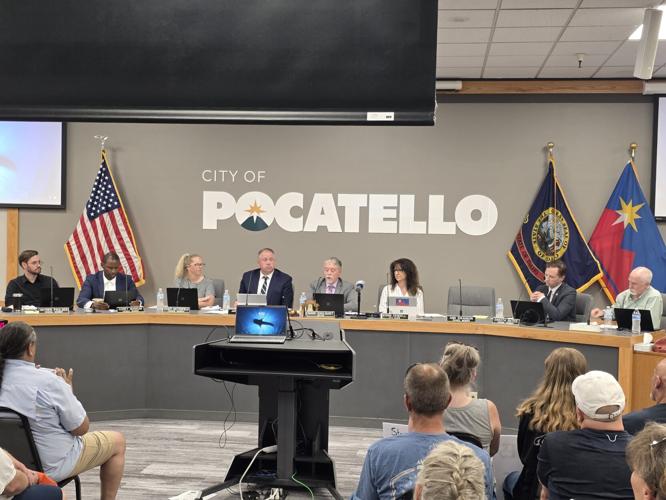
The Pocatello City Council listens during the Jul 16 hearing on the proposed AI data center at the former Hoku polysilicon plant site.
The Council never addressed the question when it voted to affirm Lewis’ denial — the only stated reason for the motion was a single conclusory sentence that didn’t address any of the three original appeal grounds individually, Stenquist wrote.
Ground three: An incomplete analysis
Stenquist argues McClane failed to analyze the data center against the full range of uses permitted in the industrial zone — the city’s most permissive classification, designed to accommodate industrial uses the city doesn’t want elsewhere.
City code required McClane to base that determination on four specific criteria, including whether the use is consistent with the zone’s intent, similar in type to listed uses, and similar in its impact on community facilities.
McClane’s own testimony effectively conceded the analysis was absent, Stenquist argues: McClane told the Council he believed an industrial zone would be “the proper zone for a data center” and that many of the four criteria “did align.”
McClane’s sole reservations centered on utility questions — water, wastewater and power — which Stenquist argues are development-stage issues that belong in the building permit process, not a conditional use determination.
Stenquist notes McClane acknowledged that information from Idaho Power “came after the fact, after I made that determination to move forward with a conditional use permit.”
Ground four: A manufactured ambiguity
Stenquist claims McClane deliberately routed the application through the conditional use process not because code required it, but because the project was politically controversial.
Rather than analyze the data center against the heavy industrial zone’s listed classifications, McClane’s written interpretation referenced “light industrial” uses — a lesser classification — raising a zoning question Stenquist argues served no purpose except to manufacture a pretext for a public hearing.
McClane’s own words make the case, Stenquist writes: “Obviously the is very interested in this type of use in the city and I felt it was most appropriate to go through the conditional use permit process because of that.”

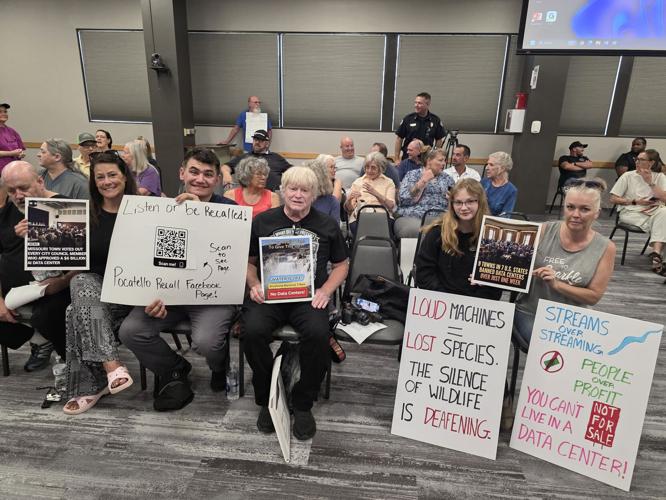
Opponents of the proposed Hoku site data center hold signs during the July 16 Pocatello City Council meeting.
Public interest isn’t a criterion under the code, Stenquist argues, and isn’t a lawful basis for requiring a conditional use permit. Routing a code-compliant use into a discretionary public hearing because of anticipated opposition “inverts the function of zoning classification and denies the applicant equal application of the City’s own ordinances,” he wrote.
Bates made a similar observation during deliberations: “This is simply asking if this use fits within our code, which most all of city staff has essentially said yes, it fits.”
Ground five: Disparate treatment
The fifth argument focuses on equal treatment. The reconsideration request notes the FBI’s data center already operates near the property — a fact both Schultz and Dahlquist acknowledged during the hearing.
It also notes the defunct Hoku polysilicon plant, whose water and power demands exceeded those proposed by Lex Developments, was built on the same site without a conditional use permit.
The Council referenced both comparisons during the hearing but never analyzed the disparity or explained why the same ordinances produced a discretionary hearing for Lex Developments and outright permission for the others, Stenquist argues.

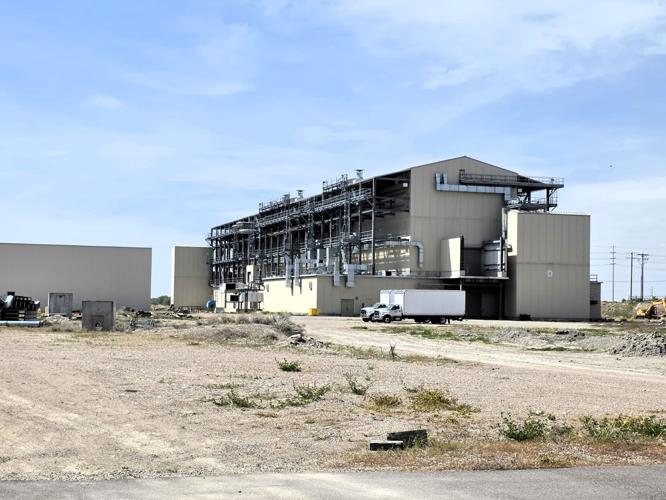
The former Hoku polysilicon plant, now known as the River Park Complex, in northwest Pocatello.
What comes nextU
nder city code, the Council has up to 60 days to issue a written decision on the reconsideration request that addresses the Council’s reasoning on each ground, as Idaho code requires.
If the Council denies reconsideration, Schultz can take the matter to Bannock County’s 6th Judicial District Court — a path he has said he intends to pursue regardless.
Bates outlined the stakes of that potential lawsuit before casting his dissenting vote. He was the only councilmember who warned that a judge ruling for Schultz could strip the city of any ability to impose conditions on the development, with the process playing out in as little as two months and ending with the data center approved and the public having no further say.
Absent a rewrite of the city’s zoning code — something McClane estimated could take 12 to 18 months — the public would have no further ability to set guardrails on this project or similar future ones.
Most of the Council and Dahlquist expressed a desire to pursue such a rewrite during the July 16 meeting, a desire that appeared to shape how the 4-1 vote played out.
Schultz sees another wrinkle in that scenario: If the 6th District Court sides with him, he said, any changes the city makes to its data center rules in the meantime won’t apply to him — he’ll be grandfathered in under the rules in place when he originally applied.
The former Hoku polysilicon plant went bankrupt in 2013 with roughly $1 billion in debts after the $700 million facility, backed by Chinese investors, was abandoned mid-construction in 2012 without ever producing a single product.
The site remains as it has been for nearly 15 years.
What becomes of a property that has drawn grandiose hopes alongside warnings of what happens when economic development goes wrong now depends on what the City Council decides — or what happens in court.



(1) comment
The AI companies have no scruples and believe their money or bullying can buy small town government Other states who have allowed these companies access to their resources have placed a moratoriums on further development or opening of other facilities. They lie about the impact their companies have on the environment and local resources, its all about the money.. not concerns for the environment or community well being
Welcome to the discussion.
Log In