




POCATELLO — A Bannock County judge this week denied a stipulated motion to change the venue of former Downard Funeral Home director Lance Peck’s upcoming trial, a move that signals the case could stay in Pocatello — at least for now.
Finding that attorneys for both sides had not met the legal threshold required to justify moving the case, 6th District Judge Javier Gabiola denied the motion following a Thursday hearing at the Bannock County Courthouse.
He told attorneys handling the case, Bannock County Prosecutor Ian Johnson and Bannock County Managing Public Defender Ashley LaVallee that pretrial publicity alone was insufficient grounds to relocate Peck’s trial under Idaho Criminal Rule 21.
“At best, what I have right now is just publicity,” Gabiola said from the bench.
Gabiola cited several Idaho cases in reaching his decision, including the Idaho Supreme Court case State v. Ish — a case that LaVallee said bolstered her argument to move the trial elsewhere — as well as State v. Hall, State v. Sheahan, State v. Winn and State v. Hadden.
Under that body of case law, Gabiola said he was required to weigh multiple factors beyond media coverage, including affidavits indicating community prejudice, voir dire testimony, whether jurors had formed opinions about Peck’s guilt or innocence based on pretrial publicity and assurances from jurors regarding impartiality. The stipulated motion, he said, addressed none of those factors.
“I do not have any affidavits indicating prejudice in the community and no testimony of voir dire,” Gabiola said. “The stipulated motion does not address any of those, except, again, at best, pretrial publicity.”
LaVallee pushed back, arguing that gathering affidavits from prospective jurors was impractical at this stage of the proceedings.
“The issue of trying to get affidavits of actual jurors or people that would even be prospective jurors is difficult because we don’t even know what our jury pool is going to be at this point in time,” she said.
LaVallee pointed to the volume and tone of local media coverage as the crux of her venue argument, telling the court that approximately 45 news stories had been published across Southeast Idaho — spanning from Bannock County to Idaho Falls — over the nearly five years since the investigation began. She described several articles as “extraordinarily inflammatory,” arguing their content went beyond what would be admissible at trial.
Gabiola was unmoved, noting that admissibility was not the relevant standard.
“Why am I considering whether it’s admissible or not? The standard is whether or not there’s prejudice in the community,” Gabiola said.
The stipulated change of venue motion filed earlier this month was 183 pages long, the bulk of it consisting of news article attachments. As the Idaho State Journal reported March 2, the one-page filing stated only that “Mr. Peck’s cases have garnered significant media attention, and a fair and impartial jury cannot be selected within Bannock County.” The motion contained no case law citations and no supporting affidavits or declarations.
Gabiola noted Thursday that he had asked both parties to file a venue change motion sooner rather than later to allow adequate time for the court to prepare, but said that request never came with permission to bypass the legal requirements for such a motion.
“I never said that I would consider a motion that was not compliant with the rule or case law, did I?” he said.
Johnson, who signed the stipulation alongside the defense, agreed the motion fell short of the standard outlined by Idaho Criminal Rule 21 but said both sides had acted in good faith, citing a desire to get ahead of potential roadblocks as the case moves toward trial.
“I do very much suspect when it comes to it, there will be a time that all the elements that will be presented to the court will definitely qualify for a change of venue,” Johnson said, adding that he was “fairly convinced” a substantial portion of any jury pool drawn in Bannock County would have some familiarity with the case.
Gabiola pressed Johnson on that assertion.
“How do you know that?” the judge asked.
Johnson conceded he did not know it as fact, saying his assumption was based on community members regularly approaching him in public to ask about the case.
Gabiola ruled the stipulated motion premature but left the door open for a properly supported refiling, instructing both parties that any future motion must include the applicable rule, supporting case law and affidavits.
“That’s basic stuff, guys,” he said.
In lieu of granting the venue change, Gabiola ordered both parties to submit joint jury questionnaires — or their respective individual questionnaires if they cannot reach agreement — by May 11, the date of the next scheduled status conference. The questionnaires, he said, will help assess potential juror bias and inform any future venue determination.
“I think not only is Mr. Peck entitled to a jury of his peers, the community is also entitled to a jury here, unless you can show otherwise,” Gabiola said.
LaVallee said she would be prepared to refile the motion with additional support, including community affidavits, if the court required it.

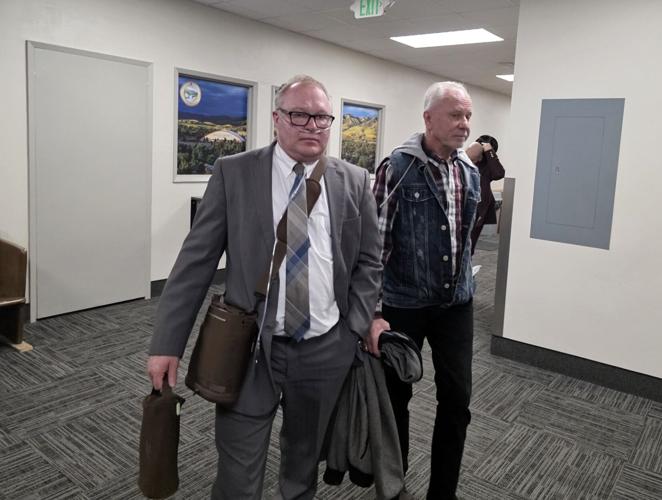
Lance Peck
Peck’s case dates back to August 2021, when Pocatello police received a report of a foul odor coming from an open window at the Downard Funeral Home at 241 N. Garfield Ave. Officers in hazmat suits executed a search warrant and spent roughly 12 hours inside, where they found 12 bodies in various stages of decomposition, approximately 50 fetuses in jars and dozens of unidentified cremated remains. Court documents allege Peck misrepresented remains to at least 25 families while operating the funeral home between 2017 and 2021.
Peck faces 22 felony charges and 63 misdemeanor charges. A tentative plea agreement reached in May 2025 collapsed that October when Gabiola rejected it in a packed courtroom filled with alleged victims and their families. Peck’s then-attorney Richard Blok subsequently withdrew Peck’s guilty pleas and left the case entirely, citing more than $37,500 in unpaid legal fees. The Bannock County Public Defender’s Office was appointed to represent Peck, with LaVallee taking over as lead attorney.
Peck, who appeared in court Thursday, is scheduled for a jury trial beginning Feb. 1, 2027. A pretrial conference is set for Dec. 7.

(0) comments
Welcome to the discussion.
Log In