

POCATELLO — Idaho State University has selected the East Coast-based Radnor Property Group to design, finance and construct a new 370-bed apartment complex on the northern edge of Bartz Field, moving the university closer to its first-ever public-private housing partnership.
According to materials ISU Senior Vice President for Operations Brian Sagendorf presented to the State Board of Education last month, Radnor has built more than 9 million square feet of student housing, completed more than $4 billion in capital improvements and partnered with more than 40 higher education institutions nationwide.
"This is a real transformational project and a high need for the university," Sagendorf said. "We've had some very nice enrollment gains over the last four consecutive years, which has been huge. If we want to continue to grow, if we want to continue to expand the opportunity to bring in students from the Treasure Valley, from other parts of Idaho, from say northern Utah, we currently don't have the housing to support that continued recruitment and all the growth strategy. This project would go a long way in that regard."

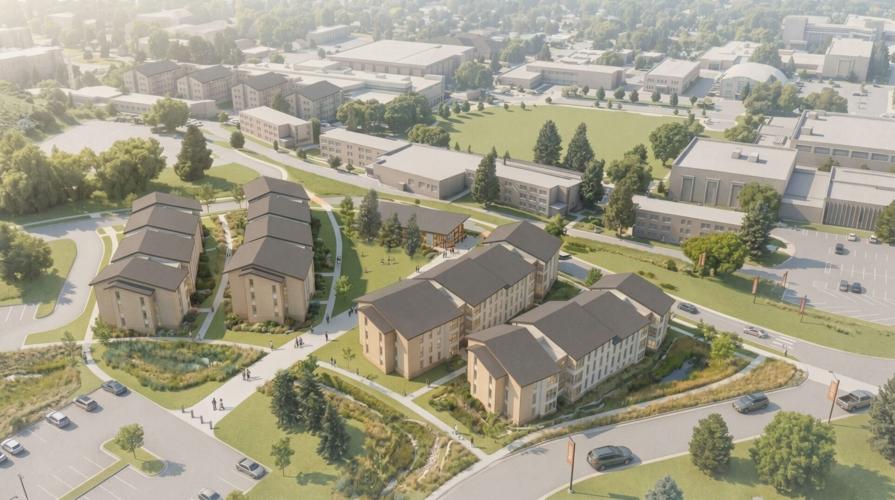
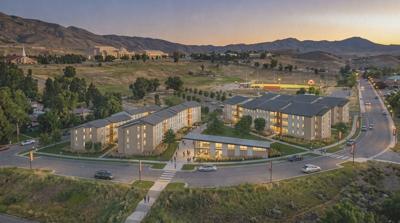
An aerial rendering shows the proposed 370-bed student housing complex in context with surrounding Idaho State University buildings and parking areas.
The roughly five-acre, 96-unit project site sits behind Reed Gym and across from McIntosh Manor, and will consist of four three-story apartment buildings and a central commons complex. Each of the four buildings will consist of a little more than 25,000 square feet of space, for approximately 103,800 total square feet.
If the timeline holds, ISU hopes to break ground in August 2027 and have students moving in by fall 2029.
Sagendorf said the push traces back to a 30-year master campus plan the university completed in late 2024 that, in part, identified a significant demand for on-campus housing, with current enrollment and facilities falling well below being able to properly serve the university's recent uptick in enrollment.
During a Thursday interview with the Idaho State Journal, Sagendorf said the 1,200 existing beds at the university's primary campus in Pocatello have sat at 100 percent occupancy with waitlists for several years. Those beds represent housing opportunities for about 15 percent of the 8,000 to 9,000 students attending school at ISU in the Gate City every year.
"We know a lot of our students have great off-campus options and off-campus housing will always be an important option for college campuses," Sagendorf said. "But we know there's a pretty high demand for students who want to have that on-campus residential feel here at Idaho State, too."
With the university unable to easily justify a $30 million or $40 million apartment project out of its own budget, Sagendorf said ISU turned to a public-private partnership model that other universities around the country have used to add housing without taking on new institutional debt.
The Idaho State Board of Education authorized ISU to launch a nationwide procurement process about a year ago, and the university received proposals from a wide field of developers who had taken notice of ISU's recent enrollment growth, Sagendorf said.
After reviewing about 12 to 15 developer qualification submissions, bringing each finalist to campus for tours and a chance to dig into the university's master plan and enrollment data before submitting formal proposals for a roughly 350-bed complex, ISU narrowed its field to four finalists before ultimately selecting Radnor.
Described on its website as a dynamic and award-winning development, investment and advisory company founded in 1999 with leadership experience spanning more than 70 years, Radnor's specialty is in complex real estate and infrastructure projects, including student housing, multifamily, mixed-use commercial and campus facilities.
Sagendorf said Radnor's proposal stood out as the most cost-effective of the bunch, a factor that mattered to the university even though it isn't fronting the construction costs itself.
"There were other proposals for larger high-rises and things like that on the property, which gave you expensive projects, translating to higher rent for students, which we're sensitive to," Sagendorf said. "We really like Radnor's initial concept, which is to have some multiple block buildings that can be a little more cost-effective in construction, a little lower cost of capital, which we expect and hope to mean a more affordable rent possibility for our students who wish to live there."
Sagendorf said the university considered other campus properties, including a vacant lot along South Fifth Avenue on the northwest end of campus and the parking situated between East Putnam and East Terry streets and South Third and Fourth avenues, but both would have required garage-level parking beneath the apartments, adding construction costs that would ultimately be passed on to students through higher rent.
A student demand survey conducted about a year ago also showed students wanted to live close to campus amenities like Reed Gym, the dining hall inside Turner Hall and Eli Oboler Library, which the Bartz Field site offers more directly than some alternatives, Sagendorf said.

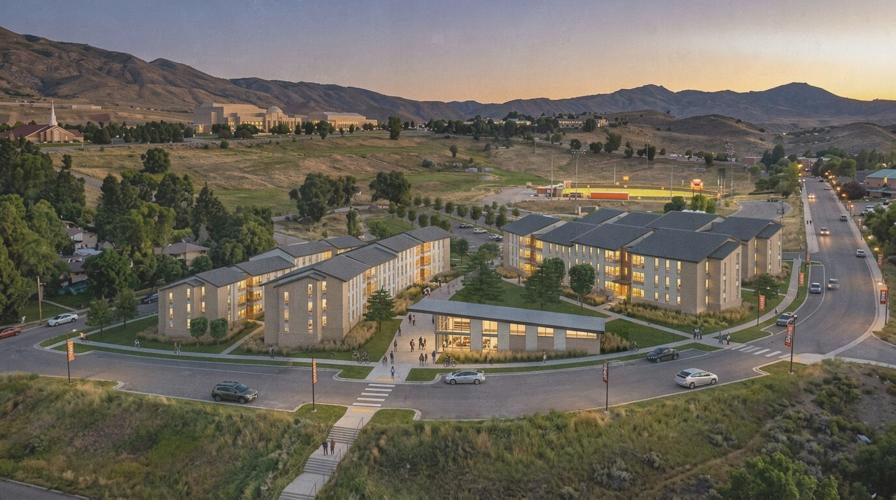
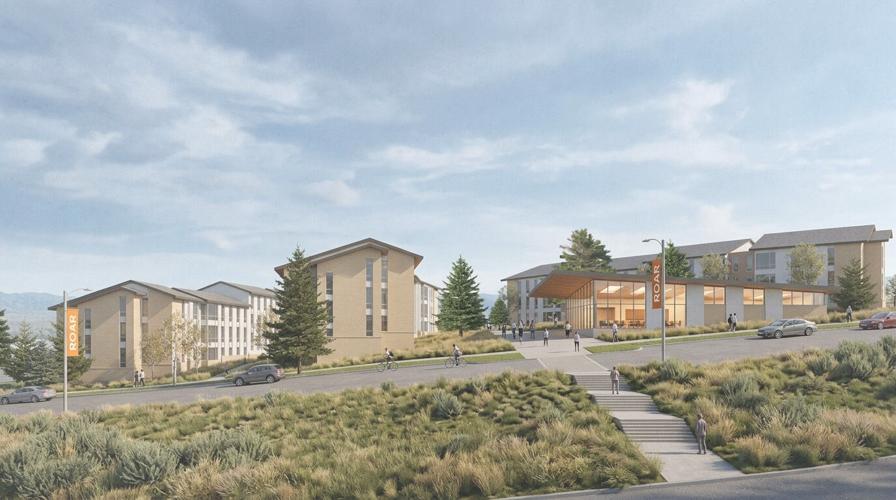
A rendering shows the exterior of the proposed apartment buildings and central commons space planned for Idaho State University's new student housing complex.
Units will be apartment-style with full kitchens, ranging from two to five bedrooms. The commons building is planned to include both indoor gathering space and an outdoor area with grilling stations, seating and fire pits, and Sagendorf said the space won't be restricted to residents of the new complex alone.
"This isn't going to be locked down to say you know we need to see your ID that you live in this new apartment complex to access the commons," Sagendorf said. "We see this as a gathering place for the students around Ridgecrest, McIntosh Manor, Schubert Heights and Turner Hall that they all might want to have a night up in the new apartment complex, having a barbecue outside, and maybe doing ice blocking down Bartz Hill afterwards."
Parking for the complex is planned south of the apartment buildings, with a likely entry point off the dirt road currently used to access Miller Ranch Stadium softball field, Sagendorf said.
Under the arrangement, ISU will continue to handle student room assignments and residential life, including staffing a resident director on site, while Radnor will own, maintain and operate the buildings, Sagendorf said.
The university and developer are still finalizing which of three transaction structures will govern the deal: a university-financed, fee-developer-delivered model similar to the University of Idaho's P3 housing project; a demand-risk model similar to Boise State's housing partnership; or an availability payment or concession model similar to a University of Idaho utility project, according to materials presented to the State Board of Education.
During the board meeting last month, ISU received authorization to enter a pre-development agreement with Radnor allowing the two sides to advance design and planning work while those larger terms are worked out.
The agreement doesn't commit the university to proceed with construction or financing, though it does require ISU to negotiate exclusively with Radnor during the design period.
Board materials show the university's financial exposure if the agreement were terminated would scale with how far the project had progressed, capping at roughly $2.89 million if all pre-development work were complete and the deal fell through immediately before financial closing.
Sagendorf said he expects to bring the university's final design package and a complete operating agreement with Radnor to the State Board of Education for approval at its April meeting in Moscow. Sagendorf said he is confident ISU will be ready to request authorization to begin construction on the project at that meeting.
If approved, ISU hopes to break ground in August 2027, with construction expected to take 18 to 20 months and wrap up in the summer of 2029, allowing students to move in for the fall 2029 semester.
"This is a transformational project for us to create more access to higher education and meet good demands of students that we're hoping to educate over the next several years," Sagendorf said. "We're very excited that maybe the freshmen and sophomores in high schools all around Idaho and even northern Utah right now come fall semester 2029 will be staying in our new apartment complex here on campus."



(0) comments
Welcome to the discussion.
Log In