

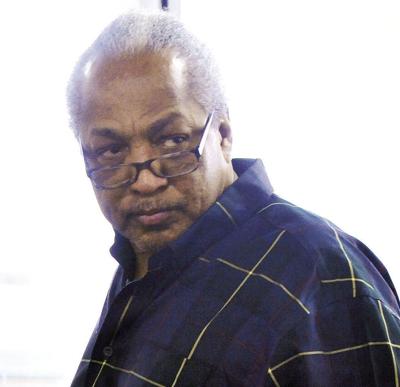
The Idaho Supreme Court has overturned the voluntary manslaughter conviction of a Fort Hall man who in April 2017 was found guilty in the June 2009 beating death of a Pocatello bar bouncer.
A unanimous Idaho Supreme Court opinion released Monday vacates the voluntary manslaughter charge and 15-year prison sentence against Martin Edmo Ish, 62, in connection to the killing of Eugene Lorne Red Elk, a 56-year-old bouncer at Duffy’s Tavern in Pocatello, and remands the case back to the 6th District Court in Bannock County for a new trial.
Among myriad issues raised in the appeal, the Idaho Supreme Court opined that a ruling from David C. Nye — the former 6th District Judge who handled the case and is now a chief U.S. district judge — finding prosecutors did not remove a potential juror with discriminatory intent was “unsupported by substantial, competent evidence and … clearly erroneous.”
Eric D. Frederickson, the state appellate public defender in Boise who handled Ish’s appeal said he was “happy with the Idaho Supreme Court’s opinion” but declined to comment further on the ruling until the case is fully adjudicated.
Bannock County Prosecutor Steve Herzog, who handled Ish’s case, said he was “disappointed” about the ruling, adding that his office “has every intention of retrying the case” in a written statement provided to the Idaho State Journal Monday evening.
“While The Bannock County Prosecutor’s Office is disappointed in the decision of the Idaho Supreme Court in remanding State v. Ish for a new trial, I respect the court’s analysis and decision,” Herzog said in the statement. “This was a particularly difficult case to try, in large part due to the fact the death of Mr. Red Elk occurred in June 2009 and the trial took place years later, in April 2017.”
Herzog added it was “worth pointing out the (Idaho Supreme) Court’s decision was based on technical errors made during jury selection and not upon the merits of the evidence.” Aside from asking for full measures of respect and privacy for the Red Elk family, Herzog said comments from his office regarding the Ish case will be limited due to the active and ongoing nature of the case.
The facts of the case state that on the evening of June 14, 2009, Ish and some friends were bar hopping in Pocatello. At one point, Ish’s group patronized the Bourbon Barrel until the staff ordered Ish to leave after a confrontation with bar staff. Ish’s friends took him a few blocks down the road to Duffy’s Tavern and then returned to the Bourbon Barrel. When Bourbon Barrel staff learned of Ish’s whereabouts, they phoned Duffy’s Tavern to inform them of Ish’s actions earlier that evening.
Upon receiving the call, Red Elk, who was working as a bouncer that night, asked Ish to leave the bar and Ish complied. A short time later, Red Elk left the bar to visit his girlfriend. A patron drove up to Duffy’s Tavern and found Red Elk lying in the parking lot gurgling blood. She alerted the bar, the police were called and an investigation followed. Red Elk was taken to the local emergency room where it was determined that he had suffered a brain injury from blunt-force trauma to the head. He was transported by air ambulance to a medical center in Idaho Falls for surgery and died three days later.
At Duffy’s Tavern, police interviewed patrons and employees. They also obtained surveillance footage from inside of the bar. In the weeks and months that followed, Ish was a suspect but the police also investigated the possibility that Red Elk was struck by an automobile.
The police investigation into Red Elk’s death went cold until almost six years later when, in 2015, two witnesses contacted the police.
One witness testified that the morning following Red Elk’s injury, Ish admitted that he “blasted” Red Elk and he “was pretty sure he killed him because he was lying there gurgling.” With the new witnesses, the state filed a complaint in June 2015 charging Ish with first-degree murder. The state later amended the charge to second-degree murder and alleged that Ish struck Red Elk in the head with a blunt object.
A jury convicted Ish of the lesser charge of voluntary manslaughter after 12 hours of deliberation following a trial that lasted 10 days.
The ruling the Idaho Supreme Court found erroneous was in connection with what’s called a Batson challenge that Ish’s 6th District public defender, Randall Schulthies, who has since retired, filed following the jury selection process and before the jury was officially seated.
According to Cornell Law School, a Batson challenge is an objection to the validity of a peremptory challenge (a defendant’s or lawyer’s objection to a proposed juror, made without needing to give a reason) on grounds that the other party used it to exclude a potential juror based on race, ethnicity or sex.
Schulthies argued in the Batson challenge that state prosecutors were discriminatory when they used six of its 12 peremptory challenges to strike all six remaining minority jurors from the pool of potential jurors.
The 1991 Hernandez v. New York and 1993 State v. Araiza case law establishes the procedure for a Batson challenge, which follows a three-step process designed to “permit prompt rulings on objections to peremptory challenges without substantial disruption of the jury selection process.”
The first step of a Batson challenge involves a defendant developing a defense supported by evidence showing a peremptory challenge has been exercised with discriminatory intent. Second, if that showing has been made, the prosecution “must come forward with a racially neutral explanation for challenging the prospective juror.” And lastly, the trial court must “determine whether the explanation offered by the state overcomes the inference of discrimination established by the defendant’s evidence-supported defense argument.
The moving party, Ish and his lawyers in this case, “bears the ultimate burden of persuasion and must show that purposeful discrimination was, in fact, the basis for use of the peremptory challenge.”
Ish’s attorney filed the appeal to the Idaho Supreme Court after the district court, Nye in this case, denied Ish’s Batson challenge. Nye had ruled that the prosecution did not strike the six jurors with discriminatory intent.
Batson’s third step, however, requires the district court to evaluate the prosecutor’s credibility to determine whether to accept the prosecutor’s reason or whether it is simply masking discriminatory intent.
In its opinion, the Idaho Supreme Court did not find the six peremptory challenges of the only six minority jurors as discriminatory on their own standing, but rather found the reasoning provided by state prosecutors coupled with the determination of Nye regarding that reasoning to be erroneous.
Most of that erroneous reasoning centered on the fact that state prosecutors cited reasoning for removing a minority potential juror that Schulthies had first used to bolster an argument to remove that juror for good cause because that individual had been exposed to the case via social media.
Nye denied Schulthies’ motion asking for the dismissal of that juror based on good cause but ruled that same reasoning, when provided as support for the prosecution’s peremptory challenge, was not discriminatory.
While the reasoning state prosecutors provided to remove the juror would typically be race-neutral on its own, and therefore not discriminatory, such reasoning was what prosecutors had used earlier to try and prevent Schulthies from removing the juror, which presented the Idaho Supreme Court with a pretext of racial bias, according to the opinion released Monday.
“We determine that, under controlling authority and in light of all the circumstances surrounding the strike of Juror 3, the district court’s finding that the prosecution did not strike Juror 3 with discriminatory intent is clearly erroneous,” the Idaho Supreme Court opinion on Ish’s appeal states. “As this amounts to structural error, we vacate the judgment of conviction and sentence and remand for further proceedings.”
Among the other issues raised in the appeal, the Idaho Supreme Court sided against Ish, finding Nye did not err in determining the destruction of a VHS surveillance tape was not the result of bad faith by state prosecutors, nor did he err when deciding to quash a subpoena Ish’s attorney filed after trial requesting the prosecution’s jury selection notes. Those rulings were moot, however, following the order to vacate the conviction and initiate a new trial, the Idaho Supreme Court said in its decision.
Herzog could not provide a timeline for when Ish’s new trial will commence.
Ish is currently incarcerated at the South Idaho Correctional Institution in Kuna on both the voluntary manslaughter conviction and for violating his parole related to a 2011 drug possession conviction. His first parole hearing was scheduled for June 2027.

(0) comments
Welcome to the discussion.
Log In