


POCATELLO — The number 222 has always been lucky to Rich Kirkham and his family.
Rich, a 66-year-old Pocatello businessman, explained it was his father Dale’s lucky day when he was assigned to the smallest class of ship in the Navy — the ship’s number was 222 — after enlisting to serve in World War II.
“He survived the war and he felt like the ship was good luck,” Rich said of his late father, who died in 2012.
In recognition of the family’s lucky number, Rich and his 35-year-old son, Rob, chose to retrace Dale’s path from WWII and to spend Feb. 22 — 2-22-22 — at Tanapag Harbor on the island of Saipan, where Dale’s ship was moored when it wasn’t in action during the war.
Rich and Rob also visited the runway on the nearly deserted island of Tinian where the B-29 Superfortress bomber Enola Gay launched prior to dropping a uranium bomb code-named Little Boy on Hiroshima, Japan, ushering in the nuclear age. It was a timely visit, given that the Russian invasion of Ukraine has brought fears of nuclear warfare back into the public consciousness.
“They did believe it would end the war and they were right,” Rich said. “It was a tragic thing that we entered the nuclear age, but it did end the war.”
Dale was raised on a farm in Lehi, Utah. He was a junior in high school when Pearl Harbor was bombed.
“His whole senior year was focused on where everybody was going to go, where they were going to fight and that sort of thing,” Rich said. “After he graduated he and a friend enlisted in the Navy.”
Dale chose to enlist as a mechanic, reasoning he’d learn a marketable skill. Dale left San Francisco Bay on a troop transport in March 1944, wondering as he departed if he’d ever return home and who would take care of the farm if he didn’t. It was the first time he’d ever seen the ocean.
He was sent to Guadalcanal — the site of an especially bloody battle — but the island was secured before he arrived. He was then assigned to ship No. 222, which was a landing craft used to transport troops to the front lines. His ship would sometimes deliver Marines to beach landings so close to the action that Dale could hear fighting from within the trees. Fortunately, however, the ship never engaged in any light combat.
Dale served aboard the ship, with no air conditioning or refrigeration, for two and a half years.
“They traveled throughout the Pacific on assignment wherever they needed to transport troops. That was their primary mission,” Rich said, explaining the Allies eventually chased the Japanese from the South Pacific to the North Pacific, securing one island after another.
They ultimately reached the Mariana Islands. The ship also escorted U.S. submarines, as it was hard for airmen to distinguish the Japanese subs from the American subs. They also picked up downed airmen.
After the war, Dale went to school at Brigham Young University in Provo, Utah, on the GI Bill and then moved to Pocatello to start an auto parts store with his brother, Reed. In Pocatello, Dale met his future wife, Bodell Smith. He later branched out on his own and started another auto parts store, called Dale’s Auto Supply. He later started a company specializing in buying wrecked cars and used equipment called Contractor Sales, which his family still operates.
Dale loved the Pacific Islands and went back to visit them with a friend in 1972, but he never made the trip with his sons.
In 2002, Rich and his family obtained the log books from Dale’s ship through the Department of the Navy and began creating a diary of where he was every day of the war. Dale was interested in the project and repeatedly asked Rich, “When do I get to Iwo Jima?” The diary was invaluable in planning the itinerary for their recent trip.
“I was lucky that I had a dad who would talk about the war,” Rich said. “Most of the men who fought in World War II in my experience were not very open about it, and they didn’t share with their family the lessons they learned.”
Rich explained the primary lesson his father took home from the war was that America is worth preserving and worth dying to protect.
While traveling from Feb. 14-28 in the North Pacific, Rich and Rob got to see war machinery on certain islands that hasn’t moved since the days when Dale served there. Many islands were closed because of COVID-19, but they managed to visit Pearl Harbor in Hawaii, Guam, Saipan and Tinian.
Guam is large and boasts a great deal of tourism. They found Saipan, which has about 50,000 people, to be more laid back. Relics from the war were everywhere on Saipan.
“A couple of days before we came home my son and I swam the beach from Saipan out to two American tanks that were out in the water, I would say 1,500 feet out in the reef,” Rich recalled. “They were unloaded from ships and never made it to shore. They’re still there.
“When you go and touch a piece of World War II and it’s still complete and the tracks are still on them, you realize, ‘Wow, there were so many people who didn’t come home.’”
On the north end of Saipan, he and his son visited the famous Suicide Cliffs, where many Japanese service members and civilians chose to jump — some holding infant children — rather than be captured in the final days of a horrific battle. The father and son also met some Japanese people honoring their ancestors. Rich felt glad that Americans and Japanese can be friends today.
“I’ve got as close to (WWII) as I’ve probably ever been and it made it meaningful to be that close,” Rich said. “After 75 years to still see guns and weapons rusting there and bomb shelters, all fading into the jungle now, we shouldn’t forget it.”
While in Saipan, Rich, who is a Rotarian, spoke to a local Rotary Club about his trip. The Rotarians there told him about Don A. Farrell, who lives on Tinian and authored the book “Tinian and the Bomb.”
On the same day that Rich spoke to Rotary, he and Rob ventured to the site in Saipan where his father’s ship was moored and they took a photograph 22 seconds after the clock struck 2:22 p.m. Fittingly, it was a Tuesday.
Tinian is roughly the same size as Saipan, but fewer than 2,000 people live there. On the island, Rich and Rob sought out Farrell, who gave them a tour of the historic sites. They saw the four runways where a bomber would launch every minute during WWII. Dale was on the island when the Enola Gay made its historic flight. Farrell also took them to the bomb pits where the atomic bomb was loaded.
Rich explained Farrell, a longtime resident of Tinian, wrote a grant through the University of Guam to do research in Washington, D.C., on the Tinian files pertaining to Tinian’s history and the Manhattan Project that developed the atomic bomb.
“He opened up these boxes that had not been opened for 60 years and started laying it all out and photocopied everything in those boxes,” Rich said of the research that resulted in Farrell’s acclaimed 450-page book.
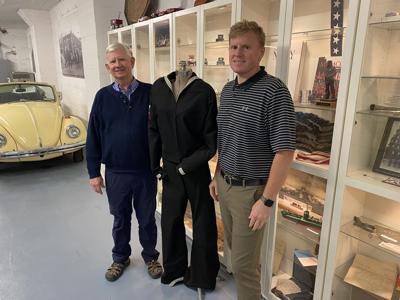
Rob and Rich both work for the company that Dale started, Dales Inc. The family has also made a small museum in Dale’s honor in a building they own in Pocatello’s warehouse district, where Dale’s uniform and other artifacts from WWII and Dale’s past are on display.
“We here are disconnected from a lot of war because we’ve never had war and traces of war in our own backyard,” Rob said. “On Guam and in Saipan you can’t go more than a couple of miles without running into some evidence that there was a war there.”
Rob explained the trip was a great way to honor Dale’s memory, but he emphasized that the best way to remember his grandfather is by espousing the virtues that Dale held dear.

(0) comments
Welcome to the discussion.
Log In