

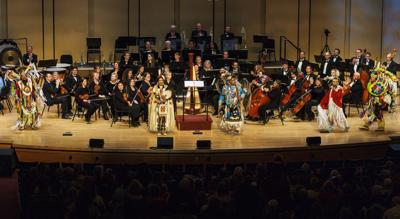
The Idaho State-Civic Symphony ushered in Native American Heritage Month with “Songs of the Land,” a stunning collaborative evening of Shoshone-Bannock drummers, dancers, internationally acclaimed flutist and composer Hovia Edwards and the music of Béla Bartók.
Symphony Conductor and Artistic Director Dr. Nell Flanders designed the evening to include, meld and celebrate tribal and western cultures. In fact, the evening began with a welcome from both nations. The event was held on Nov. 2 at Idaho State University’s Stephens Performing Arts Center.
After Idaho State-Civic Symphony Executive Director Logan Anderson formally began the evening, Flanders read an official Idaho State University Land Acknowledgment statement which declared, “We acknowledge the Fort Hall Shoshone and Bannock peoples, their elders past and present, their future generations, and all Indigenous peoples, including those upon whose land the University is located. We offer gratitude for the land itself and the original caretakers of it.”
She was followed by Shoshone-Bannock Tribal Chairman Lee Juan Tendoy who welcomed the audience with an on-the-spot improvised song, sung in both languages and accompanied with a hand drum.
The native portion of the evening was explained by Dustina Abrahamson of the Lemhi Shoshone Tribe. She began by introducing the Ghost Canyon Drum Group who sat in a drum circle on stage and provided the music to bring the dancers down the aisles to the stage.
All dancers were dressed in full regalia which were hand crafted and often passed down from ancestors. Beaded images, fringed shawls, feathered headdresses and tail feathers created a colorful backdrop to their performances.
Each dancer demonstrated a different style of dancing, beginning with Leela Abrahamson’s Women’s Traditional Dance of slow and elegant movements. That was followed by James Tone’s Men’s Traditional Dance which told stories of hunting and conquest in a measured and majestic rhythm.
The newer dance styles came next and included Raliah Marshall’s Teen Girls Fancy Shawl Dance. With outstretched arms, spreading her fringed shawl like wings, she twirled and floated like a butterfly in flight. She was followed by father and son dancers, Hunter and Wrendon Osborne who performed the Men’s Fancy Dance. They dramatically and energetically told conquest stories through prancing, squats, spins and shooting poses.
The next portion of the evening is when the two cultures melded. In native dress, Hovia Edwards joined the orchestra and together they performed her composition “Farewell” which included brief solo flute passages and a duet with Harpist Jessica Andersen.
Hovia’s name, whose heritage is of the Shoshone-Navajo-Okanogan tribes, means “song” or “music” in Shoshone. Though she lives in Fort Hall, her music and performances have impressed audiences internationally. At this performance, her quietly haunting, sad and yet sweet composition left the crowd stunned with scattered whispers of “wow,” followed by a standing ovation.
Though Edwards composed “Farewell,” she didn’t write the score for the orchestra. In fact, she doesn’t read music. Instead, she sent an audio tape of the piece to Seattle composer Justin Ralls who transcribed it and added the orchestral parts.
Ralls has been working with Rose Ann Abrahamson, a descendent of Sacajawea’s brother, to compose the opera “Nu Nah-Hup: Sacajawea’s Story.” “Nu Nah-Hup” translates to “as it happened to me.” With Abrahamson’s insight, they are writing Sacajawea’s story from Sacajawea’s own point of view.
After two years of collaboration, the opera is nearing completion with “Farewell” being an interlude in the final act. Though Edwards originally wrote this song reflecting her own point of change, it is a fitting expression of Sacajawea’s farewell with her son who was adopted and raised by William Clark.
The Western portion of the evening was the symphony’s performance of “Concerto for Orchestra,” a five-part concerto that weaves Béla Bartók’s own beloved Hungarian traditional music with classical instrumentation. A traditional concerto features one virtuoso soloist, but in this non-conventional concerto, Bartók wrote demanding orchestra section “solos’ instead, thus creating an orchestral concerto. This piece was Bartók’s last composition before he died of leukemia in America, far from his homeland.
Common points between the two cultures could be felt with the richness of both cultures being shared — one through drums, dances and flutes and the other with strings, horns and surprising humous musical quirks. Also, both cultures’ music have a constant musical foundation flowing throughout each song or movement. In native music, the traditional structure comes from the steady drumbeat that symbolizes the earth’s heartbeat. In the western tradition, this structure is the background of the various string instruments that create a unifying voice.
The symphony’s 2024-25 theme for the season is “Echoes of Time and Place.” Their goal of “exploring the way that music can evoke and honor people and places dear to us” was clearly achieved with “Songs of the Land.”
Conductor Flanders said the collaboration “opened our ears, eyes and hearts to the beauty and richness of our local Native American culture. We hope it will be the first of many such collaborations.”
The goal of including the Tribes will continue at the next concert, “Joy to the World,” on Friday and Saturday nights, Dec. 6 and 7. Once again there will be free admission to members of the Shoshone-Bannock Tribes — another opportunity to bring the two cultures together for an evening of music.

(0) comments
Welcome to the discussion.
Log In