

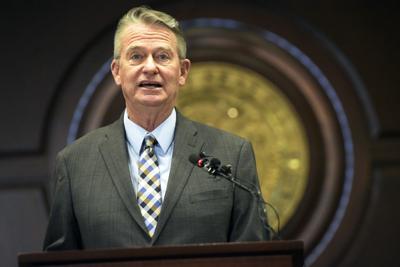
BOISE — Gov. Brad Little announced Monday that Idaho will move back to Stage 3 of its reopening, after remaining in Stage 4 since June, because of the spread of the coronavirus and “alarming” capacity questions at Idaho hospitals. The governor stopped short of issuing a statewide mask mandate, though health officials in several parts of the state have been pleading for one.
“Hospitals throughout the state are quickly filling up or are already full with COVID-19 patients and other patients, and way too many health care workers are out sick with COVID-19,” Little said.
The governor issued a new Stage 3 public health order, which limits indoor gatherings to 50 people or less; limits outdoor gatherings to 25 percent of capacity; requires physical distancing at gatherings of all types; requires masks on the premises of long-term care facilities; encourages employers to protect at-risk employees by offering telework or other accommodations; and allows bars and restaurants to operate only for seated customers at tables.
Little declared that Idaho’s economy “remains open.”
Though the state has been in Stage 4 of reopening since June 13 — allowing virtually all businesses to reopen, as long as precautions are followed — Ada County was moved back into Stage 3 on June 23 by the local health district, due to community spread of the COVID-19 virus.
Idaho has reported 60,041 cases of COVID-19 as of Monday night. Ada, Canyon and Kootenai, Bonneville and Twin Falls Counties have added more than 2,000 cases combined from Oct. 18 to Oct. 24. Idaho is averaging 46 COVID-19 cases per 100,000 people statewide as Oct. 24, up from 37 per 100,000 a week earlier.
On Monday, Southeastern Idaho Public Health reported 129 new confirmed and probable cases, as well as six additional deaths. The new cases brought the region’s total number of cases to 5,207 since the pandemic’s start. Regarding the deaths, three were Bannock County residents. One was a woman in her 100s, one was a female in her 50s and the third was a man in his 60s. Two deaths occurred in Bingham County. One was a man in his 60s and another was a woman in her 70s. A Franklin County woman in her 60s also died.
“I sincerely hope that some people have finally passed the point of thinking the pandemic is not real or not a big deal,” the governor said, “or that their personal actions don’t really affect anything. We have seen the direct impact between rising case numbers in our communities and the overwhelming impacts on our health care system, something that affects all of us, whether we have COVID or not.”
With the COVID-19 pandemic swelling across Idaho and hospitals in at least two regions of the state nearing or exceeding capacity, there’s been an increasing focus on the state’s approach to the pandemic, in which it has for months left decisions to local health districts, counties and mayors across the state.
Concerns about hospital staffing and capacity are mounting in East Idaho, a state hotspot, as hospitals in neighboring state of Utah brace for the worst.
“In Eastern Idaho, patients requiring specialized or critical care may be unable to access the care they need because hospitals in Utah are facing an equally dangerous situation,” Little said. “Utah hospitals are reporting a record number of COVID hospitalizations and will not be able to accept patients from Idaho.”
The Salt Lake Tribune reported Sunday that Utah hospitals are preparing to enter crisis standards of care and ration sparse remaining health care resources between patients.
Last Thursday, a representative for East Idaho’s largest hospital told health officials that total patient counts are high, but manageable, weeks after hospitals said their staff resources were being strained treating a rise in virus cases.
“We’re seeing patients from all over the region right now,” said David Hoffenberg, chief operations officer at Eastern Idaho Regional Medical Center. He said the hospital has focused on improving staffing, and that it is “in a much better position than” before.
While staffing levels are improving, hospital officials are asking area residents to follow health guidelines to help slow the spread of the novel coronavirus.
“We have hired 150 people in the last three months, which has helped with staffing,” Coleen Niemann, EIRMC’s director of marketing, told the Post Register on Monday via text. “However, the number of admissions to EIRMC for COVID-19 has remained consistently high for weeks. We continue to ask our community to practice measures that will reduce spread — and therefore, hospitalizations.”
In the past week, the South Central Public Health District board in Twin Falls voted to request the governor to impose a statewide mask mandate, but voted against imposing such a mandate in its own district — even as local hospital officials asked the board to take action.
In North Idaho, Panhandle Health District board members voted to lift a mask mandate in Kootenai County, at the same time they moved the county into the “red” zone for coronavirus spread and the local hospital hit capacity. One board member said he doesn’t believe COVID-19 really is making people sick.
About a dozen protesters who refused to wear masks were in the hallway outside the Lincoln Auditorium as the governor announced the move; a line of Idaho State Police troopers prevented any of them from entering the auditorium. The governor’s press conference was open only to credentialed members of the news media and masks were required.
Post Register health care reporter Kyle Pfannenstiel contributed to this article.



(0) comments
Welcome to the discussion.
Log In