

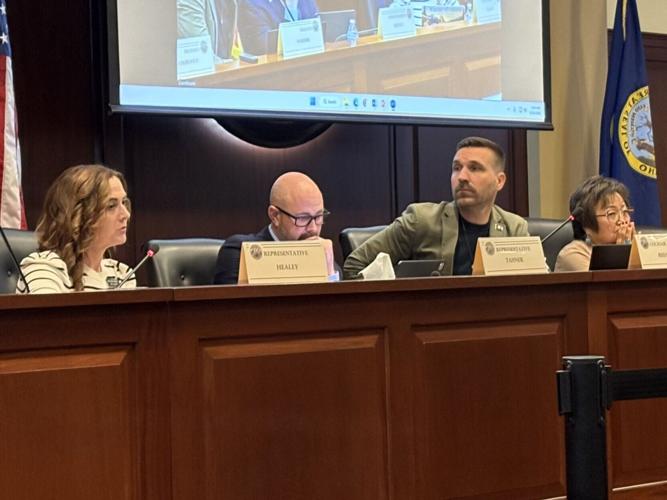




Boise Rep. Dori Healey (left) raises questions about a rural health grant aimed at rural school districts. The legislature’s Rural Health Transformation Committee voted to move funding away from the program Friday, citing unresolved policy concerns.
BOISE — Idaho Legislators voted Friday to reallocate federal funds away from a grant opportunity that would provide funds for mental and behavioral health infrastructure for rural school districts.
Friday’s meeting of the Rural Health Transformation Committee was scheduled to be a status update and look-ahead as final award deadlines are approaching to distribute a $186 million federal award from the Rural Health Transformation Program (RHTP), a five-year initiative created by last year’s One Big Beautiful Bill.
The focus of the bulk of the meeting ended up being far narrower, as legislators honed in on one of the more than 20 subgrant opportunities available through this year’s RHTP.
Sen. Camille Blaylock, R-Caldwell, brought to the committee’s attention a subgrant funding infrastructure and remodeling for rural school districts to integrate “school-based family support hubs.” These facilities seek to provide mental and behavioral health services for students and their families through telehealth and in-person offerings.
The subgrant would have provided up to $6 million over five years and spread across as many as 15 awardees. Because the grant was limited to infrastructure and remodeling, the programming implementation and surrounding policies for these services would remain up to the schools themselves.
Idaho Department of Health and Welfare Director Juliet Charron said 10 school districts had already applied for the funding that would have allowed recipient school district to relieve burdens on working parents who may have difficulty picking up their child for an appointment in the middle of the day, or may lack a behavioral health provider within the community in the first place.
A key concern of committee members stemmed from 2024’s House Bill 684, which sought to establish explicit guidance for behavioral health services on public school premises and ended up dying in committee. At the time the bill was being debated, Idaho Ed News reported bill sponsor Rep. Dori Healey, R-Boise, described the impetus for the legislation was addressing a lack of liability protections within Idaho law.
Though some schools had already implemented their own telehealth offerings, Healey had said others were wary about opening themselves up to legal issues in choosing to do so, Ed News reported.
Charron repeatedly stressed the subgrant did not create a new program or tread into an area that wasn’t already subject to Idaho law; rather, it merely served to facilitate remodels needed to offer certain health services.
“It was never the intent of the department to stand up any sort of new program,” Charron said. “… These were services that are being delivered and had been delivered back to (2024, 2023) and before.”

Juliet Charron
As for the subgrant’s permissibility under current statute, Charron noted Idaho’s 2023 Virtual Care Access Act already provides a legal framework for administering telehealth services across the state. West Ada represents one school district offering a variety of health services at present, including in telehealth.
St. Luke’s offers several integrated, school-based services for pediatric healthcare, and the Blue Cross of Idaho Foundation has offered consultation services for schools for several years to establish on-site mental health counseling so “parents don’t have to miss work to get kids to appointments,” a barrier the subgrant aims to address.
Charron also pointed to Idaho Medicaid already funding a wide range of in-school services — including for behavioral health — through its Medicaid School-Based Services program. In this case, participating school districts and charter schools can enroll as Medicaid providers and be reimbursed for the school-based services provided to Medicaid recipients.
The language in the subgrant application further reinforced any action taken in this realm must be in compliance with existing state statute, including Idaho’s parental consent law dictating healthcare providers and schools must obtain permission to administer non-emergency health-related services. This wide-reaching law was notably not yet effective when legislators were previously considering the aforementioned school telehealth access bill.

Sen. Camille Blaylock
Blaylock said she was open to revisiting the school funding opportunity in the second year of the federal grant after the legislature reconvenes to pass legislation with “some additional safeguards that are not in law today.”
“I worry that we are overstepping here just because we have this funding opportunity to create these spaces,” Blaylock said, “when elected officials just two years ago said no.”
With the exception of Sen. Mark Harris, R-Soda Springs, legislators voted in favor of moving $1.2 million in funds from the school-based health hubs to a $97 million Healthcare Infrastructure Support subgrant. Charron said the larger grant has received more than 250 applications seeking over $200 million in funding.
To incorporate this change, Charron said IDHW will need to update its plan with the Centers for Medicare & Medicaid Services (CMS), which is administering the rural health funding program, and the legislative committee will have until Oct. 30 to obligate the total $197 million funding award.
Meeting this deadline is crucial because states that don’t obligate their RHTP allocations could have unused funds redistributed elsewhere and reduce their maximum award for the subsequent year. The amount of funding Idaho will receive for the federal program’s second year is anticipated to arrive in November or early December, Charron said.
Discussion around reallocating portions of the next year’s round of funding are expected to take place at the next committee meeting on Nov. 19.


(0) comments
Welcome to the discussion.
Log In