

BOISE — Idaho Congressman Russ Fulcher co-sponsored new federal privacy legislation this week amid a growing backlash against surveillance technology in Idaho and across the country.
The bill will require federal law enforcement agencies to obtain warrants from a federal judge before accessing, queuing or receiving surveillance data that are collected by local surveillance systems, including automated license plate readers (ALPRs), cameras capturing a vehicle’s occupants, long-range microphones and electronic fingerprint detection.
Additional technology can be included as determined by the United States Attorney General as part of a periodic review occurring at least every 90 days.
In an interview Thursday, Fulcher described the core objectives of the legislation as being two-fold: It requires the federal law enforcement to get a warrant to access data collected by states and localities, and it bars federal funds from being used to purchase, acquire or install any of the surveillance technologies on list maintained by the Attorney General.
Limited exceptions to warrant requirements are in place for cases of “imminent danger of death or serious physical injury” when immediate acquisition of surveillance data is required and “obtaining a warrant is impracticable.”
Federal agencies that acquire any of the impacted forms of surveillance data will have to document the acquisition of the data within 24 hours and dispose of the data within 30 days. The court issuing the warrant can extend data retention for 90 days or in cases where the data “constitutes evidence in an ongoing prosecution for which charges have been filed.” In the event of the latter, the data retained has to be limited to prosecutorial needs, the bill states.
The attorney general will also be required to submit a report to Congress detailing the prior 180-day period including the number of incidents where federal law enforcement accessed local surveillance data, the number of warrants issued to access the data and the number of emergency exceptions used, including their justifications and outcome.
The report will also mention any instance when federal law enforcement improperly obtained surveillance data without a warrant or retained surveillance data longer than permitted and note corrective actions taken by violating agencies.
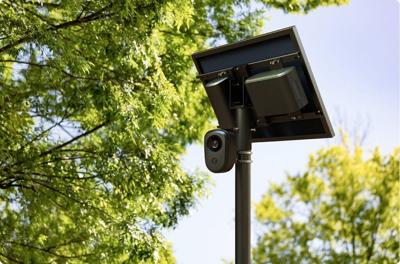
The federal legislation was initially introduced July 15 and arrives as Flock cameras and similar surveillance technologies have drawn increased scrutiny in Idaho and nationwide. In recent monthsm city councils in the the Treasure Valley have been met with widespread opposition to installing ALPRs, which can serve a range of purposes including capturing license plate numbers or sharing GPS data with law enforcement.
In July, the Idaho Press reported nearly 100 attended a Caldwell city council meeting to voice concerns about privacy and government overreach after the city had approved spending taxpayer dollars on Flock cameras. In the case of the Flock cameras, police are able to use collected data to conduct searches for plates and receive alerts when observing particular vehicles.
July also saw pushback against Axon, another ALPR provider that contracts with the city of Meridian. In that council meeting, dozens spoke out against the city’s use of the technology.
In the case of Nampa, the city uses ALPRs from Motorola and Rekor, and drew mixed feedback from a Nampa Police Department open house earlier this week, according to a report from Idaho News 6.
Though the ALPR vendor differs across these cities, each type of camera make some form of AI-assistance available to users.
In a Thursday interview, Fulcher said his decision to co-sponsor the 2026 Protection Rights in Video and Equipment Acquired Discovery (PRIVACY) Act stemmed from constituents ranking data privacy as a top two concern based on polling conducted by Fulcher’s office.
Fulcher described concerns over data privacy as having been “bubbling under the surface” for some time now as concerns about social media, cellphone and car data collection have spread more widely. He said recent months have seen the matter “come to a head” as a result of Flock cameras and similar surveillance technologies proliferating nationally at a rapid clip.
“That seemed to push constituents over the edge,” Fulcher said.
According to a blog post from Flock in June, there are more than 120,000 Flock cameras in operation across 49 states.
Fulcher noted the legislation could result in pushback from impacted law enforcement agencies, as the surveillance technologies have been utilized to successfully track and apprehend criminal suspects.
“What comes with (the technology) is the abuse concerns and that’s what this (bill) is attempting to address … because law enforcement is not perfect,” Fulcher said, adding that there were already “numerous” instances of personnel misusing surveillance systems.
As one example of this misuse, KMVT reported in March that Jerome County Sheriff George Oppedyk had used Flock cameras to search for his wife’s vehicle “hundreds of times.”
Activist group DeFlock Idaho also found outside law enforcement agencies had accessed the Twin Falls Police Department’s Flock cameras for immigration searches, in direct violation of the department’s policy. Not long after, the department opted to shut off a “Nationwide Lookup Tool” that had allowed other agencies, including federal law enforcement, to access the city’s camera data, KTVB reported.
Fulcher said a central aim of the legislation is to implement guardrails on surveillance technology in a way that does’t preclude localities from adopting their own policies, as has already been observed in Idaho.
The Idaho Legislature previously passed limits on ALPR technology through Senate Bill 1180. That law limits the use of automated license plate readers in the state, requiring that they only be used to investigate felonies, misdemeanors and missing persons. It also made explicit the cameras could not be used to enforce traffic infractions outside of when they are associated with traffic accidents.
The traffic-oriented change ended up bringing an end to Boise’s red light camera effort, as previously reported by the Idaho Press.
“I was a state legislator for 10 years, and one thing that was irritating as a state legislator was when the federal government came in and tried to override everything we did locally,” Fulcher said. “... I don’t want to be that guy. ... The people of Idaho put me in a federal spot, so I’m trying to stay in my lane.”
The legislation has received a positive reception from the American Civil Liberties Union, a civil rights organization that has described Flock cameras and similar technologies as a “major civil liberties threat” and supported litigation challenging whether ALPRs run awry of Fourth Amendment privacy protections.
In an interview Thursday, Kia Hamadanchu, senior policy counsel for the ACLU, described the PRIVACY Act as an “excellent piece of legislation” and “a step in the right direction.”
Hamadanchu pointed to the provision stipulating regular reporting of violations to Congress as a key component for accountability. When it comes to surveillance technologies, Hamadanchu said one of the biggest issues is a lack of information and a lack of transparency. With the bill including a civil right of action for individuals to sue violators, there is another avenue for remedy that doesn’t require the government to initiate corrective action to address violations.
“I just want to flag just how how bipartisan this all is,” Hamadanchu said. “... You’re seeing opposition to Flock in some of the reddest place in America, but also in some of the bluest place in America — really, truly across the political spectrum, independent of ideology.”
Fulcher had a similar position on the legislation’s wider appeal.
“They seemed to have made everybody mad — the Republicans, the Democrats — and so they’ve had a really uniting effect,” Fulcher said of the surveillance tech. “Of course, I’m talking tongue-in-cheek, but it’s true — this is a nonpartisan issue.”

(0) comments
Welcome to the discussion.
Log In