

When Beth Huston first heard about the National Eucharistic Congress planned for Indianapolis this summer, she started bugging her pastor, Emil Parafiniuk, to start planning a pilgrimage from their Holy Spirit Parish in Pocatello to the congress.
Little did she know the pilgrimage was going to come to her and her fellow Eastern Idaho Catholics.
“When I heard it was coming through Pocatello, I was just ecstatic,” said Huston, who is chair of the Eastern Deanery committee that is planning activities associated with the national Eucharist Pilgrimage. “I think it’s going to be amazing, beautiful. Pocatello has never done anything like this before. And I think it’s going to be shocking to our neighbors — we don’t have very many Catholic neighbors.”
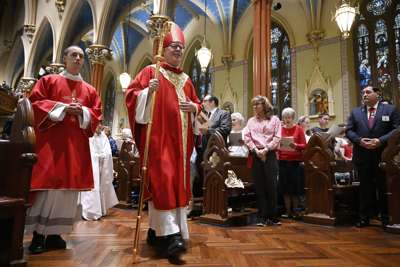
The event consists of a long-planned series of Catholic pilgrimages across the United States, with pilgrims embarking on four routes before converging on Indianapolis in two months for a major gathering focusing on Eucharistic rites and devotions.
The National Eucharistic Pilgrimage is beginning with Masses and other events in California, Connecticut, Minnesota and Texas. A small group of pilgrims plan to walk entire routes, but most participants are expected to take part for smaller segments. Each route goes along country roads and through city centers, with multiple stops at parishes, shrines and other sites.
Although it was forged amid a recent debate among bishops over whether to refuse Communion to U.S. politicians who don’t oppose abortion, the pilgrimage is a revival of a historic Catholic tradition that faded by the mid-20th century.
Each procession is being led by a priest holding a monstrance — typically a sunburst-patterned vessel that displays the host, or bread wafer consecrated by a priest at Mass.
Parafiniuk has been busily communicating with all the communities in the Eastern Deanery, coordinating activities that will take place in Pocatello on May 30-31. The Pocatello portion of the schedule will begin around 4:30 p.m. the evening of May 30, when the Eucharistic Pilgrimage arrives at St. John’s Catholic Student Center on the Idaho State University campus. The Franciscan Sisters of the Eucharist, who live west of Pocatello, will give a presentation at the St. John’s Chapel about the Eucharist and the importance of the event.
Then national and local pilgrims will solemnly process across town to Caldwell Park in downtown Pocatello. Each community from the Eastern Deanery — American Falls, Blackfoot, St. Anthony, Salmon and Soda Springs — has been invited to set up their own temporary altar in the park. There, the Eucharist will be presented at each altar and the priest from each community will bless their faithful.
From the park, the pilgrimage will proceed to St. Anthony’s Chapel, which is several blocks away. There, a private dinner will be held for Bishop Peter Christensen and the national pilgrims, and there are plans for confessions to be heard and testimonies from some of the national pilgrims. Adoration — public exposition of the Blessed Sacrament in the church — will take place until about 8:15 p.m.
The Eucharist will be transferred to St. Joseph’s Chapel on the west side of Pocatello and adoration will take place from 10 p.m. to 6:45 a.m. there, with Mass beginning at 7 a.m. the morning of May 31. The procession will then depart for Preston, where the Eucharist will be transferred to the Bishop from the Salt Lake City Diocese to continue its journey south.
“I think it’s a very important and beautiful element of a Eucharistic revival,” said Parafiniuk. “It will help us all, including priests and lay people, to understand what the Eucharist is — and who the Eucharist is, in our spiritual life.”
While acknowledging that Catholics are definitely a minority in the largely The Church of Latter-day Saints region of East Idaho, Parafiniuk believes the Eucharistic Pilgrimage is a great way to share the Catholic faith with all those living in the area.
“The LDS Church, according to the last research, is about 50 percent of the population,”Parafiniuk said. “You add 5 to 7 percent Catholics, we still have about 40 percent of the people we can address, who we can tell who we are… We need to remind them about our presence because we have a significant number of parishioners… In our parish, we have 1,100 families registered, so Catholics are a significant number in this area.”
Parafiniuk, who is from Poland, experienced a lot of Eucharistic processions in his native country that attracted large gatherings. As a result of that experience, he has been deeply involved in the planning for the Eastern Deanery activities, said Huston.
“He’s planned the canopy, the bells, the musicians, the Knights of Columbus, the cross (for the procession),” said Huston. “He’s going to standardize the altars.”
When asked what message he hopes the Eucharistic Pilgrimage will send to the people of Eastern Idaho, Parafiniuk said: “We believe as Catholics the Eucharist is Christ. And that his words during the Last Supper, they are real words. They mean what Christ is saying: ‘This is My Body.’ That’s why we believe this is His body.”
Even though they cannot receive the Holy Eucharist, Parafiniuk hopes that non-Catholics will be inspired by attending the pilgrimage and consider joining the faith.
“Even if someone is not Catholic and cannot receive the Eucharist, we also invite those people to adore, to participate, and to ask themselves, maybe at some point, you’d like to join us and receive the Eucharist,” he said. “Even if not, in Christianity we learn from our spiritual experiences… This experience can be a community-building experience.”
In order to receive the Eucharist, you must be a Catholic in good standing, meaning in the state of grace with no mortal sins on your soul. If you commit a mortal sin, you can attend confession and be returned to the state of grace.
For Beth Huston, who has also been frustrated that on the Feast of Corpus Christi there hasn’t been a more public celebration of the Eucharist in Pocatello, this event is a once in a lifetime opportunity.
“It means everything,” Huston said. “It’s a wonderful opportunity to be able to process with the public with Our Lord. It just witnesses to His majesty. Our reverence will be our testimony to His glory and majesty. I’m hoping a lot of people will join us.”
The procession is just a part of the value of the pilgrimage, Parafiniuk added.
“For us what’s very important is the preparatory process,” he said. “It’s a community-building process, so we want everyone involved in the preparation… If someone has questions, they can contact Beth Huston or the parish office, and we’ll be happy to provide them answers.

(0) comments
Welcome to the discussion.
Log In