

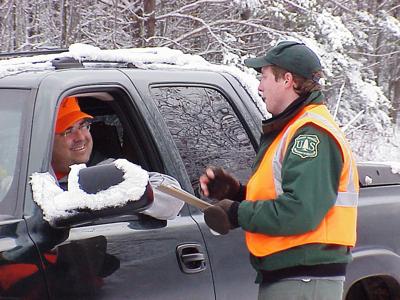
The Caribou-Targhee National Forest wants you to give them an earful.
Starting in October, Forest Service employees and contract workers will set up survey stations for people to give feedback on basic visitor experiences. The National Visitor Use Monitoring survey program will be conducted for the next 12 months in random locations across the forest.
“Although the survey is entirely voluntary, participation is extremely important so we can assess visitor experiences and strive to make it a better place to visit,” said Caribou-Targhee recreation program manager, Kaye Orme. “We would appreciate if visitors would pull over and answer a few questions. It’s important for interviewers to talk with local people using the forest, as well as out-of-area visitors, so all types of visitors are represented in the study.”
Some of the questions include: “Where did you recreate?” “How many people traveled with you?” “How long were you on the forest?” “What other recreation sites did you visit while on the forest?” and “How satisfied are you with the facilities and services provided?” Answers will be kept confidential.
Answers to these and other questions will help the Forest Service tailor its limited resources to areas people are most interested in, such as larger campgrounds, more vault toilets or roads needing attention.
The survey is conducted every five years on the Caribou-Targhee National Forest and helps officials track changing trends in use. Forest officials point to two major things changing in recent years.
“Obviously, we’re seeing an increase in visitor use every year,” said Sarah Wheeler, public affairs officer for the Caribou-Targhee. “We have seen since 10 years ago an increase in motorized use on the forest as well. As technology changes, like side-by-sides becoming more popular, we’ve seen an uptick in that as well. We expect similar results with this (survey).”
Wheeler said changing technology and the popularity of certain recreational uses has caused the Forest Service to adapt.
“The e-bikes are something that obviously didn’t exist a few years ago. We’re going to have to learn how to manage them,” she said. “We managed that as a motorized use and the Department of the Interior came out last week and says they are not. ... Snowmobiling is changing. As snowmobiles get more powerful people are able to access more areas that weren’t possible years ago.”
Backcountry skiing and fat bike usage are other areas Wheeler mentioned as growing in popularity since the Forest Service’s last survey.
“With the onset of social media, people know more and more where those unique places are, and you’re getting more use,” Wheeler said. “With use comes degradation.”
Wheeler said the last survey showed almost 1.5 million visitors using the national forest on a yearly basis. “It will be interesting to see how many more visitors we’ve seen in the last few years,” she said.
Wheeler said the survey will have at least four people out for about 300 days manning stations across the Caribou-Targhee — an area nearly the size of Connecticut.
“It’s pretty time intensive because it is such a big area,” she said. “We’ll be out there in winter when it’s freezing and 10 below out in Island Park and in the sweltering heat in August next year as well. One day we might have someone at Stoddard Creek Campground up in the Dubois area and the next day someone might be down at Big Springs and then the next, someone might be at Minnetonka Cave down in the Montpelier area.”

(0) comments
Welcome to the discussion.
Log In