

BURLEY — The city is disputing allegations made by one of its former mayors that officials violated the Idaho Constitution and dealt favorably with The Church of Jesus Christ of Latter-day Saints because of their religious faith and spiritual affiliations.
The accusations, leveled by former Burley Mayor Jon Anderson, were detailed in a Dec. 15 letter from his attorney, Don Chisholm, to the city.
The letter contended the city violated the state Constitution by entering into a development agreement with the non-taxpaying church and nearby landowners to share the cost of extending water and sewer lines to the site of the LDS Temple and by allowing the church to grant a sole vendor to bid out the work for all owners.
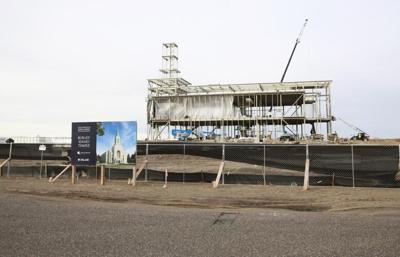
The temple is under construction at the southeast edge of the city.
“This may be a case of temple fever,” Chisholm told the Times-News, pointing out that the city’s manager, attorney and council have strong connections to the LDS church.
“It’s not just Jon who has an interest in this, it’s everybody who is a taxpayer in the city,” Chisholm said.
City officials have pushed back against the allegations, denying claims of religious bias and favoritism.
“It’s just a development agreement and it doesn’t matter that it was with a church,” City Administrator Mark Mitton told the Times-News. “If someone else would have bought that 10 acres (church property), the city would still be involved and bear a certain liability for development.”
City Council member Casey Andersen said the council did not grant any favors to the church through the development agreement.
“I don’t recall it ever being brought up. I mean, I knew the temple was going to be built there, but the biggest thing that came out of the sewer and water project is that a lot of land opened for development,” Andersen said. “It was for public benefit.”
Mitton said sewer infrastructure will initially provide service to 700 acres and, in the future, more than that. About 1,500 homes are planned in the area around the temple, with the actual number depending on lot sizes.
Most of the land was annexed into the city about 18 months ago, prior to the announcement of the temple site, he said.
The complaint will “end up in court” unless city and church officials see “the error of their ways,” Chisholm said in an email to the Times-News.
“What the city has done will have lasting consequences if it is not brought to light and dealt with properly,” he wrote.
Anderson, the complainant, told the Times-News he specifically questions the city’s development agreement regarding the project’s funding.
The letter from Chisholm alleges the city violated the Idaho Constitution when it entered into the Aug. 17 deal to share costs with surrounding landowners, Lisa Funk, LeRoy and Ronda Funk, Carol Fowler, DDBL Investors LLC, and Garth and Patricia Heidel. The church is paying its full share of the costs based on acreage.
The total estimated cost is $1.5 million.
Most of the project has been completed with the exception of one section going to the Heidel property, which will be completed in the spring.
The letter said the city will advance $743,231 for its share and for the shares of private property owners not funding their shares now — and there is no deadline for city repayment and no interest will be charged. The repayment obligation will expire if the properties are not developed in 30 years.
In a letter dated Dec. 18 to District 27 legislators, Chisholm noted “legal irregularities” in the development agreement and questioned the completeness of the legal notice published declaring a sole source for the bidding of the project.
The city responded to Chisholm in a Dec. 19 letter drafted by City Attorney Dave Shirley, contending the project benefits the public because much of the involved property was recently annexed, conceptually planned for hundreds of homes and includes a 72-acre city-owned parcel adjacent to the temple that may become a city recreational complex with a pool.
“The city’s share of the costs is for the city’s benefit, not for a private religious project,” Shirley’s letter said.
The letter also stated that cities are empowered by law to construct and go into debt for these services. In this case, the costs are shared by all of the landowners, including the city, and the church is paying its full share, according to the letter.
The infrastructure, once completed, will be owned by the city, which will receive income from it through hookups and monthly fees, the letter said. The city, at that time, would also assume operation and maintenance costs.
The letter estimated the city’s recovery time for the costs at 10 years.
Mitton said the city is rarely involved in such types of cost sharing, but it is involved this time because of property owned by the city. Burley also shared sewer and water costs when the King’s Warehouse was built on the western edge of the city and when the new U.S. Forest Service building went up on Hiland Avenue.
But Chisholm, in his letter to the city, argued that “cities are not to expend money for public works projects without complying with competitive bidding laws.”
The city, for practical purposes, he contended, made the church a general contractor without allowing licensed public works contractors to bid on the city’s share of the project.
The city’s response letter said that when property owners install their own water and sewer lines, they hire licensed contractors for public works. Because permits and inspections were done in this case, the city accepted the lines into its system.
While the city normally goes through a bidding process for its own projects, in this instance, according to the letter, “it did not make sense for the city and other property owners to try and separate out different parts of the project with different contracts and contractors’ work, ordering parts and economies of scale.”
The council complied with an alternative to the public bidding requirement, the letter said, by declaring the public bidding process would be impractical or disadvantageous because the project cost would be bid out by all the property owners and awarded to the low bidder holding licensure.
The public bidding process was done by the LDS church, which was required to get three bids, Mitton said, and the work will be completed by licensed public works contractors.
“The reason the council made the decision regarding the bidding is it didn’t make economic sense or sense quality-wise to divide it up by half a dozen people,” Casey Andersen said.
The city published a notice regarding its bidding decision in the Times-News on March 7.
That, however, didn’t alleviate Chisholm’s concerns. He said in an email to the Times-News that he was “amazed” that the LDS church was not mentioned in the legal notice, along with the amount to be spent.
“This is a serious matter,” he wrote in this letter. “Oaths of office appear to have been violated.”

(1) comment
Apparently Pocatello isn't the only town in Idaho where the "faithful" make dirty backroom deals. Shocking!
Welcome to the discussion.
Log In