


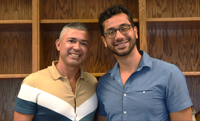
Jason Lee Memorial United Methodist Church’s new pastor Jose Marvel Souza started his life in the rural state of Parana, Brazil, which is known as the potato capital of Brazil.
It took 40 years, but his journey has brought him to another rural county that describes itself as the potato capital of America, Blackfoot, Idaho.
As a young boy, Souza’s family left the rural life to live in Brasilia, the capital of Brazil, where he lived in a Japanese colony, adopting their language and learning their traditions. Not coming from an actively religious household, Souza, on his own, found the Methodist Church in the area and started attending when he was 8 years old.
His courage and dedication were noticed, and a pastor told him, “God has a calling for your life, and I will help you find it.” Over the next five years he learned from and was encouraged by his mentor, eventually seeing his whole family join the congregation.
When Souza was 16, he preached his first sermon as a lay preacher and found that he really liked that role in the church. He started a lay leader course to pursue this passion and later attended a seminary to study theology. Two years later, he was given his first appointment as a provisional elder in a small rural church.
Souza has always lived his life as a gay man and when he was 27 years old, he met Raphael Lire and they began to date. In conservative Brazil, it was only marginally accepted to be gay. To be gay and a member of a church or to hold a position in church leadership was very unusual. What was not tolerated was for him to have a relationship or to be married.
Despite the obstacles, Souza and Lire entered into a marriage contract in 2009, which was followed five years later and after Brazil legalized gay marriage, with an official marriage certificate. Though they are married, they have chosen to keep their own last names. Also, Souza prefers the name Marvel to his first name, Jose. No, his mother wasn’t a fan of the comics, she just liked the unusual name.
During that time and despite persecutions within and without the church, Souza was officially ordained as a minister in the Methodist Church when he was 32 years old. Immediately, he and Raphael began a ministry of reaching out to the LGBTQ communities. To do so they had to hold church underground — covertly meeting.
Souza also began writing, eventually authoring 11 books. The first one was called A Manual for the Christian Gay. The last one was, “Grace Upon Grace: A Commentary Bible,” drawing from his theological studies. It was a typical commentary volume that listed unaltered Bible passages and then made comments on the content.
Ironically, it was the latter book that brought a storm of controversy and physical threats. Even before the book was published, a major Brazilian magazine proclaimed he was writing a new Bible for gay people. For their safety, Souza and Lire moved several times over the next two years. Then, a politician decided that it was his cause to protect the Bible and used their names as an example of the gay threat to their holy scripture.
With most Brazilians against them, Souza and Lire moved to Argentina and continued to minister to the LGBTQ population. There they found a Reconciling Methodist Church to support the work.
The Reconciling Methodist Movement started in America in 1982 and emphasized the inclusion of all people, including the LGBTQ community. They believe in accepting all, affirming their worth and supporting them in their struggles. They have a four-step process of discovering who you are, healing broken relationships due to your identity, connecting again with the physical earth and then reconnecting with God.
The movement has grown until last year when there was a major split in the Methodist Church. The conservative members left the main church and are now the Global Methodist Church. The Jason Lee Methodist Church is part of the remaining main church, known as the United Methodist Church.
Meanwhile, Souza and Lire were in Argentina when Covid hit and they witnessed so many deaths due to the high-risk lives of the trans community. Once again, they fled – this time to Florida.
In America, Souza needs to be a full-time pastor for four years before his Brazilian ordination can be transferred to America. And yet, again it was hard to find a congregation that would accept an openly gay, married pastor. Eventually he found that there were three openings for a pastor in the Reconciled United Methodist Church — one in Blackfoot, Idaho, one in Alaska and one in Tacoma, Washington.
After looking into the options, the one that seemed to fit naturally was to return to the rural potato world in Blackfoot. All ensuing interviews confirmed the welcoming congregation that awaited their arrival.
That feeling of “home” is a key goal of Pastor Souza’s. He knows how it feels to be persecuted and rejected, and he desires to create a safe home space for one and all. He invites everyone to join them on Sundays at 10:30 a.m. at the church with the big Welcome sign located at 168 S. University Ave. in Blackfoot.

(0) comments
Welcome to the discussion.
Log In