

POCATELLO — Testimony that Brad Scott Compher’s fingerprints were located at the Pole Line Road Home where Nori Jones was found dead with over 20 stab wounds in 2004 took center stage during the fifth day of his murder trial on Monday.
Compher, 49, of Pocatello, has been charged with felony first-degree murder for allegedly stabbing the 25-year-old Jones to death on Sept. 28, 2004. His trial is being held at the Bannock County Courthouse in Pocatello.
Three people testified Monday, including current Pocatello police Capt. Bill Collins, former Pocatello police detective Kirk Howe and a now-retired fingerprint technician with the Idaho State Police forensic lab in Meridian, Maria Eguren.
A significant amount of time on Monday was dedicated to reading the transcript of former ISP fingerprint examiner Gary Cushman’s testimony from Compher’s preliminary hearing in April 2015. Cushman was unable to testify during the trial because he died in September 2022.
Eguren testified Monday that she worked as a fingerprint technician for the Idaho State Police both when Jones was murdered in 2004 and when Compher was arrested and charged with her murder in 2014.
She testified that as a part of her job she worked with a system known as AFIS, which stands for Automated Fingerprint Identification System and is essentially a highly sophisticated computer system that electronically encodes, searches and stores the images of fingerprints and palm prints.
Eguren said that as a part of her job she was tasked with submitting latent fingerprints obtained from crime scenes into AFIS.

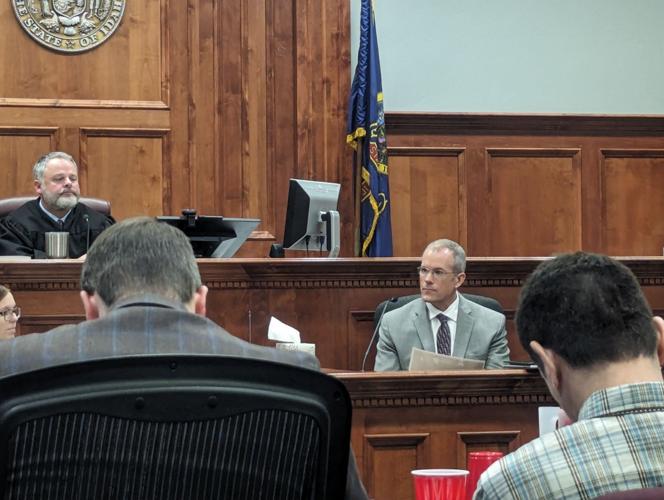
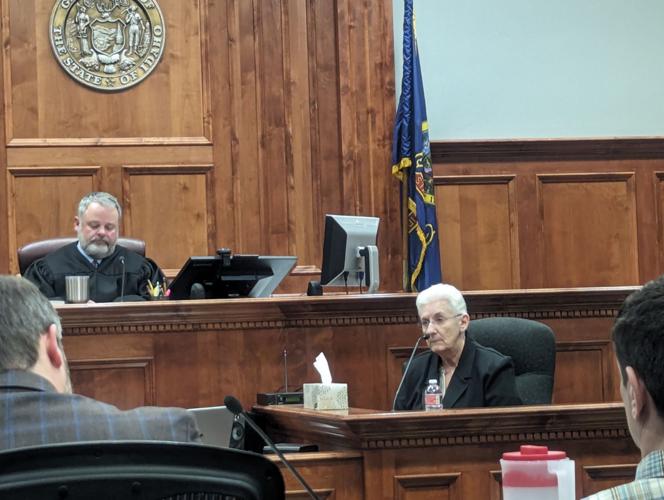
{span}Witness Maria Eguren testifies during the fifth day of the trial for Pocatello man Brad Scott Compher, 49, who is accused of fatally stabbing Nori Jones, 25, to death inside her Pole Line Road home in September 2004.{/span}
Additionally, Eguren testified that she was aware of digital fingerprinting machines known as Live Scan equipment, which many police and sheriff’s offices throughout the country use. When a criminal or person completing a background check has their fingerprints taken on a Live Scan device, those prints are automatically incorporated into the AFIS system, she said.
Eguren also testified that part of her work for the ISP crime lab involved working to confirm potential matches that the AFIS system identifies by looking at various physical characteristics of the fingerprints themselves and looking for consistencies. Eguren would not ultimately determine if two sets of prints were matches, but would indicate how they could be a match and submit her findings to a certified fingerprint examiner, which in this case was Cushman, she said.
Typically, a fingerprint can have about 100 different points, or physical characteristics, Eguren said, adding that two sets of fingerprints that have between 10-15 matching characteristics could be considered possible matches and warrant further examination from a certified examiner.
Eguren said that no two fingerprints are alike.
“Even identical twins don’t have the exact same (fingerprints),” she said.
Eguren testified that in December 2004 and again in November 2010, she was able to confirm that latent fingerprints obtained from the Jones’ crime scene matched fingerprint cards that were at some point obtained from Compher, adding that she marked them as a possible match and submitted them to Cushman for additional analysis.
Cushman during the preliminary hearing in 2015 testified that at least one of the fingerprints located at the crime scene came back as a match belonging to Compher.
Both Howe and Collins testified that they observed scars on Compher’s arms during interactions with him while investigating Jones’ murder. Howe testified that he observed the scars on Compher’s arms on Sept. 10, 2014, while he was serving a detention order against him at Portneuf Medical Center in Pocatello. He said that he found it odd that Compher had gotten a tattoo over one of the scars.

Pocatello police Capt. Bill Collins testifies during the fifth day of the trial for Pocatello man Brad Scott Compher, 49, who is accused of fatally stabbing Nori Jones, 25, to death inside her Pole Line Road home in September 2004.
Collins testified that he observed scars on Compher’s arms when he and a previous testifying witness, former Pocatello police detective Anthony Busch, interviewed Compher at his home in 2011.
During that initial 2011 interview and again years later, Collins said that he asked Compher if he had ever met Jones or been to her residence and during both interviews Compher denied ever meeting her or being at her home.
Collins also testified about interviewing Jones’ boyfriend at the time of her death, Rio Wilde, and his father, within days of her murder, noting that both men volunteered DNA samples and were also photographed extensively. Collins said that he did not observe any potential defensive wounds on Wilde or his father.
Collins also testified about interviewing a different suspect in the case, Robert Spillett, whom he interviewed about a week after Jones’ death. Collins said that he did observe a gash on Spillet’s hand when interviewing him but that Spillett said he received the injury while working on his vehicle, something that Collins said he was able to corroborate by speaking to members of Spillett’s family.
Additional witnesses are expected to testify this week on behalf of the prosecution team, which includes Bannock County Assistant Chief Deputy Prosecutor Jonathan Radford, Chief Civil Deputy Brian Trammell, and JaNiece Price, the homicide and narcotics specialist for the prosecutor’s office.
Those witnesses include pocatello police officers at the time of Jones’ death, including Matt Harris, Scott Long, Val Wadsworth and former Pocatello police officer Steven Westfall.
The defense team, which includes Chief Deputy John Scott Andrew of the Bannock County Public Defender’s Office, contracted attorney Gary Edward Proctor of Baltimore and Bannock County Deputy Public Defender Rilie Fry, could call their first witnesses by the end of the week.
Compher’s trial is expected to last three weeks.
If convicted of the felony first-degree murder charge, Compher faces up to life in prison.



(0) comments
Welcome to the discussion.
Log In