

BLACKFOOT — Chalk art, as an art form, is considered over 500 years old. For Blackfoot it was first mentioned 100 years ago when Maude L. Greene, a chalk artist, came to town. And that is all we know about that event. We don’t even know if she was a screever creating art on sidewalks or more like Leonardo da Vinci or Peter Paul Rubens, who used red, black and white chalk on toned paper for sketch studies.
In the beginning, madonnari, Italian street painters, would draw images of the Madonna on plazas outside of churches during their holy days. They would travel to famous churches to earn a few coins from religious pilgrims.
The street artists, known as screevers, who revived the art in the Victorian age, shifted from religious figures to messages or pictures on pathways for “a copper or two” as the fictional Bert said in Mary Poppins.
About 50 years later, Greene brought some facet of chalk art to Blackfoot. It is a shame we don’t know more about her work or how she was received. What we do know is that the time has come for chalk art in Blackfoot again. This time it will be a patriotic sidewalk chalk contest — thanks to the America250 Committee, the Bingham Arts Council, the city of Blackfoot and the Bingham County Commissioners.
Starting on Friday at 9 a.m., artists from 10 years old to infinity can claim a roughly 5-foot square section of sidewalk on Broadway in Downtown Blackfoot for their “canvas.” They will then have eight hours to create their masterpiece.
The first question a chalk artist needs to answer is what message they want to communicate. Doodling in advance to find the right message and how to use the space effectively is a smart idea. Pencil and paper are a lot easier to design on than chalk and concrete.
One rule of thumb is to put the main message in the middle and add other objects so that the observers’ eyes will naturally flow from one to another and then back to the main one — anchoring the message. Any written words should circle or arch over the main object to keep the eyes focused on the message. Straight lines, including words, tend to lead people’s eyes on to the next picture
Once the design is ready, begin by using white chalk to outline the design features. This is the time to make last-minute changes, and white chalk is much easier to erase as adjustments are made.
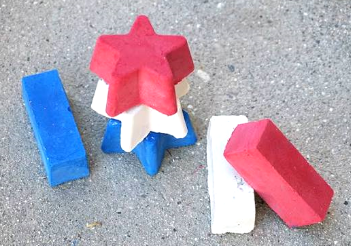
There are countless ways to communicate a message — even with only a few color choices. Using a palette of only red, white, blue and black chalk — provided for free — can sound restrictive, but perhaps there are ways to expand the color options.
For instance, blending colors is allowed. That means pink, light blue, dark blue, purple and gray can be made for more variety. Blending can be done by mixing right on the sidewalk in layers, but it can also be done by grinding down the chalk to a powder, then mixing powders and adding water to form a paint slurry. This makes it easier to control the new color’s tone and hue; it also means bringing a paintbrush and something to grind chalk with. Even with blending, no yellow, green, orange or brown is possible for this contest.
Nevertheless, a lot can be communicated through contrasting colors, using different shades of the same color or using textures. Is it better to leave the chalk rough or smooth it down? Water can make a textural difference.
Sidewalk artists are famous for using a water spray bottle to wet down their creation and not lose so much chalk to wind and passing air currents. The water helps to anchor or set the chalk. If the spray bottle is adjustable, it can be used to target small areas or to broadly set areas with a fine mist.
Water is also helpful for erasing mistakes. To do so, use wet paper towels or Q-tips saturated with water and dab at the offending chalk using fresh sides of the dabber as needed. The Council is helpfully providing paper towels and Q-tips.
After a day of creating art, the masterpieces will be protected overnight from wandering, clueless feet. Saturday morning, there will be time for the artists to touch up their art before the judging starts at 11 a.m. The Council will also take pictures of each chalk picture — as many others will when they stroll next to this gallery during the Broadway Market that starts at noon.
The winners will be announced Aug. 14 at 6 p.m. at The Candy Jar Gallery. There are cash awards and prizes for each age category: 10 to 12-year-olds, 13 to 15-year-olds and 16-plus years old.
Too bad the Council isn’t also providing a cap for a few coppers for the working artists. Still, the atmosphere of art being created, the variety of talents and messages emerging, and the colorful finished pictures promise to make an entertaining and perhaps inspiring weekend.

(0) comments
Welcome to the discussion.
Log In