



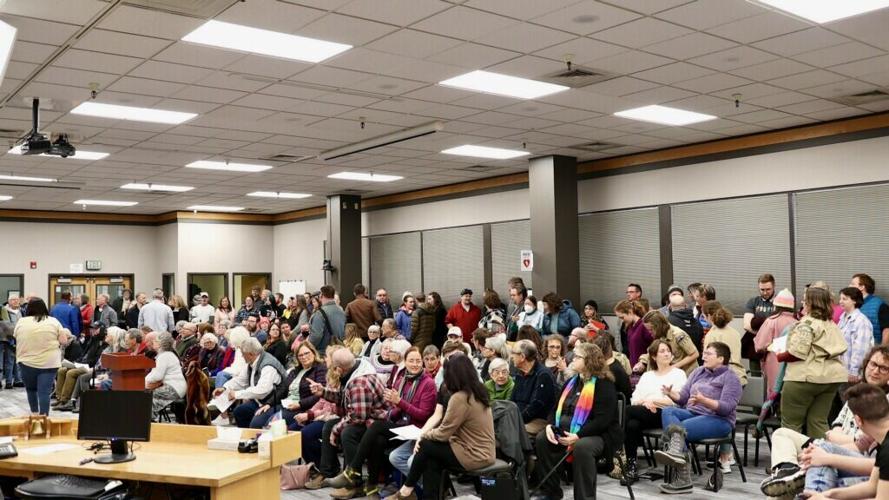




POCATELLO — The national conversation surrounding the banning of books focused on gender and sexuality was the center of attention at a packed Pocatello town hall meeting held at City Hall Tuesday night.
The council chambers at City Hall, which has an occupancy of 180 people, was at max capacity about 15 minutes before the meeting began and approximately 40 more people filled the adjacent foyer to observe the meeting on a television installed on the wall.

Eric Suess, the director of the Marshall Public Library, speaks during a town hall meeting at Pocatello City Hall Tuesday night about the library.
After Eric Suess, the director of the Marshall Public Library, provided a brief overview of the process patrons can use to challenge books that are available to check out from the library and potentially harmful, two dozen local residents provided Mayor Brian Blad and the Pocatello City Council with public comments.
Some spoke in favor of particular books being banned from the library because of the belief they are harmful to children. Others spoke in favor of the books being available, primarily because they believe these books save lives and because it’s not the job of library staff to do what parents should be doing when it comes to monitoring what content their children are consuming.
Suess explained that prior to this year, only two books had ever been challenged at the Marshall Public Library since he became the director in 2011. Without naming the books or going into specifics, Suess said one of those books was ultimately removed from the library and the other was kept, though it was moved from the young adult to the adult section.
This year, two books have been challenged, Suess said. The first book, which a local resident who provided public comment would later explain was a book that she challenged, “Gender Queer: A Memoir,” was kept and it remained in its original place in the adult section. The fate of the second book, also unnamed, has not yet been decided, Suess said.

Over 200 people attended a town hall meeting at Pocatello City Hall Tuesday night where book banning at the Marshall Public Library took center stage.
“There may be items in our collection that are offensive, shocking or even boring,” Suess said. “But at the same time, those same items may in fact be useful or valuable to other patrons.”
Public comment followed and although particular moments of the meeting were slightly contentious and involved those with differing viewpoints talking over one another, resulting in Blad reminding those in attendance to be civil and respectful, the one-hour meeting was mostly peaceful.
Some audience members displayed signs. One sign included a rainbow with the words “We belong” underneath. Another read “Protect children not porn.”
The repeated theme of several of those in favor of removing particular books from the Marshall Public Library focused on the contents of “Gender Queer: A Memoir,” a 2019 graphic non-fiction book written and illustrated by Maia Kobabe that recounts Kobabe’s journey from adolescence to adulthood and the author’s exploration of gender identity and sexuality.

Vickie Christensen, a library specialist at the Marshall Public Library, holds a copy of "Gender Queer: A Memoir" while speaking during a town hall meeting at Pocatello City Hall Tuesday night about the library.
The first speaker, Pocatello resident Vickie Christensen and a library specialist at the Marshall Public Library, spoke about how the book detailed graphic sexual encounters and included cartoon depictions of the sexual acts. She read graphic passages from the book and showed those in attendance the images contained within.
She explained that she unsuccessfully challenged the book to have it removed from the Marshall Public Library’s collection.
“This page in the book shows pictures of pedophilia,” she said. “This does not represent anyone in our library that needs to be represented.”
Another speaker in favor of library staff determining what books should be kept on the library’s shelves was Brandon Pifer. He said he loves LGBTQ+ people, but to him there is another minority group that matters, children “who don’t have the ability to discern.”
“Kids or people in general up to a certain age don’t have the ability to discern what they should consume and what not to consume — what’s harmful to them,” Pifer said. “I’m asking for discernment. I am asking for consideration of the young children who don’t know any better.”
Another Pocatello resident, Dorothy Guisande, said that years ago if adults in the community were to possess some of the books available at the Marshall Public Library, they would have been arrested or put in jail.
“This is not about homosexuality,” she said. “Adults can do as they please. This is about child abuse, child pornography and the pictures in many of those books.”
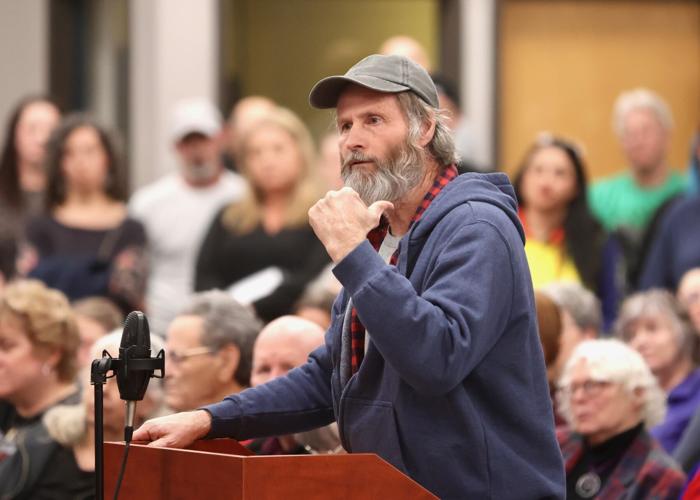
One Pocatello man, Paul Frantz, warned those in attendance that children who are allowed to view what he believes to be harmful material that’s available at the library could end up being sexually abused or develop sexually abusive tendencies themselves. He referenced an old episode of the 1970s sitcom “All in the Family” where a little boy and girl were outside playing the hospital game, resulting in some upset parents.

Pocatello resident Paul Frantz speaks during a town hall meeting at Pocatello City Hall Tuesday night about the Marshall Public Library.
“And for all of you, every last one of you, if your children, your grandchildren, your nieces and your nephews wind up, because of that kind of stuff, in the back alley playing hospital with a neighbor and your child gets molested or raped, you know what, you got it coming,” he said.
He asked how many women in the audience would like to be raped, followed by, “this stuff does help children to think that way. You don’t want to think so, well I’m standing here to tell you you’re wrong.”
The phrase repeated by many of those in favor of library staff not being the gatekeepers of content available at the library was simple: Let me be the parent of my own children.
A Pocatello woman, Caroline Reams Wight, said she was speaking as a mother, a teacher and a member of the Holy Spirit Catholic community before thanking staff for all of the various services offered at the library.
“And secondly, to ask you to let me be a mom,” she said. “Let me make decisions about what my children read and about what we discuss. Let me have the discussions about what books they bring home.”
She said she texted members of her book club asking what they would like her to say at the meeting and several said the same thing she did, “Let me be a mom.”
“Let me talk to my kids, let me have the hard conversations, let me talk to them about what is right and wrong,” she said. “As a teacher, I know that the only way we are going to raise a society that is able to accomplish anything is if we have those hard conversations where we develop those critical thinking skills.”
She continued, “My kids won’t gain anything if all those options are taken from them. My kids will just be in their little vacuum, be on these phones. And quite frankly, the library is not what I’m afraid of, what I am afraid of is everything my kids can find (using a cellphone).”
Pocatello resident Bob Marcinko echoed a similar sentiment, first commending library staff and then explaining that when his two boys were young either he or their mother would accompany them to the library.
“They never went to the library alone,” he said. “I was there or their mother was there as a parent and we looked and saw what they were choosing or where they were going in the library. We helped them pick out their books. The librarians are not my parents, they’re not my kids’ parents and they’re not my grandkids’ parents.”
Another common sentiment surrounded the idea that books like “Gender Queer: A Memoir” aren’t harmful, they’re actually saving lives.
Edward Kammerer, now age 43, said he first came out as gay to himself at age 12 in 1991 in a small town in New Hampshire. Books like the one mentioned above didn’t exist when he was of that age, he said.
“I did not know a single LGBTQ+ person, I had never seen an LGBTQ+ person in the media,” he said. “I knew that I was gay but I didn’t know what that meant, I didn’t have a word or concept for it. I share that today to let you know how important these books are. I hear a lot of talk about saving the children, what I don’t hear a lot about is the LGBTQ+ children. Children know early that they are different. They know early that they are LGBTQ+ and they need to see representation of themselves in their community in these books that are designed for young adults.”
He continued, “I could only imagine how much easier it would have been for my family when I came out to them to have books like this in our library, to have stories that they could see my identity reflected in literature that they could access and understand. When those books are available, people thrive. LGBTQ+ people exist…These books save lives.”

An audience member holds a sign that reads "We belong" under a rainbow at a town hall meeting at Pocatello City Hall Tuesday night about the Marshall Public Library.
Ember Marsh, a 14-year-old girl from Pocatello who identified herself as being queer, said that children’s “intellectual freedoms, identities and cultures are being stripped away from us if this book banning will be put in place.”
“The American Library Association defines intellectual freedom as ‘the right of every individual to seek and receive information from all points of view without restriction. It provides for free access to all expressions of ideas through which any and all sides of a question, cause or movement can be explored,’” she said. “We as children need the right to explore and engage in different ways of life, opinions and our own identities. As children, we are queer and our public spaces where we are provided literature and education should reflect this.”
She continued, “Marginalized peoples’ cultures have been stripped away and don’t dare continue to take away our humanity by erasing us from the past and the present. Protect us queer children and our rights and liberties.”
Pocatello Mayor Brian Blad, before adjourning the meeting, had the last word.
“I want to express my appreciation to everybody being here tonight,” Blad said. “It’s an amazing place we have to live here in Pocatello. I think it’s unbelievable we have a community like we have and I am grateful for that community. I honestly believe we have an asset in our LGBTQ+ community and we can learn an awful lot from them.”
