

POCATELLO — Idaho State University is laying off 45 people and enacting significant structural changes impacting four colleges as it works to address an $8 million deficit caused by a state mandate to reduce its budget by 3 percent.
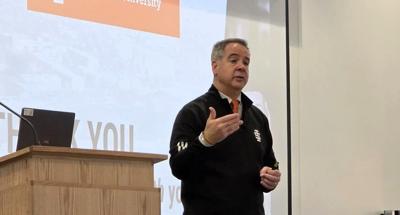
Idaho State University Provost Adam Bradford delivered the news to faculty this week during several meetings with individual colleges. The Idaho State Journal obtained a recording of the meeting with the school’s College of Science and Engineering, or COSE, as well as several infographics included in an accompanying slideshow — both of which spell out two massive changes for a Bengal community that’s been on high alert for months.
First, the school’s College of Arts & Letters is absorbing the College of Education to form the new College of Humanities, Education and Social Science, or CHESS.
“That change is significant, and we wouldn’t have entertained it if it didn’t yield significant savings,” Bradford said, noting the move will save ISU approximately $1.8 million.
Second, ISU is merging three COSE departments with its pharmaceutical services program to create a new Department of Biomedical Sciences that will fall under the umbrella of its Kasiska Division of Health Sciences.
The casualty of these two moves and others across the university — 45 people will no longer be working at ISU, confirmation of rumors that started swirling last month
When asked about the timelines for implementing the layoffs, reorganizations and other cuts and if more layoffs will come at the conclusion of this academic year, ISU officials said “University leaders will be actively engaged in the next few months to move the budget planning initiatives forward — working through details, answering questions, addressing challenges and adjusting as needed”
Budget breakdownAccording to infographics shared during the College of Science and Engineering meeting, ISU’s reduction target is $8 million. ISU President Robert Wagner told the Journal this was the university’s benchmark this past fall shortly after the 3 percent state budget reduction mandate became permanent in August 2025. The institution’s financial strategy to achieve that goal includes $5.44 million in personnel reductions. By employee category, that involves the elimination of 11 of 76 administrative positions, 12 of 351 faculty members and 21 of about 699 staff members, according to the slides presented to faculty. That’s a 14.5 percent reduction of administrators, 3 percent of faculty and 3.4 percent of staff.
Additionally, 14 percent of the $8 million target, or $1.12 million, will come from reductions in operating expenses, according to the slides. The remaining 18 percent of the $8 million target, or $1.44 million, will come from additional revenues. Sources say a large portion will come from a significant increase in student fees.
When asked what were the specific dollar amounts for cuts or savings as they relate individually to layoffs, furloughs and hiring freezes, ISU provided the Journal a written statement saying, “ISU’s budget planning includes five strategic areas that address not just personnel, but also structural redesign; strengthening our academic core; operational efficiency; investing in people and performance; and revenue growth and diversification. At this time, ISU’s total budget plan results in approximately $8.3M in savings and additional revenue.”
ISU officials later sent an email correcting the response to say, “As part of organizational and structural changes, ISU is reducing its workforce by approximately 45 positions, nearly 40 percent of which are currently vacant, and reductions are proportionally aligned to administration, faculty and staff,” and provided the following figures for each type of employee:
— Faculty total positions: 12 of 634, or 1.89 percent
— Staff total positions: 21 of 1,102, or 2 percent
— Administration total positions: 11 of 75, or 14.7 percent
ISU officials added that “the emphasis of ISU’s budget planning is to realize savings in state-appropriated central funds. These figures reflect the total number of ISU employees across all funding sources, while information presented in ISU’s college-level presentations focused specifically on centrally funded full-time positions.”
The bigger pictureThe $8 million deficit stems from multiple factors beyond the 3 percent state-mandated budget cut announced in August 2025.
According to school officials, “ISU also needs to solve for an estimated $3 million increase in health insurance and related fringe benefit costs, and $2.2 million in adjustments for enrollment growth, program expansion, and inflationary cost increases that are not being funded by the state in FY2027.”
Additionally, all state agencies, including Idaho’s public higher education institutions, were recently asked by the Legislative Services Offices to show the potential impacts of additional 1-2 percent budget reductions.
“This additional holdback has not been enacted by the legislature at this point, but if enacted, for ISU, this equates to an additional reduction of $1-$2.1 million,” ISU said in a written statement.
The Idaho Press reported that the Joint Finance-Appropriations Committee, after an hours-long meeting, “voted Friday in favor of broad agency and program cuts for this year and the years thereafter, recommendations that will make up a bill to be voted on by both chambers of the Idaho Legislature.
JFAC voted to enact 4 percent budget cuts for state agencies including ISU, which represent a 1 percent increase beyond the 3 percent cuts recommended by Gov. Brad Little in his office’s budget.
College of Education eliminated
The College of Education, which has operated at ISU since 1958 and moved into its current building in 1968, will cease to exist as a standalone college. Its programs will be absorbed into the new College of Humanities, Education and Social Science.
Dick Sagness, who served as College of Education dean from 1979-89, warned the consolidation could jeopardize the college’s accreditation.
“If they combine them, they’ll lose their accreditation, and if you want to have an unaccredited college, that certainly is doing the students no favors,” said Sagness, who retired from ISU in 2000. “That is an absolutely critical factor for the college and for its graduates.”
Sagness recalled a similar proposal years ago under a previous president that was abandoned due to accreditation concerns.
The College of Education houses numerous programs, from K-12 teacher education to doctoral degrees in fields including early childhood education, elementary education, special education, music education, deaf education, instructional design and educational administration for principals and superintendents.
Roger Wheeler, who holds three degrees from the College of Education, said state lawmakers created the crisis through poor fiscal planning.
“This is a problem that the state of Idaho has developed, not the university,” said Wheeler, a retired educator. “The university is doing whatever they possibly can to keep their head afloat in this situation, but I have some very definite negative feelings about what’s going on in Boise.”
Wheeler criticized Gov. Little for signing a bill providing $50 million in private education vouchers despite overwhelming public opposition and for other sweeping tax cuts that preceded this budget shortfall.
“I’m so angry with Governor Little ignoring the overwhelming number of people who said, veto that bill, and he ignored it totally,” Wheeler said. “Our leaders in Boise don’t pick up on how these cuts affect the entire state economically. It just trickles down.”
Sagness echoed Wheeler’s frustration with state leadership.
“The governor and the legislature gave a significant number of tax breaks, which ultimately went to the wealthy, and now they’ve put the universities in this position,” Sagness said. “They gave away about $50 million that could have been used to support public education.”
Despite concerns about losing college status, Wheeler said he believes faculty will persevere.
“Teachers teach everybody — doctors, lawyers, candlestick makers,” Wheeler said. “The people who are instructors and professors in the College of Education are going to continue to strive for excellence wherever they are.”
Science and Engineering restructuring
The College of Science and Engineering is also facing significant reorganization, according to infographics shared during the COSE meeting.
The reorganization merges three COSE disciplines — biochemistry, microbiology and anatomy and physiology — with the L.S. Skaggs College of Pharmacy’s pharmaceutical sciences to create a new Department of Biomedical Sciences, which will be nestled under the Kasiska Division of Health Sciences.
The consolidation aims to achieve three goals: enhanced research productivity and engagement through joint research pursuits, increased collaboration and a relaunch of the Idaho Biomedical Research Institute; curricular and budget efficiencies through coordinated course offerings, shared resources and streamlined operations; and expanded student opportunities and mission through diverse scholarly and career paths to pursue medical education and serve ISU’s health science mission.
Bradford told faculty an audit revealed the institution spent $800,000 last academic year on anatomy and physiology instruction beyond resources allocated to the Department of Biological Sciences.
“We spent about $800,000 last year on anatomy and physiology instruction, and we’ve got folks across the institution doing instruction in anatomy and physiology,” Bradford said. “We really need to look carefully at how we can bring those folks together and realize some efficiency, because it’s not sustainable. That’s about the equivalent of almost seven full-time positions.”
According to the infographics, the COSE reorganization nets budgetary savings of $550,008. Restructuring chair assignments and reducing chair spending by 40 percent will save $139,800; the elimination of two administrative assistant positions will save $119,513; and eliminating two open faculty lines will save $290,695.
Bradford also referenced ISU’s efforts to acquire a medical school during the COSE meeting, though he did not provide specifics.
“We’re in the process of trying to purchase a medical school,” Bradford said. “It’s incredibly beneficial for our financial situation, but in other ways, in terms of student opportunities and mission.”
ISU officials confirmed the university and the State Board of Education remain in an exploratory phase evaluating options to increase partnership opportunities with the Idaho College of Osteopathic Medicine, or ICOM, which was founded in 2016 on ISU’s Meridian campus.
Faculty concerns
Dave Delehanty, a biology professor emeritus who taught at ISU for 25 years before retiring in June, expressed concerns about the reorganization, particularly the decision to split up the Biology Department.
“Biology has been the most successful department on campus for the last 25 years, and it’s not clear to me why you would want to split that up,” Delehanty said. “If the cost savings come from reduction in force, that doesn’t mean there has to be a realignment of departments.”
He also raised concerns about disrupting the department’s research culture.
“ISU biology has an excellent research culture — that’s very hard to establish,” Delehanty said. “You would take a research powerhouse in the university, split it up, and move people into a department without a research culture. A lot will be lost.”
Delehanty said faculty weren’t consulted about the specific changes before they were announced.
“The administration is arguing that they had listening sessions and so on, but I’m not aware of discussions of the benefits and costs of this kind of very substantial change,” Delehanty said. “They didn’t invite the biology department to say, ‘Do you think it’s strategic to split you up?’”
Dan Dale, an ISU physics professor, said faculty concerns extend beyond biology. Dale noted physics has undergone six major reorganizations in just under 20 years — about one every three and a half years.
“I think you need a critical mass of people doing research, and it’s better to keep them together,” Dale said. “They decided to do it without really thinking ahead of time. Who would be the chair? How would this work? I haven’t seen any evidence of forethought in that regard.”
Dale also criticized the lack of communication with students.
“In discussions with students, the students have no idea what’s going on, and I think their information is coming from places like gossip on social media,” Dale said. “I think the communication could be a lot better.”
Communication and process
Bradford opened the COSE meeting by reflecting on delivering layoff notices to affected employees.
“I walked into those meetings very much prepared to be met with anger and even vitriol and deep frustration, all of which I was not only prepared for but was absolutely okay,” Bradford said. “But what was really humbling for me is that, almost without exception, that is not what I was met with. Sadness, yeah. Fear, for sure. But in a lot of cases, I was very surprised to see them offering compassion and grace to us.”
He called it “by far and away, the worst professional day of my career.”
Bradford said no additional personnel actions are planned beyond the 45 positions already announced within the Division of Academic Affairs.
“We do not have any additional plans to eliminate positions outside of those that we’ve already communicated about,” he said.
However, Bradford acknowledged uncertainty regarding potential additional state cuts.
“There’s very little left to cut without some even more disruptive changes than the ones we’re currently involved in,” he said. “If it’s an ongoing cut and they require that of us, I think that we can likely handle that through attrition, and we’re hopeful to not have to engage in more personnel action. But I have to be morally honest and say I don’t really know, because this is very much a changing environment.”
ISU officials said in a written statement that student success will not be impacted by budget initiatives and that staffing will be “thoughtfully realigned to better match service needs, reduce duplication, and improve efficiency while maintaining core functions and service quality.”
When asked if changes to student tuition and fees are part of the budget plan, officials said, “Changes to student tuition and fees are not included in the current budget reduction and revenue generation estimates.”
More information will be shared with the larger community in mid-February, according to ISU officials.

(1) comment
Let's hear it for the GOP-led state legislature, which continues to ignore constituents and make financial decisions that benefit the wealthy and corporations and screw everyone else.
Welcome to the discussion.
Log In