



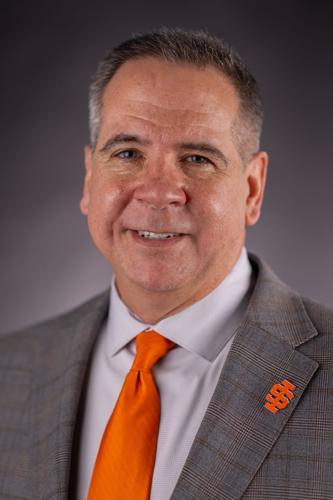


POCATELLO — As Idaho State University grapples with immediate budget cuts and plans for deeper reductions ahead, President Robert Wagner says speculation about upcoming layoffs or furloughs is premature.
ISU is currently navigating a 3 percent budget reduction alongside all state agencies, excluding K-12 public schools, following Gov. Brad Little’s August executive order. Wagner said the holdback resulted in a $3.1 million cut for the current fiscal year.
Looking ahead to July 1, 2026, when fiscal year 2027 begins, Wagner said ISU faces a projected $8 million budget shortfall after the 3 percent cuts became permanent in September.
“We’re in the process of collecting and gathering information and ideas right now, and decisions about how we will respond to the budget cuts will be made in the spring,” Wagner told the Idaho State Journal during a recent interview. “Those changes may include organizational, structural and personnel changes.”

Idaho State University President Robert Wagner
The timing of the recent and indefinite state holdbacks come on the heels of ISU achieving its first balanced budget in nearly a decade after eliminating a $15.5 million structural deficit.
“July 1, 2025, was the first balanced budget that Idaho State University had in nearly 10 years,” Wagner said. “And we’re very, very proud of that. I’m proud of the work that our institutional community did to take care of that deficit.”
Just months after reaching that milestone, the 3 percent holdback announcement pushed the university back into the red.
To meet the $3.1 million reduction for the current fiscal year, Wagner said ISU found efficiencies within its operational funds and implemented a hiring pause for some positions, allowing the school to save salary dollars that would have otherwise been spent.
The decision for ISU administration to recently alert faculty about potential future personnel changes was deliberate to avoid shocking the campus community if and when difficult decisions are announced in the spring, he said.
“I am not going to say layoffs are definitely coming because we’re still in the process of collecting ideas and information,” Wagner said. “It would be premature for me to say, to be as definitive as that, and say there will be layoffs.”
While responding to the recent cuts after working hard over the past few years to produce a balanced budget was no walk in the park, the more substantial challenge lies ahead.
Coupled with the permanent 3 percent holdback, fiscal year 2027 will come with a maintenance-only budget that provides no increases for salaries, health benefits or inflationary costs, Wagner said, projecting an $8 million budget gap beginning July 1, 2026.
Throughout the fall semester, the university has engaged in an extensive feedback process, conducting listening sessions across all units, colleges, departments and divisions, Wagner said. An online survey has also been created to solicit input from the Bengal community at large on how the university can find efficiencies and address the projected shortfall.
“All of this feedback is coming in right now. It’s very good. We’ve been receiving very constructive and very positive feedback,” Wagner said. “We have great people here at Idaho State who understand this institution, they understand the mission, the important mission that we have in front of us.”
Wagner said the collected feedback will be shared with ISU’s budget advisory group — a representative body of faculty, staff and students — and the Administrative Council, adding that beginning in spring semester 2026, these groups will formulate the institutional response to implement by July 1.
Wagner noted the university’s approach extends beyond simply reducing expenses. The institution is also developing strategies to increase revenue through multiple channels.
“Our strategies go beyond just cutting,” Wagner said. “We’ve also asked for strategies and ways that we can increase revenue as well.”
He pointed to ISU’s 6 percent enrollment increase this fall as a positive development that will help to offset budget pressures. The university has experienced enrollment growth for four consecutive fall semesters, a trend Wagner hopes to continue.
Additional revenue-generating strategies include expanding auxiliary services, exploring different educational delivery models and increasing philanthropic support.
“We want to come out on the other side of this stronger as an institution,” Wagner said. “We want our budgets to be much more resilient as an institution. But we also have to very strictly remain mission focused.”
Despite the financial challenges, Wagner said ISU has significant positive momentum. Beyond enrollment growth, the university has seen increases in research grants and philanthropy, he said. Community and alumni engagement have reached new levels, and the institution continues expanding academic programs to meet workforce needs throughout the state.
“Idaho State University has incredible momentum right now,” Wagner said. “Our enrollments are up for the fourth straight fall semester. Research dollars and research grants are up. Philanthropy is up. We’re engaging with our alumni, with our community, like we never have before.”
Wagner, revisiting his inaugural address, compared the university to a tree with deep roots that can withstand storms and emerge stronger.
“Sometimes the storms and the wind, they batter that tree, but really what’s happening is the roots are digging stronger into the ground,” he said. “I believe that’s what’s happening here. Budget cuts are a bit of a storm, and the tree is swaying back and forth, but those roots are just going deeper, and they’re finding the nutrients that they need to make the tree stronger.”
The budget holdbacks affecting ISU and other state agencies stem from revenue shortfalls following significant tax cuts approved by the Idaho Legislature and Gov. Little. According to documents the Idaho Capital Sun obtained from the Idaho Division of Financial Management, the cuts were designed to ensure state government remains “lean, efficient and aligned with the values of our taxpayers.”
Wagner declined to speculate about future legislative actions but expressed confidence in state leaders’ commitment, including Little’s, to higher education, pointing to investments in financial aid initiatives like the Launch program and opportunity scholarships.
“I do know that this state legislature and our governor have shown they value higher education,” Wagner said. “They’ve shown that by investing in financial aid for students and families.”
As ISU develops its response strategy, Wagner said the institution will remain focused on its core mission of meeting the educational and workforce needs of Idaho while being sensitive to impacts on people and programs.
“We as a public institution, we take that contract seriously when we say we’re going to meet the educational and workforce needs of the state,” he said. “As we go about developing the strategies to address the budget shortfall that we have, we will remain mission focused.”
Wagner said he could not yet specify how different groups — faculty, staff and students — might be affected by the budget strategies, as those decisions have not yet been finalized.
Regarding potential tuition increases, Wagner said the university would balance any proposals with students’ ability to pay and the importance of keeping higher education accessible and affordable for Idahoans.
What the school will not do, according to Wagner, is put ISU back in the financial hole it worked so hard to dig out of over the past few years. The university will not return to operating with a structural deficit, Wagner said, noting the importance of living within its means while continuing to serve the state.
“Our objective is to have a balanced budget every July 1,” he said. “I don’t believe it’s acceptable for us to have a budget that leaves us in the red. This is something that we have to address.”
With decisions expected to be announced in spring 2026, the ISU community continues to provide input as the university charts its path through the financial challenges ahead.
Whether that map comes with a reduction in ISU’s workforce is left to be seen.

(0) comments
Welcome to the discussion.
Log In