

Ask Buck Bailey what he remembers most about his service in WWII, and you might be surprised by the answer. It’s not the rumbling noise he felt while riding in the belly of a B-17 bomber during a dangerous mission. It’s not the time he had to be rescued by a fellow crewman because he lost his oxygen mask and fell to the deck, unconscious. It isn’t what he calls the “mayhem” as he navigated his plane through his first bombing mission over Berlin.
Although all those things, and more, are lodged in the memory of the 90-year-old veteran, what Bailey remembers most is what he calls his “Christmas in Cambridge.” His Christmas of 1943 was spent at an orphanage in Cambridge, England. “It’s one thing I will never forget. I went out there and visited the kids who were orphaned by the war. The airbase had sent Christmas presents, and I spent the whole day opening gifts and playing with the kids.”
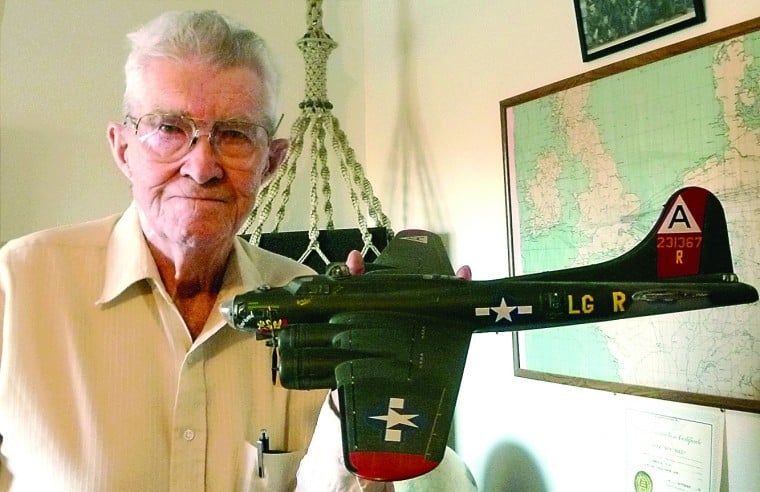
Long-time Pocatello resident Lamond “Buck” Bailey served as a bombardier and as a navigator onboard a B-17 heavy bomber as it flew bombing missions over Germany. He and the crew with whom he served nicknamed their B-17 aircraft the “Chowhound,” because as Bailey explained, “Those guys loved to eat. And we knew that guys who loved to eat that much would always make it home for dinner.”
Bailey was raised in the Pocatello area, and got his nickname “Buck” because his father was a wheat farmer in Arbon Valley. At 18 years of age, Bailey enlisted in the military on Dec 8, 1941, the day after the Japanese attack on Pearl Harbor. “I’m glad I did,” he commented about his immediate enlistment. “Everybody was mad,” he said, “and we wanted to do something about it. ‘How dare they do that to us?’ everybody thought.”
Bailey ended up stationed in England with the Eighth Air Force of the Army Air Corps, participating in the Combined Bomber Offensive of the U.S. Army Air Corps and Britain’s Royal Air Force. Squadrons of B-17 heavy bombers flew mission after mission to degrade German airpower, bombing military installations and manufacturing facilities.
From the Spring of 1943 through 1944, and early 1945, the B-17 “Flying Fortress” was the workhorse of the Allied war effort in the air. The highest priority of Operation Pointblank, an effort to concentrate on German fighter strength, was to weaken German air power by diminishing the capabilities of German aircraft assembly plants and ball-bearing factories. Sometimes taking heavy losses, the B-17s prepared the way for the eventual invasion of Allied ground forces. By April 1945, the Combined Bomber Offensive was effectively complete.
Bailey did his part while riding in the Chowhound, either as a bombardier or the head navigator. Pointing to a framed map on the wall of his study, Bailey ran his finger along the lines he had drawn on the map years ago, as he returned from each bombing mission to his room on the base. “I drew a line on the map, and wrote down the date, to show where I had been,” he said. There were 23 lines on the map, originating from the base in southern England, with most of the lines spearing into the heart of Germany. “We flew 5 bombing raids over Berlin,” he said. “On the first bombing raid we lost 68 bombers.”
Bailey described those bombing raids over Berlin as pure mayhem. “We were dropping bombs, and our airplanes were being shot down,” he said. “Everybody was trying to kill each other. War is not a nice thing,” he concluded.
Over all those bombing runs, the Chowhound did not remain completely unscathed. “We had a lot of hits,” Bailey said. “We had seven or eight holes in her at one time.” Bailey described what it is like to ride and work inside a B-17 bomber. “There’s limited space inside, and it’s noisy with the four engines,” he said. “It’s constant work to make sure you’re flying on course. We flew in formation; there was a lead airplane, and the rest of us would fly off of that. We went as a group, and flew by dead reckoning.”
Bailey shared several other memories of his service, notably, the time he was chosen to be the deputy lead navigator on a Berlin bombing run. “They came and got me and put me in a different plane, not the Chowhound,” he recalled. “It was an honor, I guess.” Bailey also recalled being saved by a crewmate when he lost his oxygen mask. “We were on a bombing run, and my oxygen mask was kind of loose,” he explained. “I stood up and passed out. I was lying on the catwalk when the bombardier found me,” he said.
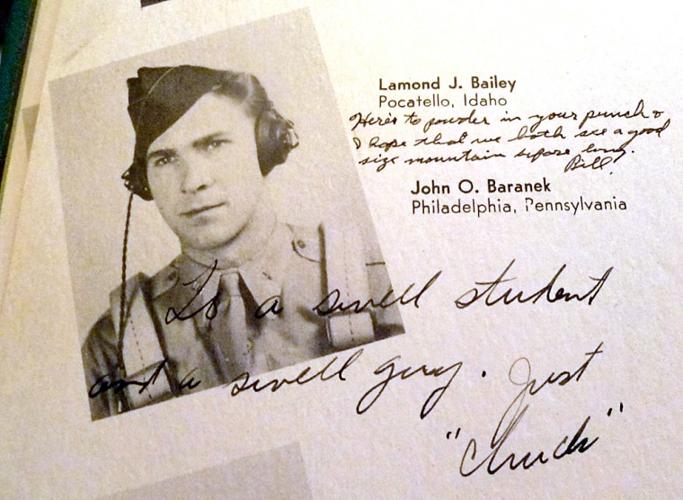
Bailey opened up his military-issued footlocker to share some of his memorabilia from the war. Among other things, there was his Class of 1943 yearbook from aviation training in Big Springs, Texas, with a photo of Bailey in his flying gear and intercom radio headphones. Bailey displayed the contents of his “survival” kit, containing everything an airman needs to stay fresh when away from the base, including shaving gear, a septic pencil for small scratches, miniature playing boards and pieces for checkers, even a toothbrush. “The toothpaste is a little hard after all these years,” commented Bailey, fingering the miniature aluminum tube.
“This was my English wallet,” he said proudly. “ English money is bigger than ours,” he explained. Bailey said he very much enjoyed his off-duty time in England. “I loved going to London,” he recalled. “One time I was in London at night, and the Germans had been bombing, and I remember that all the servicemen were out in the streets watching the anti-aircraft fire. It was funny; the Brits had shot down a German bomber, and everybody cheered. You’d have thought somebody just scored a touchdown.”
“I was on my way home by the time the US invasion of France started,” recalled Bailey. “I got out on the point system. I was done with the war,” he said. Bailey returned to Pocatello after his military service, eventually becoming the Vice President of Idaho Bank and Trust. He also worked as a radio announcer, on KEIO radio (now KWIK radio) and became experienced in announcing rodeo.
Bailey kept tabs on the war from Pocatello after his return. After six decades, with the humility characteristic of the “The Greatest Generation,” Bailey downplays his experiences and contribution to the Allied victory. “Everybody experienced the same thing,” Bailey said of his fellow soldiers, seamen and airmen. “Everybody had a whack at it. We just did our thing.”
About the B-17 Flying Fortress:
The Boeing B-17 is a heavy bomber aircraft with four engines, developed for the United States Army Air Corps. The storied aircraft became known as the “Flying Fortress.” The B-17 was primarily employed by the United States Army Air Forces in the precision strategic bombing campaign of World War II against German industrial and military targets. The United States Eighth Air Force based in England, the Fifteenth Air Force based in Italy, and the British Royal Air Force’s Bomber Command combined their efforts to weaken German defenses and industrial power. A sustained B-17 bombing campaign, known as Operation Pointblank, helped to secure Allied air superiority over the cities, factories and battlefields of western Europe in preparation for Operation Overlord, the invasion by Allied forces of German-occupied western Europe. The B-17 also participated to a lesser extent in the Pacific Theater where it conducted raids against Japanese shipping and airfields.

(0) comments
Welcome to the discussion.
Log In