








What do you do after the worst moment of your professional life plays out in front of thousands of people and millions more on television?
If you’re Chari Hawkins, you persevere.
“Sometimes we don’t realize how strong we are until we’re put in a situation where we just want to crawl in a hole and we want to quit, we want to stop, and we decide not to,” Hawkins said.
But on August 8, 2024, in Paris, none of that seemed possible.
Everything had been going according to plan for the Rexburg native.
She opened the two-day Olympic heptathlon competition with a strong showing in the 100-meter hurdles, finishing fifth with a time of 13.16 seconds. She felt ready, confident and prepared to fulfill a dream years in the making.
“In warm-ups, I didn’t miss a bar,” Hawkins recalled. “Everything was great. I felt amazing. It was a good day. I was in a good headspace. I was ready. I’ve never been more ready.”
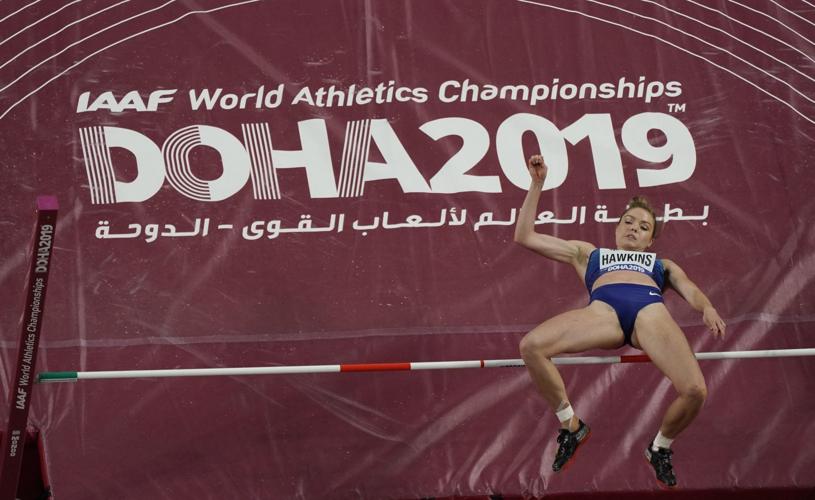
But in her bread and butter event, the high jump, where she had cleared 1.79 meters at the U.S. Olympic Team Trials a little more than a month earlier, Hawkins failed to clear the routine 1.71-meter mark in three consecutive attempts.
It was the first no-height of her career.
“I could have cleared that with my eyes closed,” Hawkins said of the moment that shattered her Olympic dreams.
“I don’t know if I’ve missed a 1.71-meter bar since I was in college,” she added. “Even in 2019 at Worlds, when I had my worst jump since my freshman year of college, I still cleared that height.”
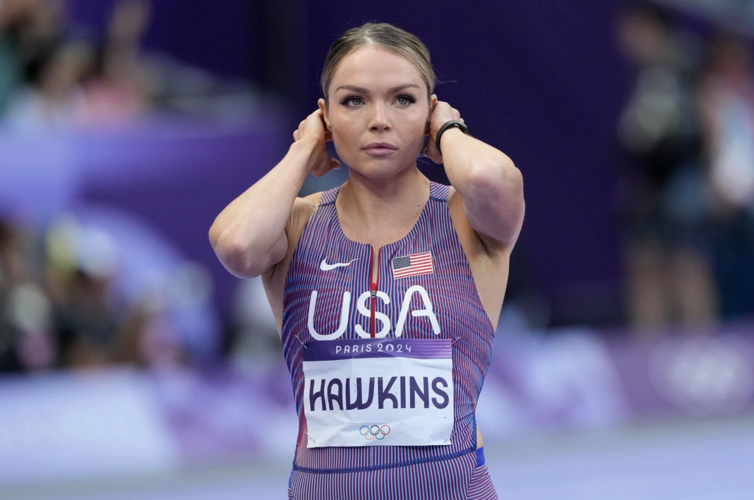
The tears rolled down Hawkins’ face as more than 80,000 spectators watched in stunned silence at the Stade de France in Saint-Denis —including her parents, husband, in-laws, friends and coaches. Almost everyone she cared about had come to witness what they hoped would be her long-awaited moment of triumph.
But instead, she had just become the only athlete in the field to no-height in the high jump — an event which was also the one that made her fall in love with track in the first place.
Television cameras captured the raw emotion as confusion turned to despair. Great Britain’s Katarina Johnson-Thompson, who won the silver medal, was pictured trying to comfort the inconsolable Hawkins.
“It’s such an easy bar to clear, and I didn’t clear it, and now I’m no longer viable for a medal,” Hawkins reflected. “I was looking into this crowd of 80,000 people and looking at the Olympic rings on every single flag, and noticing I’m here, and I did this, and this is how my Olympic journey ends?”
THE MAKING OF AN OLYMPIAN
A journey that began in Rexburg, where Hawkins was the youngest of five children.
Athletics ran in the family. Her father Bill Hawkins won five state titles coaching boys basketball at Madison High School for 29 years, and all of her siblings played college sports.
“She was always into sports — she liked sports a lot,” Bill remembers. “When you have big brothers and sisters that are all about it, and then your dad and mom are involved in it so heavily with the whole coaching thing, it’s something you can’t keep away from.”
So Chari followed suit.
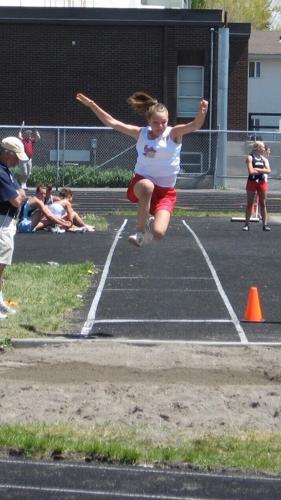
She was a three-sport athlete in volleyball, basketball and of course, track and field. Chari started competing in track in the sixth grade when she was drawn to the high jump. Countless Hershey track meets followed before her coaches suggested that she try hurdles in the eighth grade, too. She was a natural, three-stepping between hurdles − an advanced technique that takes most athletes years to learn.
“She’s one of those special athletes that don’t come around very often,” Bill said.
But off the track, Chari was struggling.
Beginning in the seventh grade − a year after starting track − Chari developed an eating disorder. It stemmed from feelings of inadequacy among her friend group.
“I think I felt like I didn’t belong in the group. I felt like one of us was not like the others,” Chari said. “One thing that my friends would always say to me was, ‘Oh man, Chari, you’re just so thin. I wish I was thin.’ I was like, ‘Ah, OK, that’s what I can contribute to the group.’”
So she became an expert at hiding it.
“I would just dish myself up food and eat a little bit of it and act like I stirred it up and be like, ‘I’m so full. Thank you so much,’” Chari said. “My parents didn’t realize how little I put on my plate in the beginning.”
“The crazy thing is, she told us that later on,” Bill added. “Call us interesting parents, but we didn’t—at least I didn’t. My wife might tell you she did, but I really didn’t think that she had one (eating disorder).
No one else did either − not even herself until years later. But it continued until her sophomore year when track became her outlet and ultimately her lifeline.
Chari started doing the heptathlon junior year and after only a handful of meets qualified for the USA Track and Field National Junior Olympics in North Carolina the summer before her senior year at Madison. She ended up placing fourth despite having never thrown a javelin before.
“It was so crazy, because that’s when all these scholarship offers started coming in,” Bill said.
Eighty-four to be exact.
Chari went on to win seven state championships in total, three-peating in both the 100 hurdles and the high jump — a far cry from her freshman year when she took fifth and third, respectively, in those same events.
“I think I knew that I could be better if I had more energy. I quit starving myself because I decided that I wanted to be better at track, so I started eating and I got a lot better at track,” Chari said. “So track helped me with my eating disorder 100%.”
Chari decided to stay relatively close to home, heading just 181 miles south to Utah State.
It proved to be the perfect choice.
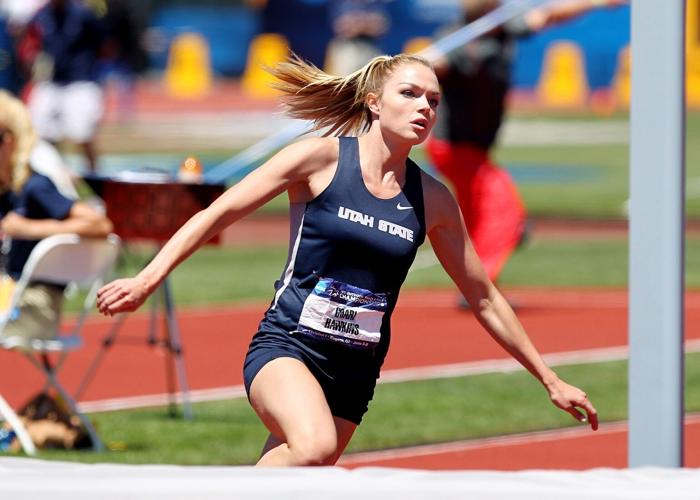
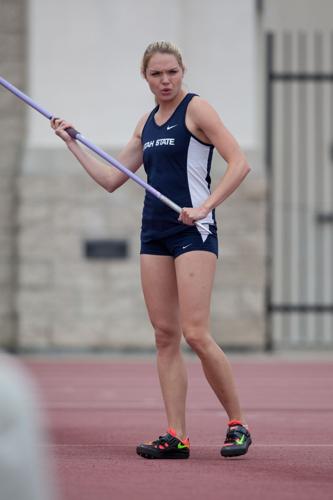
Chari became the most decorated women’s track athlete in program history, earning her first of five All-American honors as just a sophomore when she placed 11th in the heptathlon at the NCAA Outdoor Track and Field Championships. She went on to earn All-American honors in both indoor pentathlon and outdoor heptathlon in each of her final two seasons, as well.
Chari also racked up 24 all-league honors across the WAC and Mountain West Conferences, represented the Aggies at the World University Games in South Korea and became Utah State’s first individual Mountain West champion when she set school and conference records in the pentathlon (4,173 points) at the 2014 MW Championships.
More than a decade later, Chari still has the most All-American honors by a Utah State women, while holding five school records: the 60 meters (8.30), indoor high jump (1.83), outdoor high jump (1.81), pentathlon (4,173 points), and heptathlon (5,750).
“Chari is like most really good athletes — and I say this in a positive way —she’s high-strung,” former Utah State head coach Gregg Gensel said. “She really knows what she wants to do and works really hard to go after it.”
She would need every ounce of that determination for what was to come.
CHASING THE DREAM
Chari missed out on her first attempt at becoming an Olympian in 2016. She finished 15th out of 18 in the heptathlon at the U.S. Olympic Trials, where only the top three make the team.
Before then, making the Olympics had always seemed like this impossible dream for Chari. But even after a 15th-place finish, it suddenly felt like a real possibility.
But the road ahead would be anything but smooth.
A hip injury following the 2017 USA Track and Field Outdoor Championships sidelined her for nearly a year. When she finally returned to competition in May 2018, Chari made it count — winning and breaking a 30-year heptathlon record at the England Athletics U20/Senior Combined Events Championships, all while pursuing a master’s degree at nearby Bath University.
Chari followed that comeback with a third-place showing at the 2019 USA Track and Field Outdoor Championships, scoring 6,230 points — a personal record at the time — and earning her spot on Team USA for the World Championships later that year.
What’s remarkable is Chari was able to do all of it while battling major anxiety and panic attacks for eight years (2011-19). It became so intense that a poor performance made her feel like a “bad person.” But thanks to coaches Sheila Burrell and Craig Poole, she learned to replace those feelings with gratitude.
“She finally gave herself permission to let it happen,” Poole said. “Instead of trying to think through the events, she gave herself permission to just go compete, and it paid off.”
But just as everything seemed to be finally falling into place, her world came crashing back down again. Just five days before the World Championships in Qatar, Chari hurt her ankle during a routine drill for the long jump.
“We were jumping off of a box, which gives you a lot more speed and height,” Chari said. “I landed in the sand and heard three snaps in my ankle.”
Chari ended up tearing all four ligaments in her right ankle and chipped her talus bone. But she didn’t bow out, gutting out a 12th-place showing with 6,073 points.
“They were like, ‘You definitely need surgery,’” she said. “But I said, ‘Well, I can’t get surgery because I literally have the Olympics.’”
Fortunately for Chari, the 2020 Olympics were postponed due to the coronavirus pandemic, finally allowing her to have the surgery. But even with the extra year of recovery, she still wasn’t 100% by the time the 2021 Olympic Trials came back around.
She still earned 6,236 points − a personal record. But it was still only good enough for a sixth-place finish.
So Chari had to sit and watch three other women realize their Olympic dreams instead of her.
It didn’t give her any comfort that her score would have made her an Olympian in virtually any other year either. The competition was so intense that year that her 2024 Olympic Trials point total of 6,456 wouldn’t even have been enough.
“I was so overwhelmingly heartbroken that I knew I couldn’t leave it here,” Chari said. “There was just something in me that just knew that it couldn’t end like that.”
THE ROAD TO PARIS
So Chari got in touch with Poole, a veteran coach with 58 years of experience who had worked with multiple Olympians.
“I was kind of hesitant. I wasn’t sure I would have the time,” Poole admitted “But I talked it over with my wife and we decided that if she didn’t have anybody to work with and she was here in San Diego, why not go with it?”
Also, working alongside Burrell, who is going into her 17th season as the head coach at San Diego State, they refined her technique across all seven events.
“Our focus was to try to improve all events,” Poole said. “But if she was going to compete with the world’s best, then she had to have a good javelin and a good shot put.”
The newfound strategy worked.
Chari claimed the pentathlon title at the 2022 U.S. Indoor National Championships, finished third at the 2023 USA Outdoor Track and Field Championships and took eighth at the 2023 World Championships in Budapest. So in 2024, everything was clicking. A seventh-place finish at the World Indoor Championships in Glasgow, Scotland in the spring set the stage for a career-defining moment.
When Chari stepped onto the track at historic Hayward Field in Eugene, Oregon, the venue held painful memories. She had competed there twice before—at the aforementioned 2016 and 2021 Olympic Trials that each ended in heartbreak. But this time felt different.
With her entire family watching from the packed stands, Chari finally had her breakthrough moment. She set the tone early by placing third in the 100 hurdles and posted a runner-up finish in the shot put with a personal record of 14.67 meters. But it wasn’t until the javelin on Day 2 that Bill knew this was at last her time.
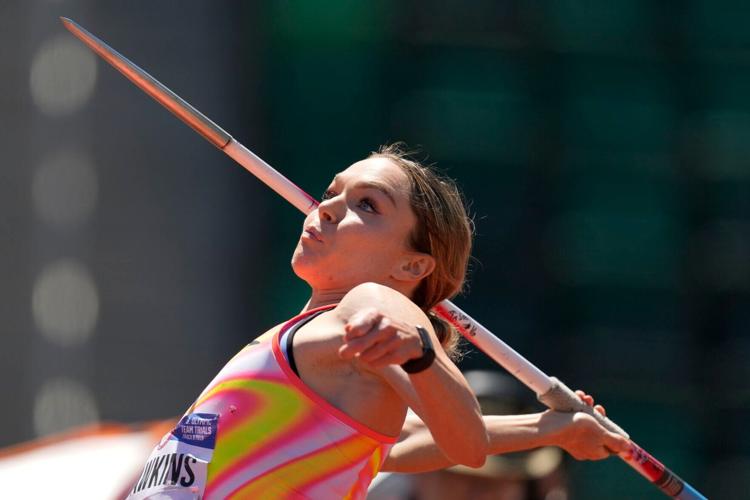
Chari nearly won the event with a throw of 49.28 meters —Ashtin Zamzow-Mahler edged her by just two inches. But it was still another personal record and firmly secured Chari’s’ spot in the top three.
“I’ll never forget seeing her husband, and he came up and gave me a hug,” Bill said. “He comes up to me and goes, ‘I just wanted to congratulate you on your daughter being an Olympian.’ He’s hugging me and, man, it got kind of teary-eyed a little bit.”
The waterworks really came out when she made it official in the 800-meter finale, clocking her third personal record of the event at 2:14.76. Her total of 6,456 points — yet another personal best — earned her second place behind two-time world champion Anna Hall and, more importantly, a spot on the Olympic team.
A dream nearly a decade in the making.
“Making the team—especially one that you’ve tried to make so many times, that has kept you up at night hoping you’ll make it—is almost as painful as not making it,” Chari said. “It’s traumatic because you’ve had all these visions in your head: ‘What if you don’t make it? What if it doesn’t go well?’ When you finally do make it, yes, it feels so freeing and relieving, but it also feels like a close call. Like you just evaded a really scary, bad accident.”
OLYMPIC TRIUMPH AND HEARTBREAK
The opening ceremonies provided a surreal full-circle moment for Chari.
Years earlier, as a teenager at a basketball tournament in Las Vegas, she had gotten a photo with a young LeBron James who was still in high school.
“We all knew he was going to the NBA. I saw him out of the corner of my eye, and as an adult, I probably wouldn’t have gone up to him, but my little kid self just ran up and was like, ‘Can you take a picture with me?’”, Chari said with a laugh. “He was so sweet — at the time, he had a flip phone.”
Now, as an Olympian, she approached the now NBA legend again on the Team USA boat.
“I had the photo ready to go,” Chari recalled. “I was like, ‘Can I just show you something?’ I showed it to him, and he grabbed the phone out of my hands. He goes, ‘Oh my goodness,’ and then he was like, ‘You just took me back. Thank you for showing me that.’”
The surreal moments continued in the Olympic Village, where her roommates included gold medalist track stars Gabby Thomas and Sydney McLaughlin.
“I was like, ‘Who put me in this room?’” Chari said with a grin.
The magical moments were the start of what she hoped would be a fairy-tale ending. Because at 33, she was also the oldest participant in the field.
It was anything but.
The confusion surrounding the high jump didn’t help, either.
“A lot of things happened on her first jump,” Bill said. “She’s sitting there, and they haven’t told her that she’s up, and then all of a sudden they said, ‘Chari, you’re up, your time is running.’ She had like 25 seconds to actually jump, run and get to where she’s supposed to be.”
“In all of her career, the high jump’s never been a worry,” Bill added. “It was just weird to be honest with you.”
The cameras also caught another gut-wrenching moment.
Chari, who was still visibly shaken, walked over to Burrell in the stands. In an effort to comfort her, Burrell shared her own Olympic heartbreak from the 2000 games in Sydney, Australia. She too had no-heighted in the high jump of the heptathlon no less.
“I think I’m grateful for it, because it was a moment that I didn’t even realize was so emotional,” Chari said. “I didn’t even notice the cameras. It’s so interesting how when you’re going through something you don’t even realize it anymore.”
Chari now had seven and a half long hours to think about what was next.
“I had a lot of time to go home and sob my eyes out. I had a long time just to be depressed,” she said. “There were thoughts of, I want to go in a hole and hide. I just want to go home.”
The worst part for Chari was trying to deal with the guilt.
“I just kept saying, ‘I’m sorry’ out loud and in my head,” Chari said with her voice breaking. “I was apologizing to all the people who had sacrificed for me. I was apologizing to myself for letting me down. I was apologizing to all the people that came to watch me and all the people who were there hoping that I would do something great. I’m so sorry that I couldn’t be that girl for you.”
But she didn’t quit.
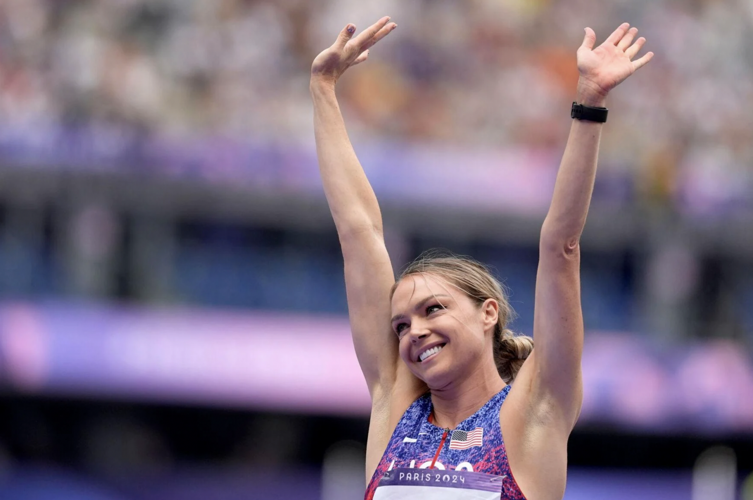
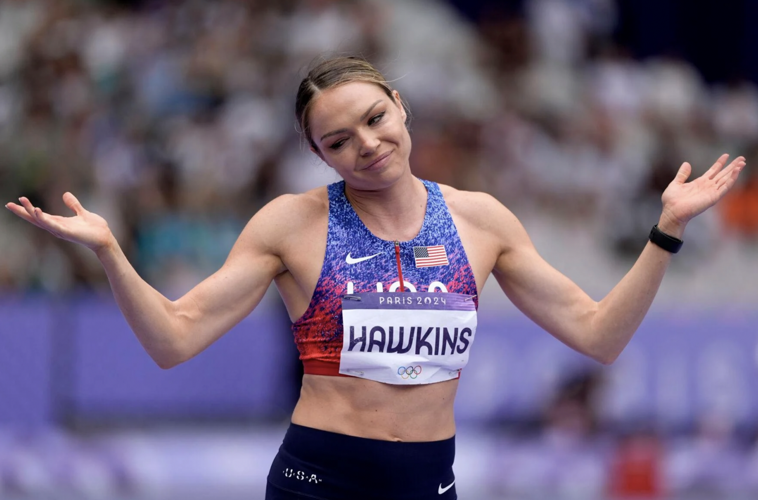
Chari held her head up high and went back out there with a smile — albeit forced — and played to the crowd with a shrug and a wave after completing all of the remaining events.
She finished dead last in 21st place with 5,255 points. But the scoreboard only told part of the story.
“I’m going to tell you right now, a lot of athletes wouldn’t have carried on,” Bill said. “But she continued to do all the other five events after having her heart ripped out, and she flat out was cheering the other athletes on, trying to help their mood be that much better.”
A DIFFERENT KIND OF GOLD
It’s something that Chari continues to do to this day.
On her Instagram page, she posts daily content featuring mainly exercises for both professionals and everyday people alike to her over 1.1 million followers. She regularly offers advice and encouraging messages, with recent posts stating “Get out and move. Nobody else can do it for you. You’ve got this.” Chari has transformed her platform into something far more personal and meaningful — inviting her audience to vote on her ESPY outfit, sharing vulnerable details about her Olympic heartbreak and opening up about the most painful chapters of her life with unflinching honesty.
She chronicled the training of her first-ever marathon. When Chari crossed the finish line at the London Marathon on April 27 in 4 hours, 14 minutes and 30 seconds, she became one of 56,640 finishers that day − helping set a new Guinness World Record for participation. Most recently, she graced the ESPY red carpet on July 16, sporting the dress chosen by her audience —showcasing the genuine connection she’s made with her fans.
“Something that I am so honored to do is to be able to share my story to help other people reach their fullest potential, hopefully showing them — if I can do it, you can do it,” Chari said.
Chari is planning on writing a book, but beyond that, she’s not sure what’s next. While she would love a shot at redemption at the 2028 Olympics in Los Angeles, those Olympics are still three years away. So for now, she’s taking it one season at a time.
“She certainly is somebody I’ll never forget,” Poole said. “Not only because of her athletic ability, but her as a genuine person − that’s the most important thing. She’s just a lovely young person, and I really enjoyed working with her. She’s gonna do really well in the future.”
So regardless of what’s to come, Chari has already answered the question posed nearly a year ago: What do you do after the worst moment of your professional life?
You get back up, you inspire others and you prove that strength isn’t always about clearing the bar — sometimes it’s about deciding not to quit when everything falls apart.
“Looking back on it, I guess the only thing that I really have to say is, it must have been needed for my story to get told a different way,” Chari said.

(0) comments
Welcome to the discussion.
Log In