

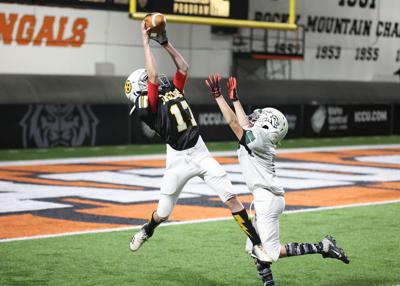

If you were paying attention to what was happening with head injuries and the National Football League about 10 years ago, you were probably rightly concerned about whether to allow your child to play football. Granted, little league football is nothing like a grinding professional career of daily blows to the noggin, but as a parent, it would only make sense that you’d start to question the safety of signing your child up for youth football.
Les Hernandez, who has been president of the Southeast Idaho Youth Football League (SIYFL) since 1992, can certainly understand your concerns. He’s coached his own kids in football, as well as soccer (another sport with known concussion concerns) and basketball, and he certainly wouldn’t put them in unnecessary harm. But Hernandez would like you to know: With youth football season approaching and signups taking place now, his league is doing everything it can to minimize the risk of head injury – and all injuries – among its 1,400 players, who range from fifth to eighth grade.
“I think the biggest thing is you don’t see the significant injuries because people are more aware,” said Hernandez, whose league includes 63 teams from 19 southeastern Idaho communities. “It’s the second concussion where injuries become more significant. Ten years ago, nobody really paid attention to it. I remember watching (former NFL quarterback) Steve Young play with multiple concussions and thinking, ‘They need to get him out of there.’ Now, people know better.”
That increased knowledge about how to prevent, treat and manage head injuries is reflected in significant rules changes and requirements in the SIYFL. This is not your grandfather’s “rub some dirt on it and get back out there” little league football.
For example:
— Coaches are certified by the National Youth Sports Coaches Association, which provides in-depth training on how to recognize concussion symptoms and how to manage players who suffer head injuries. There are sports medicine professionals on the field during games to help recognize head injuries, and coaches are responsible for removing players should they suffer injuries during practice.
— The league has a concussion protocol it follows, and once players are diagnosed, they have to sit out according to that protocol. “We follow national standards,” Hernandez said. “When in doubt, sit out. We require a release from a doctor or registered concussion specialist, just like you would with a broken arm.”
— Helmet manufacturers have made significant improvements in safety design in recent years. “The helmets go through the same rating process as adult helmets,” Hernandez said. “Virginia Tech does the rating on adult helmets and youth helmets.”
— The league has imposed weight limits on players who carry the football, so you don’t have a situation where an early-maturing, very large running back is getting a running start on head-on collisions with much smaller defenders.
— The SIFYL has reduced the number of kickoffs, which can be high impact plays that lead to more — and more significant — injuries.
— The league partners with Portneuf Medical Center to provide its own concussion training, and Brent Faure, the director of the Portneuf Sports Medicine Program, sits on the SIFYL’s Board of Directors. “I sit in on the director’s meetings and when they start talking about safety rules, I perk up,” Faure said.
Faure says the goal of concussion management is to prevent further injury while the patient is still symptomatic. “You want the second concussion to be a separate injury,” he said. The thought of a “second concussion” is probably a scary one for parents, but Faure notes that active children can sustain head injuries from a wide spectrum of activities, not just football: rodeo, downhill skiing, soccer, gymnastics, four-wheeling. It’s important that concussion patients fully heal before they get back into contact situations of any kind.
Interestingly, Faure says the Portneuf Concussion Clinic doesn’t like to see new patients until three to five days after they sustain a head injury. That gives the patient time to engage in “normal activities” like going to school first, so they can better ascertain what symptoms they are suffering. Once a person is diagnosed with a concussion, they typically get physical therapy which focuses on balance and vision, cervical musculature and some exertion. They start concussion patients into some kind of physical activity, whether it be as simple as short walks to begin with, almost immediately.
The average teenager takes about four weeks to recover from a concussion, and Faure says new research is showing that college-aged athletes probably take as long, even though there was some thought they recovered sooner. But, he cautions, there is no timeline for individual concussion cases because each injury is different, as is each person.
“There’s a saying, ‘Once you’ve taken care of one concussion, you’ve taken care of one concussion,’” Faure said, “because each case is so different.”
Like most things in life, you can chart the impact of head injuries on a spectrum, ranging from a one-time, relatively moderate injury all the way to a severe brain injury — or a lifetime of cumulative impacts from a “concussive career” — like football, or heavy construction. Parents might ask, “At what point do I draw the line and pull my child from a specific activity that may be causing head injuries?” Faure says the Portneuf concussion clinic uses a tool developed by the Cleveland Clinic to measure concussion patients in areas like memory, reaction time, processing speed, etc. The tool measures how much impairment has been suffered by the patient and shows when they are improving and recovering.
It also provides a baseline for the patient to compare against if they suffer further head injuries. If they start to see a more permanent, or more significant decline in these areas, it may be time for the parent to pull the child from a particular activity.
Faure says over the last eight years, the Portneuf clinic has only counseled 3 patients out of sports activities because of repeated or ongoing symptoms.
As much as we’d all like to bubble wrap our children and grandchildren to protect them through adulthood, we also want them to be active and engaged. And as Les Hernandez notes, there are probably always going to be kids who want to play football. Each parent has to make the judgment call about what activities they are comfortable with for their children. Hernandez and Faure are trying to make the little league football option as safe as they can.
Brad Bugger has been observing sports in Southeast Idaho for over 40 years as a sportswriter, broadcaster and fan. He can be reached with column ideas, comments and suggestions at bpbugger@gmail.com.

(0) comments
Welcome to the discussion.
Log In
The Idaho State Journal invites you to take part in the community conversation. But those who don't play nice may be uninvited. Don't post comments that are off topic, defamatory, libelous, obscene, racist, abusive, threatening or an invasion of privacy. We may remove any comment for any reason or no reason. We encourage you to report abuse, but the decision to delete is ours. Commenters have no expectation of privacy and may be held accountable for their comments. Comments are opinions of the author only, and do not reflect the opinions or views of Idaho State Journal.