

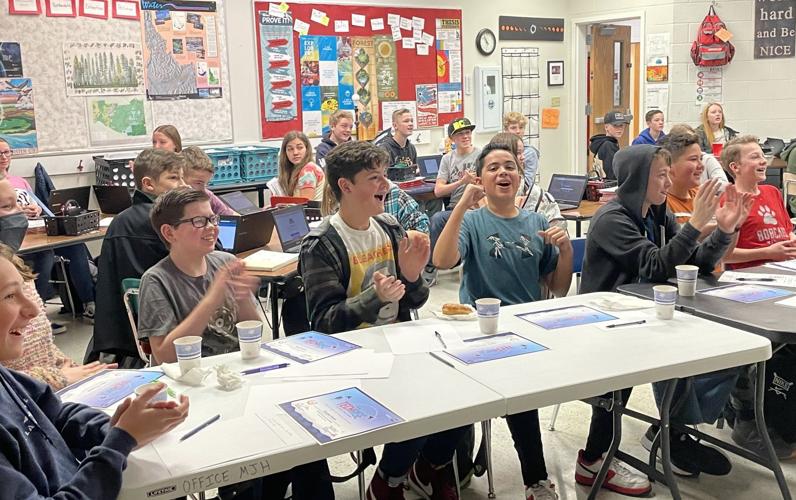


A group of students at Madison Junior High School is one of 57 winning teams around the nation for a NASA student challenge.
The team was comprised of 13 eighth-graders who participated in NASA’s TechRise Student Challenge. The challenge is designed to attract, engage and prepare future STEM professionals. Teams were challenged to build experiments that can independently operate and collect data from the edge of space aboard a suborbital rocket or a high-altitude balloon.
“This was a project that these students had to commit time outside of regular school hours to complete,” said Neva Telford, an eighth-grade science teacher at Madison Junior High. “This was an aha moment for these students and many of those moments happen outside of the classroom.”
Telford coached the students and oversaw them as they worked, but all work on the competition was conducted outside of class time by the students, she said. The students met twice a week before school started.
Nearly 600 teams applied for the competition, representing 5,000 students from grades six through 12 from across the country, according to a NASA news release.
“At NASA, we educate and inspire the next generation of scientists, engineers, and explorers,” said NASA Administrator Bill Nelson in the release. “The TechRise Student Challenge is an excellent way for students to get hands-on experience designing, building, and launching experiments on suborbital vehicles. I’m so impressed we received hundreds of entries from across the country, and I want to congratulate the winning teams. I can’t wait to see these incredible experiments come to life!”
The team’s project, called Gateway Shipping, seeks to determine the best biodegradable packaging materials to protect medical supplies shipped to and from space. Team members wrote a proposal to NASA explaining the need for the project and how it would be conducted.
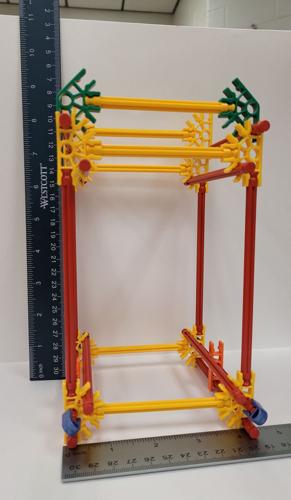
The students also built a 4-inch by 4-inch by 8-inch prototype NASA TechRise box out of K’Nex toys to decide what could fit inside the box of their experiment.

The team’s prototype shipping box, made out of K’Nex toys.
NASA is sending the team $1,500 to build its experiment on a NASA-assigned spot to test the experiment on a suborbital rocket that will be operated by Blue Origin or UP Aerospace. The team also will receive a suite of materials for preparing their payloads, access to flight simulator software and technical support from experts. The flight test is expected to be conducted in 2023, the NASA release said.
“Not many kids can say they got to make an experiment that they actually got to test in space,” Telford said.
The students are:
Jacob Palofax, Doug Flamm, Christian Allen, Emma Allen, Carter Gemlich, Cade Ratcliffe, Ryan Hymas, James Tedjamulia, Ellie Larsen, Marie D’Evegnee, Ace Ingram, Thomas Sessions and Lincoln Wikham.

(0) comments
Welcome to the discussion.
Log In