

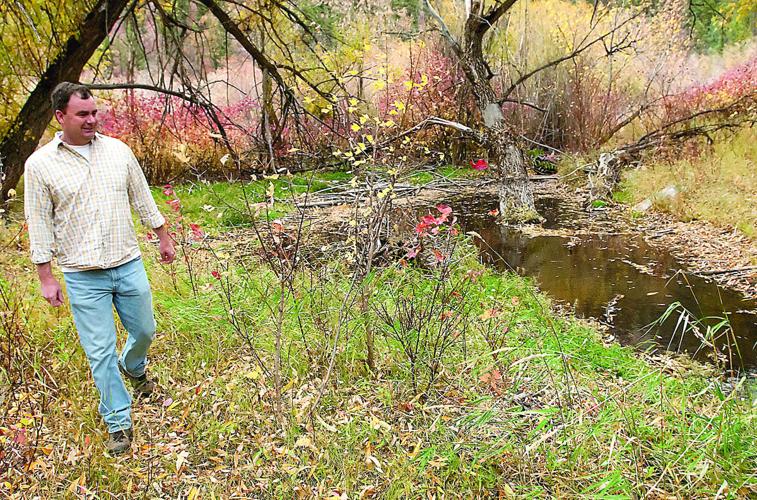
This is one newcomer that can really change the neighborhood.
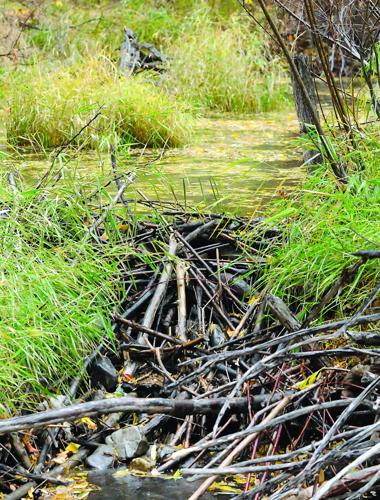
The modest beaver, diminutive in size, mild in manner, can impact an ecosystem like few other animals. Triggered to build dams by an innate reaction to the sound of running water, even a small beaver colony can quickly re-route a river, block a stream and create acres of marshland. Usually those changes are beneficial, but not always.
“It’s certainly both good and bad, but more good than bad,” said Paul Chase, a fisheries biologist for the Logan Ranger District.
The good comes in the form of improved riparian areas, cleaner water, more desirable plants such as willows and chokecherries, and better habitat for various fishes, birds and small mammals (as well as the occasional moose). The bad can include swamped campgrounds, washed out roads and, during heavy runoff years, dams that wash out and sweep away spawning fish. A couple of summers ago a large dam on the west end of Guinavah-Malibu Campground caused so much flooding that part of the campground was abandoned.
“Oftentimes they’ll use our culverts as part of their dam and that can cause flooding,” Chase said, “but they are one of our keystone animals.”
In areas where it doesn’t overlap with human structures, beaver activity is very valuable.
“You end up with more fish in a stream (that is dammed), or larger fish in a stream, or both,” Chase said. “They can do a lot of the same things we do, but better, and they’re cheaper.”
An added bonus, according to Joseph Wheaton, an assistant professor in watershed sciences at Utah State University, is that native Bonneville cutthroat trout appear to more easily navigate past beaver dams than do non-native brown and brook trout. The compatibility of cutthroat and beaver is a good sign for the continuing efforts to boost cutthroat populations in this area, and is probably indicative of the fact that the two species evolved together.
Land managers have long understood the potential benefits of beaver dams, but Wheaton said interest is rising in the annual Partnering with Beaver in Restoration workshop he is hosting at USU next week. He attributes that to land managers seeking cheap, natural solutions to stream management problems.
“We are pretty good at restoring systems with Tonka toys, but pretty crappy at doing it in a way that can be flexible,” Wheaton said. “Healthier ecosystems allow dynamic change and expansion, they move around. We’ve dealt with the beaver for so long, yet there’s not much understanding of how much benefit they can provide.”
Of course turning a project over to the beaver means accepting some uncertainty, but Wheaton argued that it’s really not that hard to predict the possible outcomes of letting the beaver do its thing. And in places where the flooding could become an issue there are relatively cheap, simple solutions that allow water and fish to pass through the dam. A “beaver deceiver” is a device that uses pipe or fencing to keep the beavers from completely blocking a waterway, thus maintaining some flow and minimizing flooding.
Wheaton said that all too often human builders react to a new dam by killing the beavers and blowing up or dismantling the dam. Utah’s management plan now calls for problem beavers to be live-trapped and relocated, acknowledging their value and their vulnerability.
The beaver, of course, was the primary reason white visitors first came to this area and to many other parts of the West. Not long after Jim Bridger and his fellow trappers “discovered” the region — called Cache Valley because many of the trappers stashed their furs here — all the beaver were gone.
“They should be extinct, but they’re so damn resilient,” Wheaton said. “Here’s this little rodent that can do millions and millions of dollars worth of work, and do it for free.”
Somehow the frumpy-looking creatures managed to recolonize Logan Canyon, and have gradually returned to healthy numbers, Chase said. Trapping is still allowed in Utah, but Chase said most trappers work ethically, taking only one or two beaver from a certain area to avoid wiping out an entire group.
“It seems like the population here has expanded somewhat,” he added. “We’re pretty happy with the beaver we have and we’re trying to expand the numbers we have.”
At this time of year beavers are busily reinforcing their lodges for the winter — when they slow down but don’t hibernate — and sticking tasty branches into the mud as food storage for when the snow falls. In the spring they will once again begin building, sometimes in new areas, often using previously abandoned dams. Chase, for one, looks forward to seeing where those dams will be.
“Where you have good beaver numbers,” he said, “good things are usually happening.”

(0) comments
Welcome to the discussion.
Log In