

Tariff plans introduced by the Trump administration bring another level of uncertainty into the Idaho agriculture market.
They included a 10% blanket tariff on all imports, 25% tariffs on certain Mexican and Canadian agricultural products, and up to 145% tariffs on specific Chinese goods. While the long-term impact remains uncertain, these policy shifts could affect production inputs and export competitiveness.
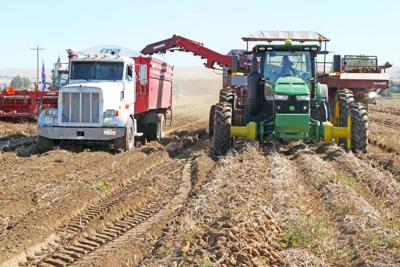
“Obviously, it’s going to affect us,” said Jordan Johns, who grows potatoes, wheat, sugar beets and garbanzo beans at Hymark Farms in Aberdeen. “Higher input costs. I do continue to see costs go up. When the tariffs talk started there was a rise in input costs.”
Idaho relies heavily on exports, particularly to Canada and Mexico, and retaliatory tariffs could significantly reduce these markets. Additionally, tariffs on imported inputs like fertilizer raise production costs for Idaho potato growers like Johns.
Growers need to make planting decisions well in advance, and the possibility of changing trade policies makes it difficult to plan for the future. Amid all the back-and-forth discourse about tariff escalations even before Trump began his second term, Johns did what he felt best.
“We initiated a crop plan and stuck to it,” Johns said.
More concerning for growers are the rising per acre costs for commodities.
Fertilizer costs went up 5-6%, Johns said. “We’ve seen that increase across the board for inputs. We haven’t been able to cut any inputs to reduce cost.”
According to Johns, the higher input costs are squeezing profit margins for growers.
“We’re kind of in that cycle,” Johns said. “All commodities are now being affected.”
Yet Johns is confident that Trump will deliver what he promised growers.
“I’m very optimistic the president is going to get better trade agreements in place,” he said.
Meanwhile, organizations like the American Sugarbeet Growers Association and the National Potato Council continue to represent growers nationally in Congress.
“Those that represent us are doing what they can,” Johns said. “I’m happy with the effort.”
Despite the challenging environment and potatoes being most impacted now, Johns won’t quit the crop.
“We’ll always stay in potatoes,” Johns said. “I’m trying to ride it out and hope it changes. It gets harder and harder to grow and raise it.”
Idaho dairy owners also have long-standing problems getting renewed focus.
The availability of year-round workers transcends administrations, said Rick Naerebout, Idaho Dairymen’s Association CEO in Twin Falls. The association includes 350 dairies and about 5,000 workers.
There’s not a visa for year-round ag workers, Naerebout said, and labor has remained an issue for the last two decades.
The H-2A visa program allows farm employers in the United States to hire guest workers to fill seasonal farm jobs if employers can demonstrate that U.S. workers are not available and the presence of H-2A workers will not adversely affect similar U.S. workers.
Despite complaints that the H-2A program is costly and cumbersome, the number of seasonal jobs certified to be filled with H-2A workers has quadrupled over the past decade. H-2A workers now account for about 15% of average employment on U.S. crop farms and a higher share in southeastern states.
There’s sustained interest from agricultural employers in expanding the program to allow for year-round employment of H-2A workers, rather than just seasonal work.
Periodically negotiations are undertaken in Congress to expand H-2A so year-round agriculture workers are covered, Naerebout said. Typically it’s the politics around immigration that sinks any measure, as happened most memorably 12 years ago.
The Senate passed a comprehensive immigration reform bill in 2013 that included provisions to replace and expand the H-2A agricultural guest worker program. The bill was titled the Border Security, Economic Opportunity, and Immigration Modernization Act.
The bill aimed to phase out the existing H-2A program and establish a new agricultural worker visa program. This new program, called the “W” visa, would have allowed for both seasonal and year-round agricultural work, offering more flexibility for employers.
The bill also included a path to legal status for undocumented agricultural workers already in the U.S., referred to as a “blue card” or “certified agricultural worker” status.
The new visa program was designed to incorporate enhanced worker protections and improve labor conditions.
However, the bill did not become law. While the Senate passed the bill on June 27, 2013, by a vote of 68-32, it was not considered by the House of Representatives and therefore died in the 113th Congress. Work of comprehensive immigration reform has not risen to that level in Congress since.
“Politics bigger than just the visa get in the way of a good solution,” Naerebout said.
Tariffs and up and down rates do affect dairy farms.
“Mexico is our biggest trade partner,” Naerebout said. “China and other countries have had an impact.”
“It has not put dairymen at risk of going out of business,” Naerebout said, “but it does impact short-term profitability and cash flow.”
Dairymen also knew Trump would bring change.
“Most of them expected fluctuation and volatility,” Naerebout said. “A lot of them are Trump supporters. They believe long-term benefits will outweigh the short-term disruptions.”

(0) comments
Welcome to the discussion.
Log In