


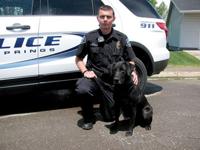
SODA SPRINGS — When Soda Springs Police Officer Tyler Scheierman leaves his position soon to join the Idaho State Police, he’s taking an important tool with him — Tex, the only K-9 dog in the county.
Tex is a detection dog and Scheirerman has been his handler for four years. The bond between the Labrador retriever and the officer was so strong that Scheirerman purchased Tex for $1,500. The city Police Department had originally purchased the dog in 2009 for $4,500 and spent another $6,000 in training for the new K-9 team. The money had come from drug seizures and not city tax funds.
And it was a wise investment.
When Scheirerman made a routine traffic stop in Soda Springs on Feb. 8, Tex helped uncover 41 pounds of marijuana valued at about $100,000 hidden in a 1997 Plymouth van driven by Brian Eng, of Rhenton, Wash. Eng was subsequently charged with trafficking and the arrest became the largest drug bust in the city’s history.
It was just one of several drug discoveries and arrests involving the work of Tex and his human partner.
The Soda Springs Police Department has long focused on combating illegal drugs. In a drug enforcement program brought to existence by Lt. Jon Bunderson, himself a very successful K9 handler, large sums of currency and noteworthy amounts of illegal drugs have been taken off the streets.
Bunderson said police dogs come in two varieties.
Detection dogs like Tex are used to detect contraband. Officers require what’s known as probable cause to search vehicles that have been stopped for routine traffic violations. What an officer may never smell with his or her nose, a dog’s keen sense of smell can detect in seconds, according to Bunderson. A vehicle that an officer has no probable cause to search can be sniffed quickly by a dog and if the animal signals an alert, it can then be searched.
Patrol dogs are trained to track and apprehend suspects, track and locate missing persons, conduct area searches for evidence and provide handler protection. Patrol dogs can also be trained to detect drug odors as well. Such a dog is referred to as a dual-trained dog and has many more hours of training.
Despite the cost of thousands of dollars, police dogs can quickly earn their keep.
Illegal drugs often are accompanied by large sums of money which departments can seize and put to use. Many departments have turned to federal grants to fund dog purchases, along with sources such as fine money, contributions and asset seizures.
As a result of Scheierman and his dog’s departure, the nearest detection dogs in Caribou County will be in Bannock County.
Bunderson said the loss of a local dog like Tex will pose a problem because officers must deploy a dog within minutes of stopping a vehicle — not practical when the dog is one to two hours away.
Caribou County Sheriff Ric Anderson described the upcoming loss of Scheierman’s dog as “an incredible loss, it’s a valuable asset.”
With the recent bust of one of Idaho’s largest pot farms, record drug and cash seizures, law enforcement in Caribou County could likely put a new K9 crime fighter to work. Anderson said he is looking into getting a dog for his department but is waiting to see the results of the personal property tax issue.
Though K9’s are unquestionably good tools, officers in the Southeast corner of Idaho likely won’t be doing dog sniffs any time soon.
Newly elected Franklin County Sheriff Dave Fryar said,“Drug dogs are really great with a good handler.”
As Fryar settles into his new role as sheriff, he said there are no current plans on the table for his department to acquire a drug dog.
Soda Springs Chief of Police Joe Rice is bracing for the loss.
“It’ll be a huge loss,” Rice said. “We’ve got a lot of time and training invested in both of them.”
Rice said he thinks that U.S. Highway 30 running through Soda Springs is a major corridor for illegal drugs, Rice said he has no immediate plans of replacing the dog despite having funding available. At one time Soda Springs used two detection dogs, as well as a tracking blood hound and a dual purpose trained Belgian Malinois.
Soda Springs Mayor Kirk Hansen said that replacing the dog has been discussed in a previous City Council meeting some time ago and it was decided to evaluate the issue and that nothing has changed since then.
“It’s a high priority and they do a splendid job,” the mayor said.
With no dogs in the area for at least a while, officers may have to dig a little deeper into their tool boxes to detect and intercept drug shipments.

(0) comments
Welcome to the discussion.
Log In