

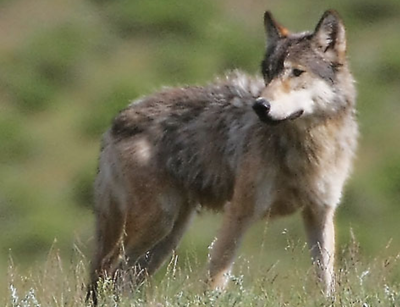
IDAHO FALLS — It’s not uncommon for employees to spot mule deer, elk, rabbits and mice at the Advanced Test Reactor Complex on the Idaho National Laboratory’s desert site. But a possible wolf sighting has generated a little more interest in the area’s wildlife recently.
INL spokesperson Carisa Schultz said an employee reported seeing two animals, which he believed to be wolves, outside the ATR Complex’s northern fence on Saturday. Although such a sighting is unusual, it’s far from improbable, she said.
“I have not heard of a wolf sighting on INL property (before), but it is likely that there is a wolf population on the INL site,” she said, adding that it’s located 50 miles west of Idaho Falls. “It is almost 900 square miles in size and many different types of wildlife can be found on our desert site.”
Gregg Losinski, regional conservation educator for the Idaho Department of Fish and Game’s Upper Snake Region, said he isn’t surprised by the possible sighting either.
“There is lots of wolf activity all around that area since there are cows and agricultural activities,” he said, adding that there are many other animals on the INL property, too, which could also draw the wolves there. “On a daily basis, (it’s not uncommon for wolves) to travel 20 miles for food.”
And many animals have figured out that the INL site, which prohibits hunting and trapping, is a safe place to go, Losinski said, adding that wolves are intelligent creatures and have probably realized that too.
But officials haven’t verified the wolf sighting yet. Schultz said some ATR Complex personnel recently walked the perimeter of the facility’s fence, but they weren’t able to find any fresh tracks. Still, they did report the possible sightings to Fish and Game officials, and have encouraged their employees to report any other sightings to their facility managers.
They have also reminded employees about the importance of respecting wildlife in the area.
“INL procedures call for respecting wildlife and employees should not approach, attempt to feed, harass, or otherwise interfere or interact with wild animals,” she said.
Losinski doesn’t believe the wolves, which are much less likely to attack than domestic dogs, pose any real threat to INL employees. Still, he agrees that people should always be careful around wild animals and avoid any interaction.
“Wildlife should be left alone whether (the animals) are little or big,” he said, adding that even if they aren’t considered dangerous they can still carry diseases.
The Idaho Department of Fish and Game tracks a variety of animal sightings in its work, and officials encourage the public to report living and even dead wildlife they see. For more information, visit www.fishandgame.idaho.gov.

(0) comments
Welcome to the discussion.
Log In