

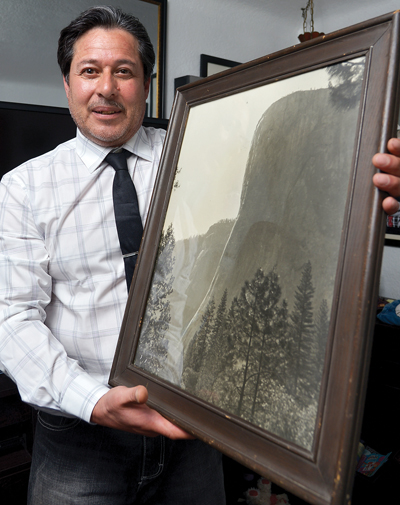
POCATELLO — Sergio Romero knew the framed photograph found within a stack of paintings seemingly destined for the garbage was something special, something unique.
He thought the photograph of Yosemite National Park’s El Capitan was so special, he even decided to hang it in his living room. It wasn’t long before a friend, looking at the photograph hanging on Romero’s wall, further impressed upon Romero just how special the photograph could be.
That’s when Romero went to work researching the photograph.
“I have tried my hardest to discredit the image,” Romero said. “I didn’t want to make a fool of myself. I made sure I knew what I was talking about. Everything I have found has been to its favor.”
After all his due diligence, Romero believes that what he and his son found in the remnants of that estate sale in June 2011 could be the earliest known work of famed American photographer Ansel Adams.
But getting the photograph authenticated appears it may be an uphill battle. Aside from the typical skepticism one might expect in such a situation, Romero feels as though some of the experts he has communicated with have difficulty even comprehending a work from such an early moment in Adams’ life could exist.
Adams received his first camera in 1916 during a family trip to Yosemite. It was a summer during which Adams’ love for both photography and Yosemite were ignited. Historians show that Adams returned the following year with even better cameras and a tripod. He was also in the company of a friend, retired geologist Frank Holman, with whom Adams explored the High Sierra.
At the same time, Adams also began working with a photo finisher in San Francisco, learning darkroom techniques.
It is during this period that Romero believes the photograph was taken and developed by Adams. Specifically, he believes it was the summer of 1917, when Adams was just 15 years old.
What may further stymie the experts is that the photograph Romero and his son found measures 16 inches by 20 inches, a size Adams wasn’t known to work in with any regularity until the late 1930s.
Romero’s hunt to discredit the idea it was an Ansel Adams photograph hanging in his living room began with the signature on the back. Although the signature clearly reads “Ansel Adams,” It was unlike any Adams’ signature he could find in his research online.
That’s when Romero, realizing the work may be an early one that is prior to any fame, reached out the Center of Creative Photography at the University of Arizona in Tucson. The center, founded by Adams, is where all the photographer’s possessions are archived, including numerous letters he wrote to family members as a youth.
“They sent me samples (by e-mail) of his early letters,” Romero said. “At the end, he signed the letters. I cut all these signatures out and pasted them close together so people could see and compare versus the signature on the image. They matched.”
In the early stages of his research, Romero also had the paper on which the image was developed and the image itself checked out. The paper was deemed authentic to the period and the photograph was determined to be a black-and-white silver gelatin, also specific to the period.
His research didn’t stop there. On the back of the photograph there is also a seal from a company called “McDowell and Harding Art Dealers.”
In researching that company, Romero said he found it was an operation that was founded in 1916 in Sacramento, Calif., that specialized in selling the works of well-known artists.
Also in Adams writing, as compared to the copies of the early letters Romero received from the Center for Creative Photography, was a note on the back of the photograph that says “Property of William J. Potter.”
Romero’s research led him to a William James Potter, an internationally known artist of the period, who would likely have had works carried by McDowell and Harding Art Dealers.
“I also placed Ansel Adams and William James Potter at an international art exhibit in 1915 in San Francisco,” Romero said.
The exhibit was one that celebrated the completion of the Panama Canal a year prior, Romero said. He speculates the photograph may have been a gift to Potter from Adams.
But even with all that, Romero realizes people are going to have an issue with the size of the print simply because no one believes he was working with such large prints as a youth.
While common knowledge shows Adams was developing photographs as a youth, even working for a photo finisher to learn the skill, Romero points to Adams’ letters as proof he was dabbling in larger prints at the time.
“He explains to his aunt Mary (in a letter) how he was so excited to get back home so he can develop the images and he also mentioned enlargements,” Romero said.
To say Romero is now convinced he has the earliest known work of Ansel Adams is an understatement. But getting the work authenticated is the next big step. He estimates no fewer than 10 experts will be called in, if and when that day comes, to authenticate everything from the signature, to the paper used for the photograph and the technique used in taking the photograph, to name just a few.
But getting that done may not be as much of a long shot as Romero once thought. He says that individuals with the Ansel Adams Gallery have been trying to contact him for several months. He’s been putting off that contact on the advice of an attorney.
“I have been trying to contact (the attorney) to ask him to give me a good reason not to make this move now because this is what I have been waiting for,” Romero said. “Making it public for the world to appreciate is my goal.”

(1) comment
This is incredible. What a find. Good Luck Sergio!!
Welcome to the discussion.
Log In