

IDAHO FALLS — The Museum of Idaho has welcomed a new and colorful exhibit this month, complete with carnival music and spinning carousels.
The first carousel as you walk in the door is a treat for attendees of the exhibit because it is both historic — more than 90 years old — and a working model that ushers allow kids up to age 10 to ride for $1.
Just a few more paces brings visitors to another working carousel, but this one is smaller and spins with a hand crank. A museum volunteer working it said, “Once you get it going, it’s really quite easy.”
Between the two carousels is a hands-on interactive display of how the up-and-down motion of the animals is achieved. This gives riders the feeling of the motion of actually riding a horse or a bear or an ostrich.
Britni Storer, director of marketing for the Museum of Idaho, said this exhibit always turns out to be more than people were expecting.
“When you go through this exhibit, you’ll see all the intricacies and the delicacies and the craftsmanship that went into these works of art,” Storer said. “They really are artifacts that are diminishing.”
One of the biggest obstacles for carousels’ survival is that the value of individual carousel pieces is more valuable than in a full carousel, according to Storer.
“There were more than 5,000 in the United States… and now there are less than 125,” she explained.
The coolest thing about where we live though, she says, is that of those 125 left, two are within easy driving distance — one in Idaho Falls and one in Rexburg.
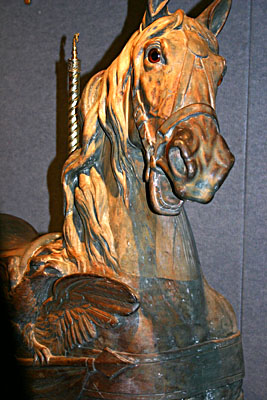
The carousels are all pieces of art, a fact that can be seen in the intricate carvings of the pieces on display.
“It’s viewed as a lost art, and you’ll begin to see that as you go through the exhibit,” says Storer, adding, “We are displaying pieces that have never been on display before.”
The exhibit comes from a collection in Hood River, Ore., and while it has traveled quite a bit, “the exhibit hasn’t been displayed to this extent,” Storer said, adding the diverse facilities of the Museum of Idaho allow for an extensive exhibit of the collection.
American carousels all go counterclockwise, while European carousels all go clockwise, according to the director of marketing.
While some could say that this is just the Americans reaching their fingers into the tradition and changing just to change, Storer said, “Americans really are the ones that took it to another level — they made carousels ornate, they made it a traveling thing. They didn’t used to be a traveling commodity.”
Carousels were first employed as entertainment for adults. Adults of the world were terrified at speeds of five miles per hour. Eventually, once cars were invented and became widely used, carousels started to cater to younger audiences, since adults saw less thrill when cars could go faster.
“Carousels were always about riding a fantasy — whether you were a knight in shining armor, or a princess, or an animal trainer,” Storer said. “ It’s all about being a part of that world that you’ve never been a part of.”
To help create the fantasy, carousels used bright colors, lights and detail.
“The front side (called the romance side) is always more ornate than the back side because you always see the front,” said Storer, adding, “Every one of these horses tells a story.”
One such horse was carved by Charles Carmel, who left the company he worked for creating carousels to start his own. After building a carousel on Coney Island, it burned down the day before it was scheduled to open.
Several museum attendees commented that they had not been overly excited about the exhibit, but when they left they were armed with new ideas, colors and histories. The exhibit is an insightful journey through the history of a fantasy-driven art form.
“There needs to be more of an effort to keep these babies around — you can quote me on that,” Storer said with a smile.
If you go
For more information, visit the museum’s website at www.museumofidaho.org. The carousel exhibit opened January 25th and will remain at the museum until May 27. Entrance is $8 for adults, $7 for seniors, and $6 for youth.

(0) comments
Welcome to the discussion.
Log In