

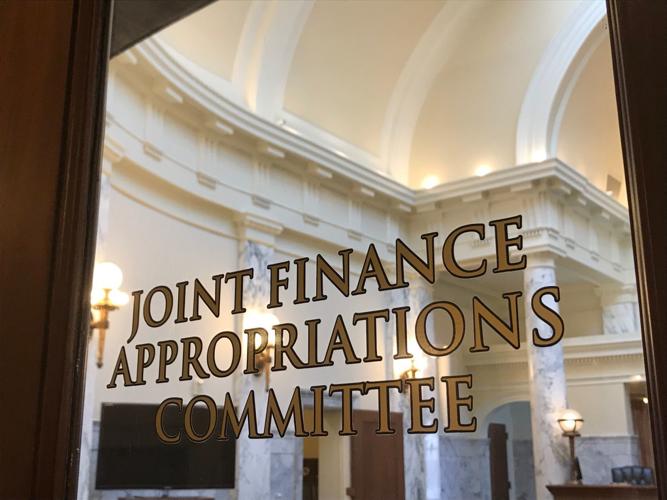
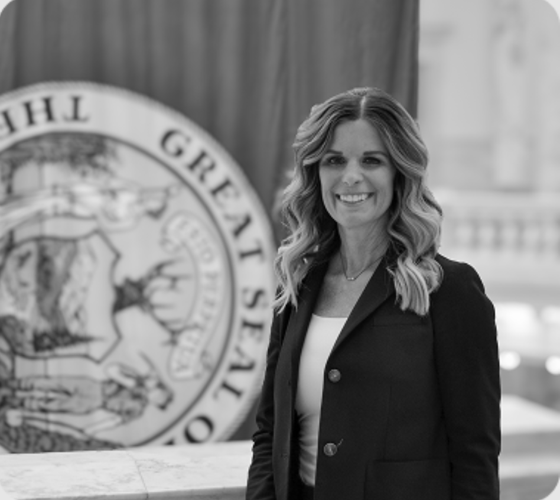
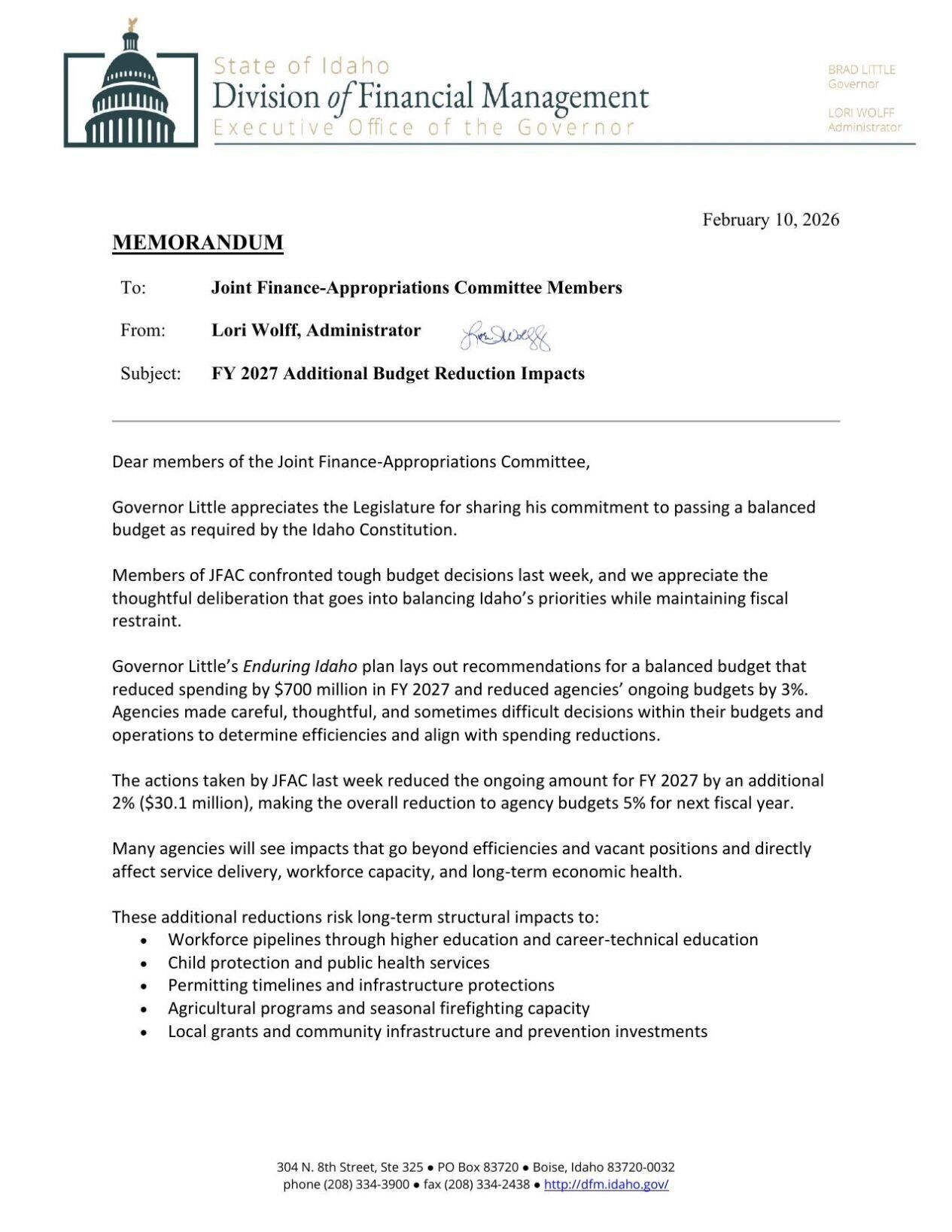
BOISE — In a letter addressed to the members of the Joint Finance-Appropriations Committee, Administrator of the Division of Financial Management Lori Wolff compiled a list of what the state can expect in the coming fiscal year after ongoing budget reductions were approved by the committee.
The letter arrives in response to JFAC’s Friday meeting, where it was decided state agency budgets will be reduced on an ongoing basis by an additional 2 percent, or $30.1 million. This number includes the 3 percent agency holdback order Gov. Brad Little made in the fall, meaning many agencies face a 5 percent reduction in agency budgets for the 2027 fiscal year.
The letter highlighted Little’s appreciation for the committee’s responding to his request to exclude K-12 public schools, Medicaid, the Department of Correction and the Idaho State Police from proposals for additional spending reductions, but said added cuts outside of these agencies would continue to be detrimental to the state.
“Additional cuts jeopardize Idaho’s ability to keep up with population growth, service delivery, infrastructure, and economic development,” Wolff’s letter said. “These effects are not temporary; rebuilding after cuts can take years, even when revenues recover. “
After not being recommended to receive any cuts in funding by Little, Idaho’s courts will see a reduction of 5 percent, or $3.8 million in funding as a result of JFAC’s direction. Wolff’s letter states explicitly these reductions will hit the state’s treatment courts — pertaining to matters for drugs, mental health and veterans — and in turn increase crime in Idaho.

Lori Wolff
Since these courts work to direct individuals away from incarceration and into treatment programs, the result will be an exacerbation of the state’s existing prison capacity problems, “leading to increased costs in the correctional system,” the letter said.
After already receiving cuts impacting the current tax filing season, the Idaho State Tax Commission will face deeper reductions of $903,000 for the next fiscal year. For the average Idaho taxpayer, this means slower processing of tax returns by as much as 24 weeks and refund delays of up to six weeks. With an increase in refund-interest payments arriving as a result of these delays, the cost to Idaho taxpayers is estimated to be $7 million, the letter said.
Cuts to the Idaho Department of Lands to the tune of $265,000 means either fewer seasonal firefighters will be available to districts under IDL’s protection or the duration seasonal firefighters are employed will be reduced, “increasing the risk of uncontrolled fires.”
The Idaho Department of Health and Welfare faces $777,000 in cuts to its Children’s Mental Health and Adult Mental Health services, requiring reductions to the state’s contract with managed health care organization Magellan and leaving “kids and adults with mental health challenges without timely care.” The end result is Idaho’s being pushed away from preventative care and toward hospitals and other crisis services, the letter said.
Idaho’s Career Technical Education (CTE) program is estimated to face $1.8 million in cuts, eliminating 164 CTE programs, which will “disproportionately” impact rural Idaho. Wolff said these cuts limit Idaho high school students’ abilities to get nurse aide certification, take welding classes or receive other forms of technical training that allow them to be career-ready when they leave high school.
“When we start eliminating these programs, we limit opportunities for these kids to be able to continue this,” Wolff said. “That is what long-term structural damage looks like.”
Idaho’s community colleges are due to lose a total of $1.3 million if budget cuts were adopted. They are poised to lose an average of 7 percent of their budgets when encountering for CTE reductions and changes to the withholding of enrollment workload adjustment funding, which increases funding for these institutions as enrollment improves.
Wolff’s letter notes that reversing the additional 2 percent cuts mentioned here, as well as several others outlined in her full letter, would cost about $13 million for fiscal year 2027, a year projected to have an ending balance of $184 million. In directing the letter to JFAC, Wolff said her aim is to make both the committee members and other legislators aware of what the state will lose if these cuts are carried out.
“I think these represent places where we’re just cutting too deep, and we’re starting to have impacts on communities, on services, prevention — the things that really are going to cause longer term, downstream impacts and costs,” Wolff said.
Members of JFAC will be taking the impact of these cuts into consideration Friday, when they are scheduled to set maintenance budgets for state agencies. These are crucial for agencies as individual maintenance budgets go before the House and Senate floors of the Idaho Legislature for a vote. Any additional enhancements (or funding increases) to these bare-bones budgets would have to come through JFAC in separate bills.

(0) comments
Welcome to the discussion.
Log In