

The Idaho Water Users Association and the East Idaho Water Rights Coalition hosted the Eastern Idaho Legislative Water College tour last Tuesday with dozens of lawmakers and municipal leaders.
The tour included about 20 legislators or legislator candidates, over 20 representatives from cities and organizations and 10 speakers who are experts in different water projects. The day-long tour involved visiting conversion projects, recharge wells, automated canals and a gravel pit conversion into a recharge lake.
Over lunch, attendees received a surprise visit from Gov. Brad Little who announced the $10 million allocation to benefit the Eastern Snake Plain Aquifer. They also received an update on negotiations and possible legislation from Alan Jackson, District Manager of the Bingham Groundwater District, and Paul Arrington, Executive Director of Idaho Water Users Association.
Jackson, widely recognized as an expert on water issues, clarified that there are two sets of negotiations happening this fall — and they each have different focuses and deadlines.
The Eastern Snake Plain Aquifer Groundwater Management Plan Advisory Council, organized by the governor, is developing a plan to ensure the stability and sustainability of the Eastern Snake Plain Aquifer that supplies water to 16 counties in Southeast Idaho. Its strategy is to reduce the groundwater use, increase the aquifer recharge and monitor groundwater levels. The council’s deadline to have a plan is Sept. 1.
According to an update by Keith Esplin, Executive Director of the Eastern Idaho Water Rights Coalition, these negotiations are not going well. The groundwater users submitted a plan written by IDWR Regional Director James Cefalo and groundwater users that includes ways to stabilize the aquifer.
However, the surface water users and Idaho Power rejected that plan, and they submitted their own that would require millions of acre feet of water to return the aquifer to a prior level — which would mean massive curtailments on groundwater pumping and dried up farmlands.
The second, more specific negotiation happening involves only one portion of the Snake River — the American Falls Reach, according to Jackson. A reach is a defined section of a river that has monitoring stations at the beginning and end of the section. This reach is important because it is one of the three places where the aquifer water leaves its underground reservoir. Monitoring the American Falls Reach is one way to measure how full the aquifer is by the amount of water overflowing out.
If the senior water rights owners, represented largely by Twin Falls Canal Company, determine in the spring that the aquifer levels are too low to supply their needs, they issue a “call” for more water from the junior water rights owners, largely the groundwater uses of Eastern Idaho. This year that call led to curtailment orders and tagged pumps in June.
The American Falls Reach negotiations are the result of an agreement that ended the curtailment order. Both groundwater users and surface water users agree to temporarily suspend the 2015 agreement and current water litigations, to allow a new, clearer agreement to be forged before Oct. 1.
According to Esplin, these negotiations are going better, thanks in part to Lt. Gov. Scott Bedke. He has insisted the surface water users allow averaging the flow levels to determine average aquifer levels over several years, a major point of disagreement. They also have agreed on an acceptable conservation number and the continued use of private recharging, which is when water is put back into the aquifer through injection wells or recharge basins.
To a degree, there is a crossover of issues between the two negotiations since the American Falls Reach is within the whole Eastern Snake Plain Aquifer system.
Among ways to recharge the aquifer and to use the pumped water efficiently, the Water College learned of the Osgood Pipeline project in the Bonneville Jefferson Water District, a conversion plan to return the fields to surface water irrigating in the area west of the Idahoan plant and Idaho Power plant. The proposed 10-mile pipeline and wells would cost about $30 million.
Currently the Idaho Water Resources Board is offering grants of 50 percent to 70 percent of the cost to convert to surface water irrigation. By piping in river water, called surface water, the farmers take less directly from the aquifer.
A simple recharge well set up next to a flowing canal was also visited. These less expensive units simply take unneeded irrigation water from the canal, screen it and then pump it back into the aquifer through a separate injection well. There are plans to space a hundred of these recharge systems along canals. The downside is that they can only divert water when it isn’t needed for irrigation. But they can recharge 100-acre feet a day without massive pipes or pipelines. The fractured lava content of the subsoil allows more ready absorption into the aquifer than in other places in the world.
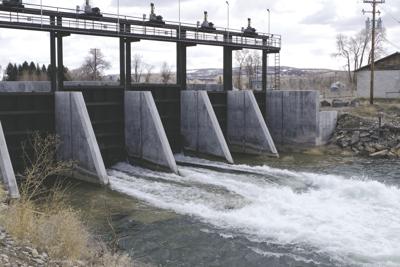
Another major way to efficiently use the canal water available is to automate the canal gates to immediately respond to flow conditions, lessening any loss or under use of the canals. The tour also visited the Great Feeder Canal headgates, an automated system that diverts about one third of the Snake River into 15 canals. The automation goal is to use every drop of the available water.
The municipal water needs were also outlined by the Idaho Falls Water Superintendent David Richards. Though non-ag uses of water is less than 3 percent, it is a growing need. For example, a farm uses 9 gallons of water per minute per acre. That same land developed into a subdivision with one-fourth-acre lots uses 9.6 gallons of water per minute per one-fourth acre — a much greater water need.
Likewise, the Domestic Use Well exemption in Idaho allows every home not on a municipal system to pump 13,000 gallons of water per day per one-half acre. In 2008, there were 29,000 acres being irrigated through domestic wells. And that number is increasing with more developments across the state. Often, developers would rather put in a community well, but the Idaho Department of Environmental Quality permit and water rights are hard to acquire. Looking to continue future growth, there may be new Idaho legislation to classify and manage the domestic wells better.
Besides ways of monitoring water usage, conserving how the water is used, returning water to the aquifer through recharge sites or surface irrigating and growth considerations, cloud seeding was also mentioned in passing. Unlike the other approaches, cloud seeding is about making more water by adding particles to snow clouds creating greater snowfall — leading to greater snow melt and more water. This last year the cloud seeding program in Eastern Idaho yielded 8 percent more water, an increase of 632,000-acre feet.
One thing all parties agree on is the importance of finding a way to sustain the agricultural economy for all farmers and ranchers — and residents of Idaho and beyond. The Eastern Snake Plain Aquifer breadbasket region of the state contributes heavily to Idaho being No.1 producer of potatoes in the nation, No. 1 in growing barley, No. 2 in beets, No. 3 in dairy and No. 5 in wheat, according to Brad Buttars of Bonneville Jefferson Ground Water District.
There is a lot at stake, and it all requires sufficient water. No wonder water issues become heated and territorial. Perhaps these negotiations — or new legislation — will bring back harmony between all benefactors of the Eastern Snake Plain Aquifer.

(0) comments
Welcome to the discussion.
Log In