

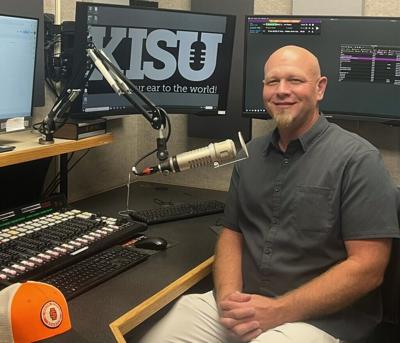

POCATELLO — After the passage of the Rescissions Act of 2025, which slashed federal funding for the Corporation for Public Broadcasting, KISU is scrambling to fill a massive budget gap which threatens local programming, jobs and the station’s very survival.
When the federal government passed the Rescissions Act of 2025 on July 18, it impacted radio stations across the nation. For KISU, a public radio station located on Idaho State University’s campus, it meant the elimination of 25 percent of its annual budget.
While larger stations and entities like PBS and NPR are more likely to be able to cover the costs of their expenses thanks to large budgets or significant contributions from donors, KISU is considered a rural radio station and more heavily relies on its federal funding to stay on air.
“KISU is a small operation,” said Jamon Anderson, general manager and program director for KISU. “We have two full time employees, a handful of part time employees and a handful of student employees. For us, that’s about $130,000 that we lost in our annual funding. It’s impossible for us to make up with cuts. We’ve been fundraising ever since the Rescissions Act was passed.”
Every year, KISU fills out a grant application based on its finances for that year. Once that application is submitted, it is awarded a certain amount, usually in January, and can use those funds in spring.
Last year, it received $150,000, which it earmarked for fiscal year 2026, which began in July. That’s where Anderson draws the $130,000 deficit from, as the station expects that funding to help supplement what it receives from local donations. Those funds from the Corporation for Public Broadcasting, or CPB, amount to around a quarter of its yearly budget.
The rest of KISU’s operating budget comes from an approximate $100,000 from the Associated Students of Idaho State University, or ASISU, personal donations amounting to around $80,000 and then around $125,000 from underwriting. KISU also has other small initiatives, providing the broadcasts for ISU Athletics, which contributes $20,000.
While those contributions can seem significant, the majority of KISU’s programming is coming from national distributors providing the station with a collection of national content from a variety of sources.
“As far as national programming, that’s our single largest expense right now,” Anderson said. “We’re talking about programs from NPR, American Public Media, Public Radio Exchange, that’s unfortunately going to be the next (budgetary) step if we’re going to spend the next six months fundraising. But after six months, if we come up short of what we need next, then we’ll start to make cuts to our national programs.”
This month alone, KISU has had $25,000 in budget cuts that include five locally produced programs and decreases in hours for its part time staff and student employees. The station will still have about 10 local programs and segments it’s creating, along with local news.
“We’re a smaller station, so we pay far less money than a larger station would for that national program,” Anderson said. “But still, it’s a significant cost associated with the programming. KISU has always been very fortunate to have what we can consider to be the highest quality programming that we could possibly collect for East Idaho. Despite having a small staff and a small budget, we’ve always been able to put together the programs that we wanted to give to East Idaho. I think now, without the CBD funding, we’re now in a position where we have to make some concessions in some areas.”
A common misconception regarding the passage of the Rescissions Act of 2025 is how it relates to NPR or PBS. According to Anderson, only 1 percent of the budgets for NPR and PBS come from the Corporation for Public Broadcasting. That federal funding the CPB received primarily went to stations across the nation.
For successful national programs like NPR, a portion of its funding comes from a set fee it receives from other stations. Each station will then pay that fee and are able to fundraise on that program.
“That’s sort of the model for most of the public media,” Anderson said. “That’s the way that they produce the shows. They have the stations actually paying into it and the cost of the programming is always based on the size.”
Anderson also said that creating local content is far more expensive than utilizing the national content. To make ends meet, KISU may be required to trade one high quality national program for something that is still recognized but that fewer people know to reduce their overhead costs.
But not all programming costs are equal. Anderson provided an example that out of an approximate $100,000 programming cost annually to KISU that one or two of those included programs might cost around $12,000 alone.
“Stations are the real losers in these cuts,” Anderson said. “There is concern about the larger ecosystem of public media. The CPB actually helps stations in a number of ways. They would help pay our music licensing fees. We have a handful of locally produced music shows on KISU. We just pay a small fee. They helped the collective bargaining of the music rights and all that stuff, saving us from having to do hours and hours of paperwork.”
Anderson continued, “We have to submit music playlists to ASCAP and all these other music royalty companies. That’s one thing that’s going to end at the end of this calendar year. When CPB completely closes its doors on the 31st of December, we have to have another plan in place for continuing our music programs. They also helped fund the public radio satellite distribution system. We have receivers here in our office and a big satellite dish on the side of the building. They help subsidize that whole system. We might be in a position where we have to pay more for that satellite service.”
Anderson has already spent a significant amount of time trying to plan for an uncertain future, taking little time off during the summer because of the significant work that still needs to be done for the rural station.
While KISU has received a significant outpouring of support from area residents — acquiring what it would normally get in donations over a six month span in just six weeks — Anderson feels that high level of donations may not be maintained year in and year out. But in terms of what the station needs to operate for the next year, those funds will help.
“I don’t want to downplay the importance of the people who have given to KISU because not only is it the dollars that we get in, but we’ve gotten so many new donors that we’ve never gotten a gift from in the past,” Anderson said. “It goes a long way, because it shows that we have a broad range of supporters throughout East Idaho, not just Pocatello, not just Idaho Falls, but as far north as Island Park and Tetonia. At a time when morale is a little low, that lifts our spirits and keeps us going. It adds another layer of importance to us when we get those personal donations.”
Thanks to donations from “viewers like you,” KISU is fighting to provide area residents with quality programming they enjoy, despite a small staff and the looming shadow of budgetary shortfalls it will have to make. But the rural East Idaho station still needs support from the community and its listeners who rely on the station.
“We’re hoping to increase personal donations, or individual giving, by about $35,000,” Anderson said. “We’re also hoping to increase underwriting, that’s the business donations, by about $35,000. We’ll then ask ISU for roughly $30,000 and then if we come up short of what we need to operate, I think the option is also there for us to go to ISU to request general funding.”
For Anderson, KISU represents opportunity and provides essential services to the community. The station works with ISU journalism classes, the school’s independent student newspaper The Bengal and provides news programming on the regional and state level, all with local perspectives. That professional development component is what Anderson says is what he’s most passionate about.
“It’s that programming, that opportunity for students and then the pure and simple fact that we have somewhere in the neighborhood of pretty close to 20,000 people in East Idaho that tune into KISU on a weekly basis. What happens when KISU is gone? With all these other stations struggling, it’s not likely that somebody else is going to move in and provide public radio to our area, at least on the FM signal. It’s important for those three main reasons.”
For now, the station’s fate hangs in the balance, dependent on the generosity of its listeners and the willingness of local institutions to step in where federal support has vanished.
To support KISU, visit kisu.org and click the donate button, or send contributions directly to the station, located on the first floor of Idaho State University’s Pond Student Union Building.

(0) comments
Welcome to the discussion.
Log In