

POCATELLO — Idaho State University officials say they're making lemonade out of the lemons dealt by this year's budget cuts, as the consolidation of two colleges into the College of Humanities, Education and Social Sciences, or CHESS, moves from concept to implementation with the start of the fall 2026 semester.
CHESS merges the former College of Education with the former College of Arts and Letters into a single college built around three schools — the School of Education, the School of Humanities and the School of Social Sciences. The hybrid college now functions under one dean, two assistant deans and the leadership structure that once ran two separate colleges.
Adam Bradford, ISU's vice provost and senior vice president of academic affairs, said the biggest challenge was helping students and the campus community navigate the uncertainty of a change of this magnitude. He credited faculty and staff, who came together to work through problems, for helping the college through the transition.
"Rumor tends to flow in change," Bradford said. "Fear is not uncommon in change. We were making some pretty good lemonade out of the lemons that were coming in our direction."
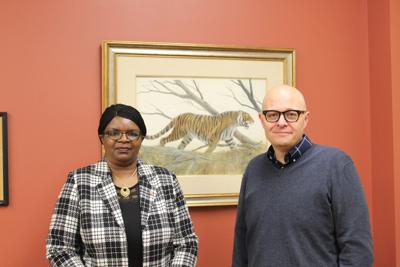
Esther Ntuli, associate dean of the School of Education and the former interim dean of the College of Education, said the intention of CHESS was to cut the duplication of resources, deepen collaboration between similar disciplines and protect academic programs — along with the students who are finishing their degrees.
"I feel like it's already working because now that we are part of the bigger college, nothing has really changed for us in terms of how we do things," Ntuli said.
The consolidation grew out of a difficult budget landscape that hit Idaho higher education earlier this year, Bradford said. University leaders looked for ways to reduce the school's administrative footprint without cutting many of the academic programs themselves.
Bradford said the colleges were a natural fit because their students already moved constantly between the two. Education majors regularly take coursework in humanities and social science departments to earn teaching endorsements in subjects such as English, history, social studies and foreign languages, while students in the former College of Arts and Letters studying psychology, social work and related fields overlap heavily with education's school psychology programs.
While not unheard of, Bradford acknowledged that the new hybrid college is uncommon nationally.
"It's a little bit of an experiment," Bradford said. "But the logic about bringing them together is based on the understanding that those students tend to work across those college lines."
The merger's biggest early hurdle, Ntuli said, was reassuring students and faculty that combining the colleges would not dilute their professional identity or jeopardize anyone's accreditation.
Programs in the school remain accredited by outside bodies such as the Council for the Accreditation of Educator Preparation and the National Association of School Psychologists, Ntuli said, and none of that status has changed under the new structure.
To assuage many of those fears ahead of this year, Ntuli said the school reached out directly to teachers and cooperating districts by hosting a three-day summer institute for school administrators run by the school psychology and educational administration programs. A representative from the Idaho State Board of Education also took part.
"Our accreditation is not going away," Ntuli said.
The reorganization coincides with ongoing institution-wide reviews of ISU's academic offerings, though the two are separate. Bradford said the university evaluates programs each year based largely on graduation numbers over the previous five years, assessing student demand along with the cost of maintaining faculty and support services for each program.
This year, the university submitted a list of roughly 25 programs to the Idaho State Board of Education for discontinuation.
Both administrators emphasized that no program is cut off abruptly. Students retain what the university calls "catalog rights," allowing them to finish a degree under the graduation requirements in place when they declared their major, even if the university later closes new admissions to that program. Bradford said a full "teach-out" typically takes two to three years.
"We never shut a program off," Bradford said. "We'll take that student through to graduation before we actually curtail that program because we have an ethical and, frankly, a responsibility to our students. We bring them in and they pursue a major. We're never going to shut that off on them."
Some of those consolidations blend adjacent programs rather than eliminate them outright. Ntuli provided an example of a master's degree in early childhood education that the university closed several years ago, folding its coursework into a larger special education master's program with two tracks — one for students without a special education background and one for licensed special education teachers seeking advanced coursework.
Bradford gave a similar example outside CHESS, in the College of Science and Engineering, where a low-enrollment measurement and control engineering program is being absorbed into the university's mechanical engineering program rather than eliminated.
"There's a story behind those programs," Bradford said.
Beyond administrative savings, both administrators said CHESS has made ISU's faculty more competitive for research grants that reward interdisciplinary teams.
ISU currently has an in-progress grant application that draws on faculty from computer science, the College of Technology and CHESS's humanities and social science programs to pursue a grant under the federal Strengthening Institutions Program. The grant aims to support artificial intelligence development across the university, including in teaching and pedagogy.
Bradford said the university expects to hear back from the U.S. Department of Education within about 45 days.
Separately, CHESS received a $50,000 state grant this year to train education faculty on integrating AI into their teaching, Ntuli said.
As ISU and colleges across the nation begin to modernize with the rapid development of artificial intelligence, both administrators described how they are approaching AI and how to navigate both the moral quandary and practical applications that could help students and faculty members alike.
Bradford pointed to emerging tools such as AI tutors embedded in ISU's Canvas learning management system, which track what students already understand and then walk them through concepts conversationally rather than simply supplying answers.
"It's not just giving the students answers, but actually helping the students increase their understanding," Bradford said.
Bradford said he is skeptical that AI has driven a major rise in academic dishonesty, comparing current anxieties to the arrival of Wikipedia and other internet resources. He added that ISU has a campuswide committee guiding how the university adopts AI tools across teaching, assessment, accreditation and general business operations, with new tools expected to roll out over the next several years.
In the School of Education, Ntuli said the focus is on training future teachers to use AI transparently and to preserve their own professional voice rather than let the technology homogenize their work.
Ntuli said students are asked to attach an AI disclosure statement to assignments describing how they used the technology. Faculty are tasked with redesigning assessments, including comparing lesson plans students write before and after consulting an AI tool, to ensure students can demonstrate they understand what they submit.
"The more we feed stuff into AI ... you begin to sound like everybody else," Ntuli said. "The biggest question is how do you use AI and retain your uniqueness?"
Ntuli said she is not concerned that AI will replace educators, referencing early childhood education as a field where the technology cannot substitute for direct human interaction.
"AI can never take our jobs," Ntuli said. "But we have to figure out how we retain our uniqueness, our brand."

(0) comments
Welcome to the discussion.
Log In