

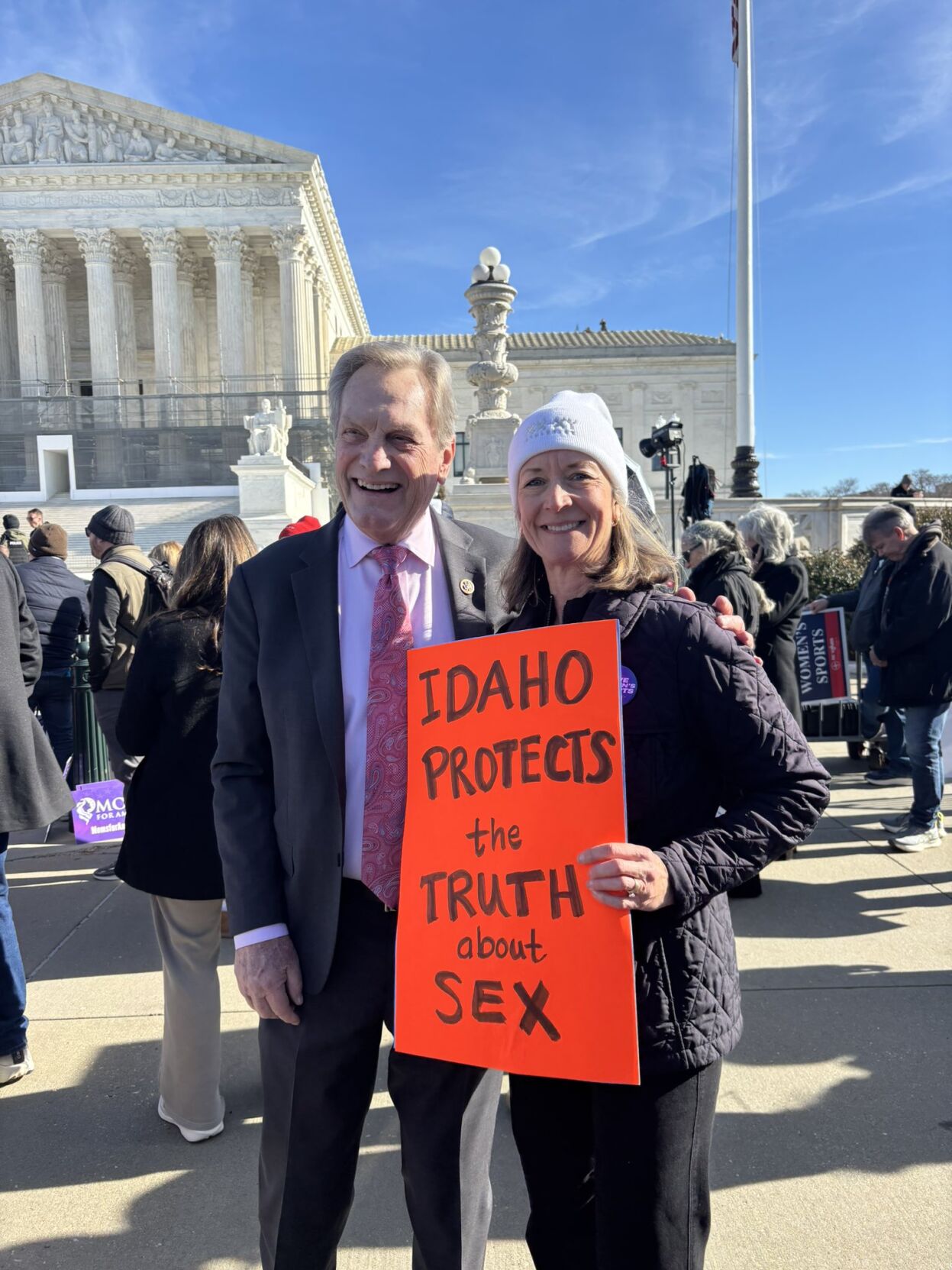


WASHINGTON — Idaho Rep. Mike Simpson and Sen. Jim Risch joined a rally Tuesday defending the Fairness in Women’s Sports Act on the steps of the U.S. Supreme Court, where the court appeared ready to uphold state laws barring transgender girls and women from playing on school athletic teams.
Supreme Court justices heard arguments that will determine the outcomes of Little v. Hecox and West Virginia v. B.P.J., two cases that will dictate whether state sports bans violate the Constitution and Title IX, which prohibits sex discrimination in education.
The court’s conservative majority, which has repeatedly ruled against transgender Americans in the past year, signaled during more than three hours of arguments that it would rule the state bans don’t violate either the Constitution or Title IX.
Idaho and West Virginia are asking the Supreme Court to allow enforcement of state laws that prohibit or restrict transgender athletes in sports. More than two dozen Republican-led states have adopted similar bans.
The Idaho case involves Lindsay Hecox, a 25-year-old transgender woman and student at Boise State University who wanted to join the women’s cross-country team and was prohibited from trying out because of Idaho H.B. 500, the Fairness in Women’s Sports Act, passed in 2020.
Hecox sued, arguing that the act discriminated based on sex and transgender status in violation of the Equal Protection Clause. She didn’t make either squad because “she was too slow,” her lawyer, Kathleen Hartnett, told the court Tuesday, but she competed in club-level soccer and running, according to the AP.
The West Virginia case involves Becky Pepper-Jackson, a 15-year-old high school sophomore who attended Tuesday’s hearing. She has been taking puberty-blocking medication, has publicly identified as a girl since age 8 and has been issued a West Virginia birth certificate recognizing her as female.
Idaho Solicitor General Alan Hurst argued before the nine justices, defending the state’s authority to maintain sex-separated athletics based on biological reality. The oral arguments focused on whether Idaho’s law violates the Equal Protection Clause and how courts should review state policies that distinguish between male and female athletes.
Tuesday’s hearing followed a ruling by a three-judge panel on the 9th U.S. Circuit Court of Appeals that upheld a judge’s preliminary injunction against Idaho’s 2020 law. Lower courts ruled for the transgender athletes who challenged laws in Idaho and West Virginia. The ACLU sued and the lower courts blocked Idaho from enforcing the law from day one.

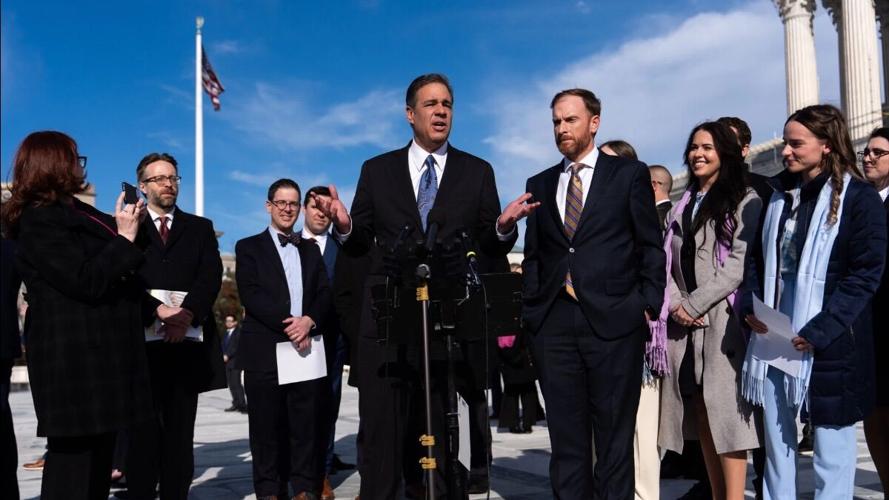
Idaho Attorney General Raul Labrador speaks to the media outside the U.S. Supreme Court on Tuesday.
When Attorney General Raul Labrador took office in January 2023, he made defending the law a top priority and appealed the case to the U.S. Supreme Court. The court agreed to hear Idaho’s case in July 2025 alongside the West Virginia case.
The legal fight is playing out against the backdrop of President Donald Trump’s broad effort to target transgender Americans, beginning on the first day of his second term and including removing transgender people from the military and declaring that gender is immutable and determined at birth.
Chief Justice John Roberts signaled Tuesday he sees differences between a 2020 case in which he supported claims of discrimination and the current dispute. In 2020, the Supreme Court ruled LGBTQ people are protected by a landmark federal civil rights law that prohibits sex discrimination in the workplace. But last year, the six conservative justices declined to apply the same analysis when they upheld state bans on gender-affirming care for transgender minors.
Justice Brett Kavanaugh, who coached his daughters in girls basketball, seemed concerned about a ruling that might undo the effects of Title IX, which has produced dramatic growth in girls and women’s sports. Kavanaugh called Title IX an “amazing” and “inspiring” success, according to the AP.
Some girls and women might lose a medal in a competition with transgender athletes, which Kavanaugh called a harm “we can’t sweep aside.
Prominent women in sports have weighed in on both sides. Tennis champion Martina Navratilova, swimmers Summer Sanders and Donna de Varona and beach volleyball player Kerri Walsh-Jennings support the state bans. Soccer stars Megan Rapinoe and Becky Sauerbrunn and basketball players Sue Bird and Breanna Stewart back the transgender athletes.
About 2.1 million adults, or 0.8 percent, and 724,000 youths ages 13 to 17, or 3.3 percent, identify as transgender, according to the Williams Institute at the UCLA School of Law.
Despite the small numbers of transgender athletes across the United States, the issue has taken on significant importance. NCAA president Charlie Baker told Congress in 2024 that he was aware of only 10 transgender athletes out of more than a half-million students on college teams.
The NCAA and U.S. Olympic and Paralympic Committees banned transgender women from women’s sports following an executive order signed by President Trump in February 2025.
The public generally supports the limits. An Associated Press-NORC Center for Public Affairs Research poll conducted in October 2025 found that about 6 in 10 U.S. adults “strongly” or “somewhat” favored requiring transgender children and teenagers to compete only on sports teams that match the sex they were assigned at birth.

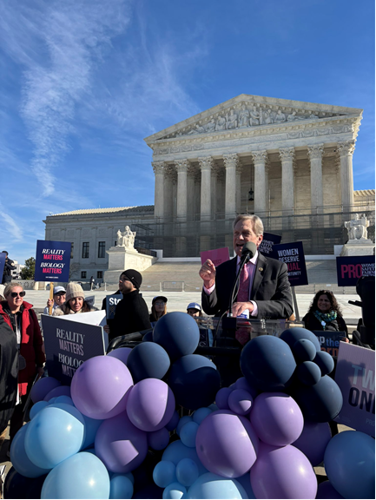
Idaho Republican Representative Mike Simpson addresses a crowd in front of the U.S. Supreme Court building in Washington on Tuesday.
Simpson recently signed an amicus brief supporting Idaho’s law, and he has supported and cosponsored several bills to prohibit males from participating in athletic programs or activities designated for women, according to his office. Risch has introduced legislation to protect women’s sports nationwide and supported Idaho’s Supreme Court case with an amicus brief, according to his office.
“Female athletes deserve our full support in keeping men out of women’s sports,” Simpson said in a Tuesday news release. “I was honored to stand up for just that outside the Supreme Court steps today alongside female athletes and some of the fiercest supporters of women’s sports. Idaho has led the way to protect women’s sports by ensuring biological males cannot compete, and I’m confident the Supreme Court will side with Idaho’s common-sense law and the truth.”
“I commend Attorney General Labrador and his office for their strong defense of Idaho’s commonsense law before the U.S. Supreme Court,” Risch said in a Wednesday news release. “It was an honor to sit inside the court room and witness Idaho leading the nation in protecting fairness in women’s sports.”
Labrador said his hope is that the court “will affirm common-sense protections that ensure women’s spaces and sports remain fair, safe, and dedicated to empowering female athletes.”
The cases could have sweeping legal ramifications for about a dozen other Republican-led states that have enacted laws banning transgender athletes in sports. A ruling for West Virginia and Idaho would effectively apply to the other two dozen Republican-led states with similar laws.
The outcome also could influence separate legal efforts by the Trump administration and others seeking to bar transgender athletes in states that have continued to allow them to compete.
Decisions for the two cases are expected by early summer.
The Associated Press contributed to this report.

(0) comments
Welcome to the discussion.
Log In