

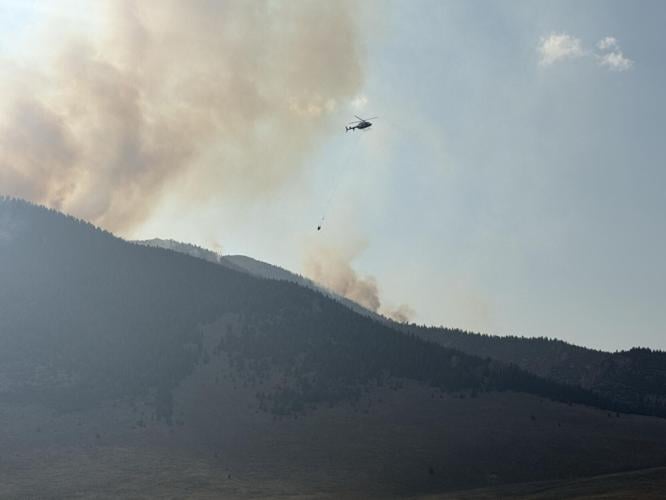




BOISE — Idaho’s fire suppression account balance has maintained a positive standing, but several key expenditures are still to be reconciled, and heightened potential for wildfire remains present throughout the state.
This week’s meeting of the Idaho Land Board arrived with just over a month remaining in the state’s official closed fire season, which runs from May 10 through Oct. 20 and during which state burn permits are legally required. Though nearing the end, National Interagency Fire Center (NIFC) forecasts are predicting above-average fire potential across the entire state in September, Idaho Department of Lands (IDL) Director Dustin Miller said.
“We’re not out of the woods yet,” Miller said. “Our potential for fire is gradually beginning to decline with shorter days, cooler nights, but drought and cured fuels will continue to present challenges.”

Idaho Department of Lands Director Dustin Miller
As of Monday, emergency fire suppression expenditures have reached nearly $41 million. After incorporating $14.6 million in reimbursement costs — stemming from Idaho Department of Lands resources fighting fires outside its jurisdiction or area of responsibility — the state’s net obligation stands at $25.9 million, Miller said.
According to Miller’s fire season update, the total number of IDL protection area fires is well below the state’s three-year average. This year’s fire season has seen 218 total fires burning 10,233 acres, whereas the three-year average from 2023 to 2025 was 302 fires burning 19,296 acres.
A less positive trend compared to prior years lies in the outsized role human-caused fires have had to this point in the season. Year-to-date, this year’s IDL protection area fires were 82% human caused, accounting for 178 of 218 fires. Looking back to the prior three years, the fire season with the closest share of human-caused fires at this point came in 2023, when 72%, or 195 of 271 fires were human-caused.
When looking to fire activity including those outside IDL’s protection, more than 846,000 acres have burned in Idaho as of Sept. 8. Most of the acreage lies on land owned by the U.S. Wildland Fire Service, which has seen 564,000 acres burn in the state. Private land holdings were the next largest by acres burned at about 163,000 acres.

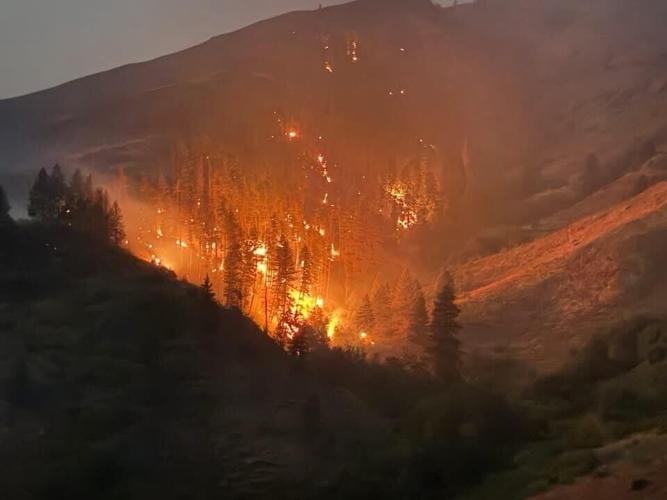
Night fire activity on the Bob Creek fire, July 27.
Miller said Tuesday the department has been able to avoid deficiency warrant spending this fiscal year, but several reimbursements — associated with payments owed by the federal government — are still to be received and incorporated alongside expenses associated with several large fires from across the state.
Boise’s Claremont fire, Washington County’s Tartar fire and the over half-million-acre Big Grass fire on the Idaho-Oregon border are among the fires that have yet to be factored into this year’s fire expenses. Though the Idaho Department of Lands is only responsible for a portion of fire costs in each of these cases, Gov. Brad Little noted the Claremont fire alone posed several million dollars in costs for IDL.
It is nonetheless better standing for the state compared to early in the fire season. In June, Idaho State Forester Julia Lauch said the state’s fire suppression fund hit a balance of $0 and IDL was “actively deficiency spending.” Upon entering the new fiscal year on July 1, however, state fire suppression funds have been shored up by a one-time transfer of $32.8 million that was approved by the Idaho Legislature during this year’s session.
“We were tight on cash at the beginning of the season,” Miller said, “but we’ve been working to reconcile costs, bring money back in from the federal government that’s owed to us and the $30 million infusion on July 1 helped.”

Julia Lauch
If the need were to arise, Little noted IDL’s authority to pay fire expenses through deficiency warrants, an effective credit line drawn against the state general fund, differs from Oregon.
In the case of Idaho’s western neighbor, the state has had to call a special session to allocate nearly $123 million for emergency fire suppression costs after over 2.5 million acres burned across the state, as was reported by the Capital Press.
At a broader level, national fire picture has shown signs of improvement in recent weeks in what has been a very active fire season. More than 8.4 million acres have burned across the country, equivalent to 147% of the 10-year average, according to the National Interagency Fire Center (NIFC).
The national fire preparedness level, a NIFC measure of the strain on fire suppression resources in the country, has notably declined from level five, the highest on the scale, to level three, indicating national mobilization is still required to manage fires in active areas.



(0) comments
Welcome to the discussion.
Log In