

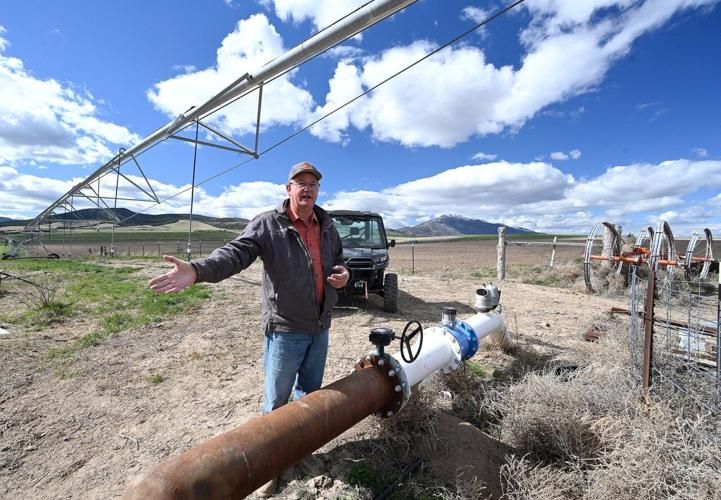
The recent completion of the Hawkins pipeline in South Bannock County couldn’t have come at a more fortunate time for shareholders of the Marsh Center Irrigation District.
Idaho’s 2026 water year is best described as precarious. Gov. Brad Little’s recent declaration of a statewide drought brings the crisis facing the state’s agricultural producers into sharp focus.
The newly completed 10-mile pipeline is fed by water from Hawkins Reservoir and replaces a network of irrigation ditches. Workers completed the first five miles in 2024 and finished the second five miles this spring.
Established in 1896, the irrigation district serves 12 shareholders and provides irrigation water for 3,220 acres.
“This is something we’ve been wanting to do for, like, well, forever,” said Wade Egan, secretary-treasurer and project manager for the Marsh Center Irrigation District. “I’m 59 years old and it’s been discussed about piping this thing for the last 24 years.”

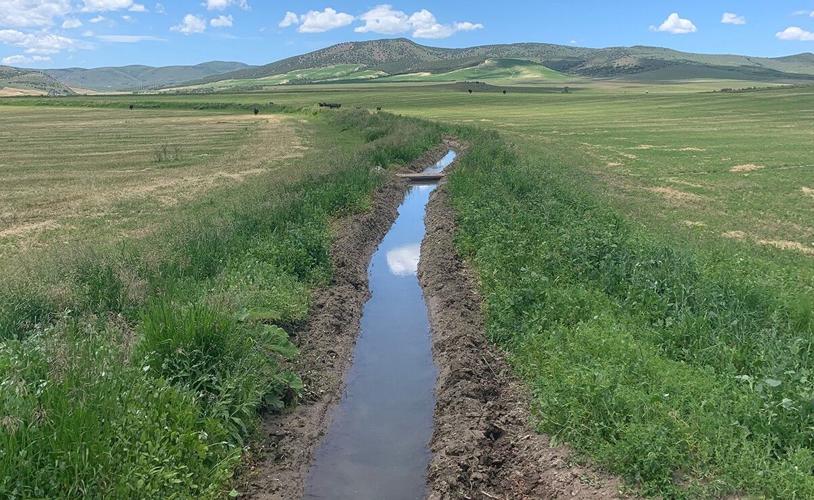
A Marsh Center Irrigation District irrigation ditch, now just a fading memory.
About five years ago, members of the irrigation district began working with the Idaho Department of Environmental Quality and the USDA Natural Resources Conservation Service to fund a pipeline to replace the system of irrigation ditches.
Egan estimated the total cost of the project at $2 million, with $250,000 coming from a DEQ State Ag BMP program grant and the remaining funds provided through the NRCS Environmental Quality Incentives Program.
Steven Smith, a Source Water 319 analyst for Idaho DEQ, said the Portneuf Soil and Water Conservation District, working with the irrigation district, submitted an application for a BMP program grant.
“We run it through our ranking process, through our basin advisory groups and that one ranked out high enough to get funded,” Smith said of the grant approval process.
The grant award totaled $250,000, with $225,000 going to the irrigation district and $25,000 going to the Portneuf Soil and Water Conservation District.
Taylor Uphoff, USDA-NRCS conservation team leader, said the EQIP grant provides technical and financial assistance to agricultural producers and forest landowners to address natural resource concerns.
“When we look at the Hawkins pipeline, this specific project focuses on improving the irrigation company’s ability to reduce surface water loss and efficiently deliver surface water to their shareholders,” Uphoff said. “The pipeline project would also allow them to utilize gravity pressure and reduce their irrigation pumps.”
Pipeline benefits include labor savings, water conservation, power savings and reduced equipment costs. The project also carries an environmental benefit — water traveling through the pipeline will not collect soil and sediment.
“Prior to the pipeline, irrigation members would have to clean the ditch of growth, scope the ditch, walk the ditch, inspect it for gophers, weeds,” Egan said. He estimated that he and three workers spent eight days cleaning their section of irrigation ditch every spring.
Egan also said irrigators can expect water savings of at least 30 percent.
“Minimum of 30 percent,” Egan said of future water savings. “It might be closer to 45 percent based on where the pipe was delivering. It’s like raising Hawkins Reservoir 30 percent and we’ve eliminated almost all pumping electricity, because it’s all downhill, so we have all this pressure, so we’ve sold our pumps — it’s big, it’s a big win.”
Past water loss was attributed to ground seepage and surface evaporation in the irrigation ditches.
“Shareholders at the end of the pipeline, when they would call for 1,300 gallons a minute, they would have to release 2,500 gallons a minute to compensate for loss,” Egan said.
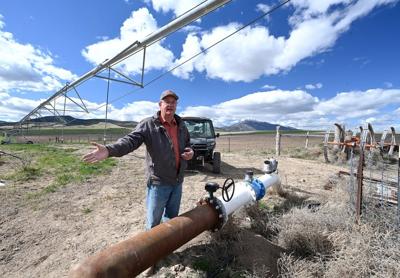
All center-pivot lines and wheel lines will now be gravity fed, saving irrigators power costs and eliminating pump maintenance and replacement expenses.

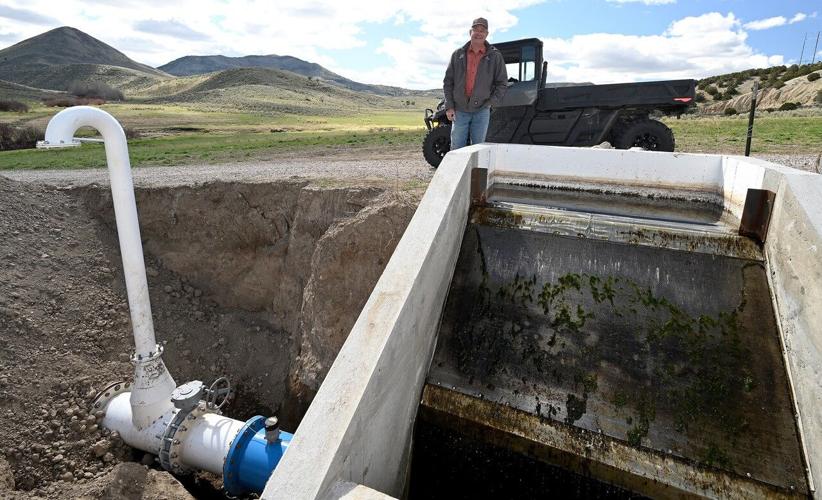
A coanda screen filter traps sediment flowing downstream from the Hawkins Reservoir prior to entering the new pipeline that has replaced a century-old system of irrigation ditches serving farmer and rancher shareholders.
Coanda screens remove debris and solids from the water as it enters the pipeline downhill from Hawkins Reservoir, providing sediment-free water for shareholders.
Egan praised the results of the cooperative effort between private landowners and government agencies.
“Private commerce and government were able to do something that works huge and it’s going to not just work for now,” Egan said. “It’s going to work for the next 100 years. I don’t see this pipeline having to have a whole lot of work for the next hundred years because that pipe is not going to deteriorate.”
Local companies completed the project. Four Trax Excavation of Arimo handled trenching and welding. Two Downey businesses — Morrison Fabrication and HydeRo Irrigation — provided steel fabrication and parts and fixtures, respectively.
A public open house is scheduled for Friday, May 8, at Hawkins Reservoir and campground, 17432 S. Hawkins Road. The event begins at 10:30 a.m. with displays, booths and a walking tour, followed by lunch and a ribbon cutting at 1 p.m. Visitors should wear comfortable shoes and bring a chair. To RSVP, email charity.staggs@sicog.org.


(0) comments
Welcome to the discussion.
Log In