

Idaho’s fuel prices are less than the national average, reports the Idaho American Automobile Association.
Normally, the price at the pump in the Gem States is significantly higher making for the decrease in gas prices quite an unusual distinction, it reported on Monday.
“Gem State pump prices are now 10 cents cheaper than the national average,” reported Idaho’s AAA’s Public and Government Affairs Director Matthew Conde.
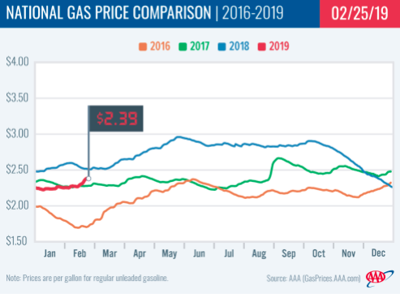
Conde reported that while Idaho’s gas prices dropped by 28 cents in January, they increased by 13 cents nationally. He noted the U.S. average price per gallon is $2.39. That’s 12 cents more than in January, but 12 cents less than in 2018.
In the Gem State, the current price is $2.29. That’s 13 cents less than in January and 29 cents less than in 2018.
“Compared to their Western neighbors — Washington, $2.86; Oregon, $2.74; Nevada, $2.84, Idahoans have plenty to celebrate,” Conde said.
Conde explained that the national gas prices functions like a train engine where it pulls state averages like Idaho’s along for the ride.
“However, Idaho is toward the back of the train, and our state is generally one of the last to react when the U.S. average changes. In this case, that’s a very good thing,” he said.
According to gasbuddy.com, Rexburg gas prices range from $2.34 to $2.41 a gallon. Those are about the same as what service stations are charging elsewhere in the Gem States.
Conde reported the following Idaho gas prices: Albion, $2.51; American Falls, $2.29; Arco, $2.43; Athol, $2.40; Bellevue, $2.40; Bliss, $2.49; Boise, $2.22; Bonners Ferry, $2.35; Buhl, $2.25; Carey, $2.42; Cascade, $2.63; Chubbuck, $2.28; Coeur d’Alene, $2.26; Council, $2.48; Dalton Gardens, $2.22; Declo, $2.70; Donnelly, $2.46; Driggs, $2.40; Franklin, $2.19; Eden, $2.68; Filer, $2.19; Fruitland, $2.31; Grand View, $2.50; Grangeville, $2.60; Hailey, $2.41; Heyburn, $2.33; Homedale, $2.26; Horseshoe Bend, $2.24; Idaho Falls, $2.24; Island Park, $2.67; Kamiah, $2.39; Kellogg, $2.40; Ketchum, $2.70; Lava Hot Springs, $2.30; Lewiston, $2.42; Malad, $2.30; Marsing, $2.26; Moscow, $2.55; Mountain Home, $2.18; New Meadows, $2.43; New Plymouth, $2.29; Orofino, $2.42; Payette, $2.31; Pinehurst, $2.40; Pocatello, $2.32; Post Falls, $2.30; Rigby, $2.24; Riggins, $2.50; Sandpoint, $2.34; Stanley, $2.73; Sugar City, $2.37; Twin Falls, $2.25; Wallace, $2.39; Weiser, $2.26.
Conde stated the increase fuel prices in parts of the country rose as a result of increased crude oil prices and a steady demand for gasoline. In other parts of the country, harsh winter weather and worries over the availability of fuel caused drivers to stock up. This in turn, caused prices at the pump to increase, he said.
Conde reported that at the first of 2019, crude oil prices increased with the West Texas Intermediate Benchmark trading at $45 a barrel. Today, that’s at $55 a barrel, he said.
“Several factors have impacted the global crude supply, including OPEC’s production cuts of 1.2 million barrels per day, increased oil embargos on Venezuela and tighter sanctions on Iran. All of these conditions have applied upward pressure on oil prices, which in turn affect gas prices,” he said.
In the meantime, domestic oil production is increasing substantially and is at an all time high, Conde said.
“According to the Energy Information Administration, U.S. oil production recently topped 12 million barrels per day — the highest amount ever recorded,” Conde said.
Despite the U.S. losing four oil rigs earlier this month, 854 remain in operation with 54 more in production than in February of 2018.
“Recent production growth has raised domestic crude inventories to 455 million barrels,” he said.
Conde also noted that in the western United States, gasoline stocks dropped slightly to 7.5 million barrels to finish the week. Despite that, current supplies remain sufficient to counterbalance price variations in other areas.
“Idaho gas prices are likely to increase in the near future, for a number of reasons,” Conde said. “Rising crude oil prices, spring travel demand, the upcoming switch to more-expensive summer-blend fuel, and seasonal refinery maintenance are all variables that AAA will be watching in the coming weeks. But for now, we’re happy to keep saving at the pump.”
For more information, visit AAA.com/shell or call 1-800-999-9391.

(0) comments
Welcome to the discussion.
Log In