

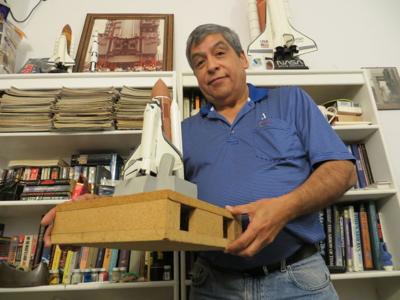
POCATELLO — Louis Archuleta, a retired subcontracted engineer for the National Aeronautics and Space Administration, says shuttles are built just like airplanes. Only the machinery he's laid hands on needs massive amounts of varying types of fuel in order to launch it into outer space.
The Gate City native has been interested in the inner workings of spacecraft since he was 9-years-old.
"It really broke my heart to see the shuttles going to museums when NASA laid off 10,500 people not too long ago," Archulta says.
In a question-and-answer-session Archuleta said this:
Q. What is your educational background?
A. "I received a certificate from Idaho State University in drafting and design in 1969. I was very lucky in 1980 to have a chance to work on space shuttles. At some point, I was involved in the design and support of ground facilities. In 1983, I had the chance to go to a launch facility to work on the construction end of things at the Vandenberg Air Force Base Space Complex Six in California. All of the structures are huge there. We had a 16-story high building that could be wheeled around. I worked my way up to the title of engineer when I saved the program tens of millions of dollars. They were behind on a project, and I came up with a way to fix the problem, the hang up. I did it in one day. That's when they first decided to put me in charge."
Q. What role did you play as an educator in Eastern Idaho?
A. "When I came back, I started working with kids in the fourth, fifth and sixth grades. The Idaho State University program was called 'Young Explorers in Space.' We would host an intensive, four-day workshop that was loaded with fun. I teamed up with two physics professors and those with the Idaho Teachers in Space program. We kept it going for nine years on a shoestring budget. One of the activities we had them do was water training. It's meant to simulate weightlessness. Students would learn how challenging it is to put a nut and bolt together with big gloves on underwater. When astronauts are truly weightless in space, it can be painful because your spine stretches out. You grow 1-2 inches. Then, when you return to earth, you shrink back down. The other thing about the lack of gravity in outer space is the fact you have flatulence, because your body is used to being grounded. Anyhow, the program ceased to exist after the funding dried up. I also worked with Shoshone-Bannock students with Ed Galindo. Our first experiment design required a pump. So, I designed one for the project. What was really neat about working with those kids is that we were able to travel to Florida to see the 'The Discovery' launch. That was in June of 1998. It was a beautiful machine. I felt lucky to have gotten to see it up close. In all of my career, I have watched 20 rockets launched."
Q. Tell me about the space shuttle design you are currently working on?
A. "Well, the space shuttle I envision continues to execrate, instead of coasting, so it gets to the destination faster. The faster the speed, the closer it will feel like being on Earth where there is gravity. The inertia gives you a little bit of a boost in that realm. My shuttle would get to Mars in two months, as opposed to one year when coasting is involved. Another part of my plan requires the system to be assembled in outer space. When I am done with this, I will send it to NASA. This design costs less and is more efficient."
Q. I understand you are also working on a theory that has to do with how time expires?
A. "That's right. I am a polymath, someone who has skills in several areas ... not just one or two. I'm good at seeing the obvious that is not apparent (in this case). In fact, anyone who is interested in learning more about this time theory can be on the lookout for an upcoming presentation on a Channel 12 program called 'La Voz Latina' that airs on Sundays from 2-5 p.m."
Q. What do you foresee with regards to the future of space exploration?
A. "Despite NASA layoffs, it's still a very competitive field. There's no doubt in my mind we will live in out space someday. The Indians and Chinese are talking about building colonies on the moon. See, helium-3 exists on the surface of the moon. It derives from the suns rays and is the best charge for field reactors. Asteroids may be another target as every element you can find on earth could be found on the core of an asteroid. Some are made out of steel. Museum curators have cut asteroids in half and it looks just like stainless steel inside. The nearest asteroid is beyond Mars. But, everything we need is out there. One day, we will have factories on other planets and people who live and work in outer space to provide energy for Earth. Then, we can turn Earth back into a garden."

(0) comments
Welcome to the discussion.
Log In