

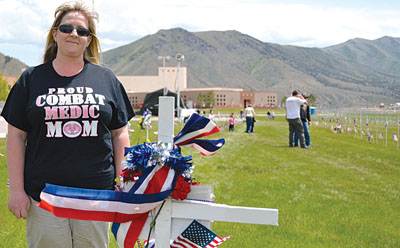
POCATELLO — Every week before Memorial Day volunteers plant a garden of gratitude in a field near Century High School. Because of the work of a “Core Four,” Hiedi Young, Melissa Hartman, Kim Charlier and Susan Larsen, thousands of fallen U.S. servicemen and women blossom into a Field of Heroes.
Thanks to the four women and hundreds of volunteers, this weekend the field was in full bloom for the 10th year.
“We’re doing what we can,” said Young. “They died to preserve my freedom. I could never repay them even if I pounded every cross by hand myself.”
Back in 2003, Pocatello resident and military veteran John Rogers decided he needed to do something to remind the public about the sacrifices our military families have made for this country. He created the first Field of Dreams and organized it on his own for the first couple of years before the magnitude of the project overwhelmed him.
That’s when Young, Hartman, Charlier and Larsen stepped in.
“For the last five years it’s been the four of us that have been the core,” Young said. They nicknamed themselves the “Core Four.”
Young is part of the Pocatello MIA*POW organization that has helped enlist an army of volunteers to prepare the field each year. This year 400 people have volunteered so far.
It all begins with a planning session in January. Any new features for the Field of Heroes are discussed and fleshed out. This year, the field includes podiums called “A Walk of Heroes.” At each podium is a brief history of American military battles.
Construction of the field began last Monday when a tractor-trailer filled with crosses and other needed materials rolled out to Century High. Survey crews created the precise layout of the nearly 6,800 crosses. String lines were set up by volunteers and the sections of the area dedicated to the wars in Iraq and Afghanistan were established. Then, one-by-one, the crosses bearing the names of the fallen were driven into the green grass.
“We have to do it with great precision,” Young said.
The finished field looks like a small replica of the massive 624 acres of Arlington National Cemetery in Virginia, where thousands of American soldiers have been laid to rest since the Civil War.
Along one side of the field is a section dedicated to Idaho’s Gold Star families — those who have lost a son or daughter to wars in the Middle East.
“It’s not a club anyone wants to be a part of,” Young said.
Creation of the field is a labor of love for Young and the other three women in the core group. Young’s husband and brother each served in Iraq and came home. And for that she is forever grateful.
“It also makes it personal,” Young said.
Her husband, Army Capt. Don Young, and brother, Marine Sgt. John Wood, were both in Fallujah, Iraq, when it exploded with fighting in 2005. Capt. Young served 16 months in Iraq and 18 months in Afghanistan.
As she sat in a small set of bleachers on the edge of the Field of Heroes, Young pointed at the vast array of white crosses, and said she knows some of the people they represent.
“I know four people who are represented by crosses now,” Young said. “I visit them personally every year and leave something.”
Saturday, Young was busy making sure the band performance under the large Army tent was set to go. Today she will help others get the Silent Wounds Vigil ready to begin once darkness falls over the temporary cemetery.
“There are wounds many people have that can’t be seen,” Young said. “Like the wife trying to cope with the loss of a husband.”
And she said many returning veterans come home with silent issues.
“You send these young people out on six or seven deployments and it’s a lot to cope with,” Young said.
Like the other core volunteers, Young watches the field every day from morning to night. The darkness seems to draw the most veterans of wars in Iraq and Afghanistan.
“This is this generation’s wall,” Young said, referring to the Vietnam Memorial in Washington.
“We see a lot of them (veterans) at night,” Young said. “They sit out in the field next to a cross.”
Young and the other volunteers for the Field of Dreams give them a space to heal.
“It’s the only thing like it in the nation,” Young said with pride.

(2) comments
fsmith, you are absolutely right & trust me...I (and the rest of the ladies) are very much aware of it. I sat with the reporter for nearly 30 minutes, we discussed alot of things from how many people it takes, how many man hours it takes, how many community partners it takes...ect. I don't know why the article was written the way it was, I think he was going for a personal story that went very wrong. I am one small cog in the machine that is the Idaho Field of Heroes Memorial and I have no doubt that if I faded into the background it would still go on without me. I feel badly for how many folks have been upset by this article.[sad]
Your "core 4" diva's are only a small part of the mamassive effort that goes into this project.. Lots of angry folks over this article, for once, I truly can't say... Good job.
Welcome to the discussion.
Log In